They thought he was just an old man. That was the first mistake.
They thought the motorcycle parked outside the diner was simply an expensive antique owned by someone too old and too tired to defend it.
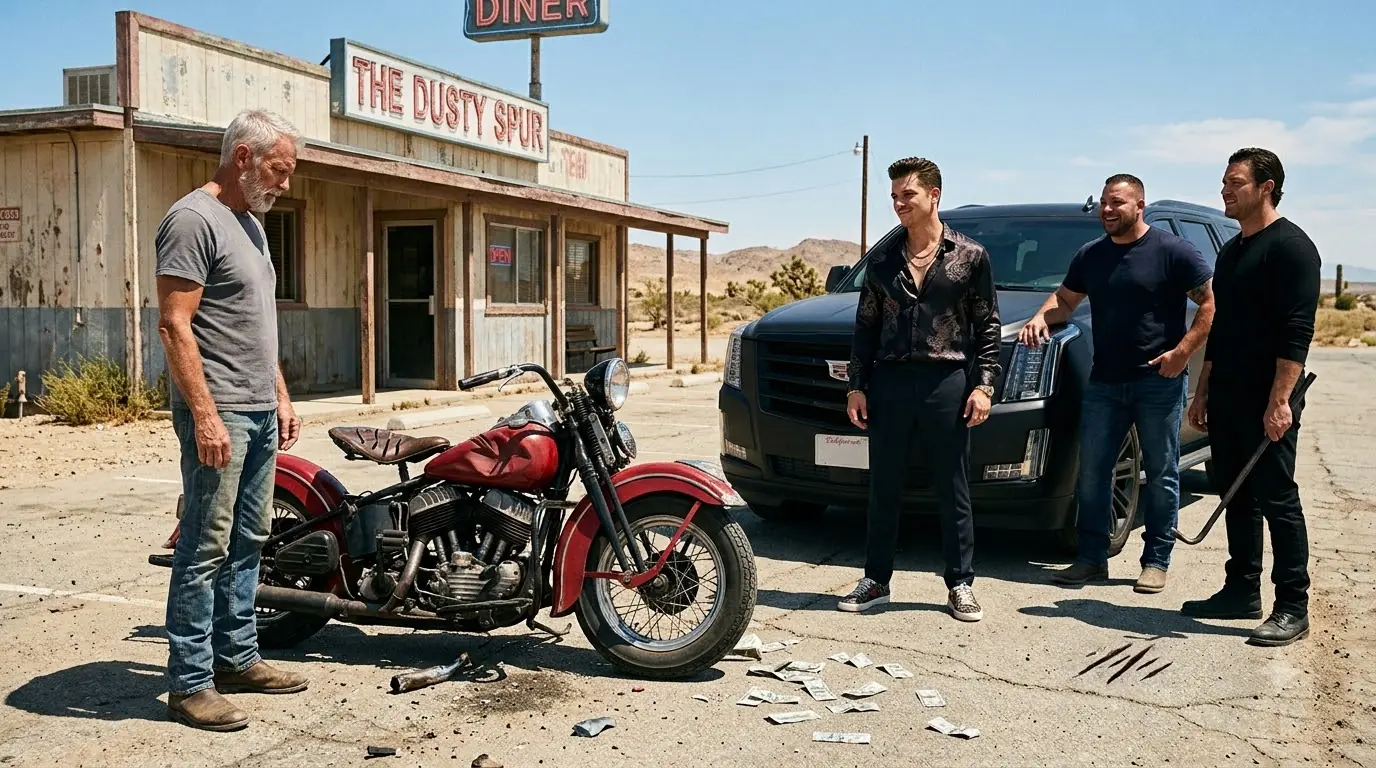
That was the second.
By the time they understood what the cherry-red 1947 Harley-Davidson Knucklehead actually represented, the damage had already been done.
And unlike most mistakes Tommy Garino had made in his twenty-eight years, this one could not be repaired with cash, threats, or a phone call to his uncle.
The Mojave Desert stretched pale and unforgiving beneath a late September sun.
Outside Barstow, California, the temperature had climbed past ninety degrees before lunch, and heat shimmered above the cracked asphalt of Route 66 like a transparent curtain.
The Rust and Bone Diner sat alone near an old truck yard, squeezed between a shuttered tire shop and an abandoned motel whose faded VACANCY sign had not worked in years.
Truckers stopped there because the coffee was strong.
Motorcyclists stopped because nobody complained about dust.
Locals stopped because Marlene Pierce had been serving breakfast behind the counter for twenty-three years and still remembered which customers wanted onions in their potatoes.
Wayne Vandergriff sat alone in the back booth.
Most people called him Dutch.
That afternoon, however, nobody inside the Rust and Bone knew enough to call him anything.
To Marlene, he was simply the quiet older man who had ordered black coffee, two eggs, wheat toast, and nothing else.
He looked close to seventy.
Silver beard.
Weathered face.
Faded Levi’s.
Plain gray T-shirt.
Scuffed Red Wing boots.
No jewelry except an old watch.
No motorcycle-club vest.
No patches.
No rings advertising membership or rank.
Nothing that suggested the man had spent almost forty-five years inside one of the most influential motorcycle organizations on the West Coast.
That was deliberate.
Dutch had left his colors at home in Oakland.
He had left the club phone there too.
The only phone in his pocket was an old encrypted handset used mostly because his closest friends refused to trust newer technology.
Today was not supposed to belong to the club.
It belonged to his brother.
Ten years earlier, on almost the same date, Raymond Vandergriff had died at sixty-nine after a short illness.
Ray had been Dutch’s older brother by six years.
Mechanic.
Welder.
Veteran.
Argumentative perfectionist.
The first person to put Dutch on a motorcycle.
The first person to teach him how to rebuild a carburetor.
The last person who could tell Dutch he was being an idiot and expect to remain in the room afterward.
Ray had also built the machine parked outside.
The 1947 Knucklehead had begun as little more than boxes of parts.
Ray found the frame in Arizona.
The engine cases came from a collector in Oregon.
The original transmission took nearly four years to locate.
Some pieces had to be fabricated.
Others were repaired instead of replaced because Ray believed an old motorcycle lost something every time a modern part was substituted simply because restoration was difficult.
For eleven years, the brothers rebuilt it together.
Saturday mornings.
Winter nights.
Arguments over paint.
Arguments over chrome.
Arguments over whether a small scratch on the primary cover should remain.
Ray wanted it polished out.
Dutch refused.
“That scratch has been there longer than either of us has been respectable.”
“We have never been respectable.”
“Exactly.”
The bike eventually became cherry red.
Not bright candy red.
A deeper color Ray mixed himself after rejecting nine commercial samples.
Chrome exhaust.
Black leather saddle.
Original-style speedometer.
Period-correct wheels.
Nothing exaggerated.
Nothing designed for attention.
Under the rear fender, nearly invisible unless someone crouched low enough to look, Ray had painted a small winged skull.
Not the emblem of any real-world club.
It belonged to the fictional Redwood Saints Motorcycle Club, the organization the Vandergriff brothers had been associated with for most of their adult lives.
Ray had once been chapter president.
Dutch eventually became something more difficult to describe.
He held no official national title.
He did not need one.
Club members from California, Nevada, Oregon, and Arizona called him when disputes became complicated.
They called when two chapters could not agree.
They called when funerals needed organizing.
When lawyers needed finding.
When younger members needed someone capable of telling them no without creating another conflict.
Dutch’s reputation had been built less on violence than on memory.
He remembered debts.
Promises.
Names.
Dates.
Who had helped when help mattered.
Who had lied.
Who had kept their word.
Men feared him because Dutch rarely acted impulsively.
Impulsive men were predictable.
Dutch was not.
But on that September afternoon, none of it mattered to him.
He was riding Ray’s Knucklehead from Oakland toward the desert because ten years earlier his brother had asked for one thing.
“If I go before you, take her somewhere hot once a year.”
Dutch had laughed.
“Why hot?”
“Old bikes hate comfort.”
“That's not how engines work.”
“That’s because engines know more than you.”
So every year, Dutch rode south.
Sometimes Arizona.
Sometimes Joshua Tree.
Sometimes Barstow.
He would drink coffee somewhere Ray would have liked, ride another hundred miles, then turn north again.
No entourage.
No club colors.
No security.
Only the motorcycle.
At 12:17 p.m., the bell above the diner door rang.
Three men walked inside.
The first was Tommy Garino.
Twenty-eight.
Las Vegas.
Expensive haircut.
Gold watch.
Cream-colored silk shirt open too far at the chest.
Designer sunglasses.
Confidence that had never been tested by serious consequence.
Behind him came Hector Ruiz and Raymond Pike.
Both older.
Both larger.
Both employed by Tommy’s uncle, Vincent Corleti, who ran a regional criminal organization built mostly around gambling, illegal loans, extortion, and businesses designed to make money appear less complicated than it was.
Tommy called himself an enforcer.
Vincent privately called him a nephew with poor judgment.
Unfortunately, Tommy’s poor judgment had been profitable often enough that nobody had forced him to correct it.
He walked into the diner like the room had been waiting for him.
Marlene looked up.
“Three?”
Tommy ignored her.
His attention had moved through the front windows.
To the motorcycle.
He stopped.
“Now that is something.”
Hector looked.
“Old Harley.”
“Knucklehead.”
Tommy walked closer to the glass.
“Forty-seven, maybe.”
Ray shrugged.
“Looks expensive.”
Tommy smiled.
He collected things.
Watches.
Cars.
Guns he rarely handled.
Motorcycles he barely rode.
The collection mattered because ownership made him feel larger.
He liked objects other people wanted.
He liked buying things from people who did not want to sell.
Especially that.
He turned toward the room.
“Who owns the red antique outside?”
Nobody answered.
Marlene continued pouring coffee.
Two truck drivers stared at their plates.
Dutch did not look up.
Tommy smiled.
“Come on.”
He raised his voice.
“Whose bike?”
Dutch placed his coffee mug carefully on its saucer.
“Mine.”
Tommy located him.
For a moment, disappointment crossed his face.
An old man.
No vest.
No obvious money.
No visible protection.
Easy.
Tommy walked toward the booth.
Dutch watched him approach.
“Mind if I sit?”
Dutch said:
“Yes.”
Tommy sat anyway.
Hector and Ray remained standing behind him.
Tommy looked through the window toward the motorcycle.
“That’s a beautiful restoration.”
Dutch said nothing.
“Forty-seven?”
“Yes.”
“Original cases?”
“Mostly.”
Tommy smiled.
“I collect vintage machines.”
Dutch looked at the gold watch, silk shirt, polished loafers.
“I’m sure you do.”
Something in the answer bothered Tommy.
“You selling?”
“No.”
“I didn't give you a number.”
“Wouldn't matter.”
Tommy pulled out a money clip.
“Thirty thousand.”
Dutch picked up his coffee.
“No.”
“Cash.”
“No.”
“Thirty-five.”
Dutch took a sip.
Tommy’s smile tightened.
“Forty.”
Dutch set the cup down.
“The bike isn't for sale.”
“Everything is for sale.”
“No.”
Tommy leaned back.
“You know what forty grand buys an old guy?”
“Probably something I don't want.”
Hector smiled.
Tommy did not.
“Take the money.”
Dutch looked at him.
“No.”
Only one word.
No explanation.
No apology.
Tommy had heard refusals before.
Usually they came wrapped in fear.
Not now.
The old man was not trying to impress him.
Worse.
He seemed bored.