“You paid sixty dollars for forty tons the cannery refused?”
The neighboring farmer’s laughter carried across the crowded liquidation auction outside Viroqua, Wisconsin, in the fall of 1971. Thirty-one-year-old Della Vickers stood beside forty-seven warped produce crates, a damaged hand-cranked root washer, and six acres filled with crooked carrots that no commercial processor wanted. She folded the winning auction ticket between her leather-gloved fingers and looked calmly at the man questioning her.
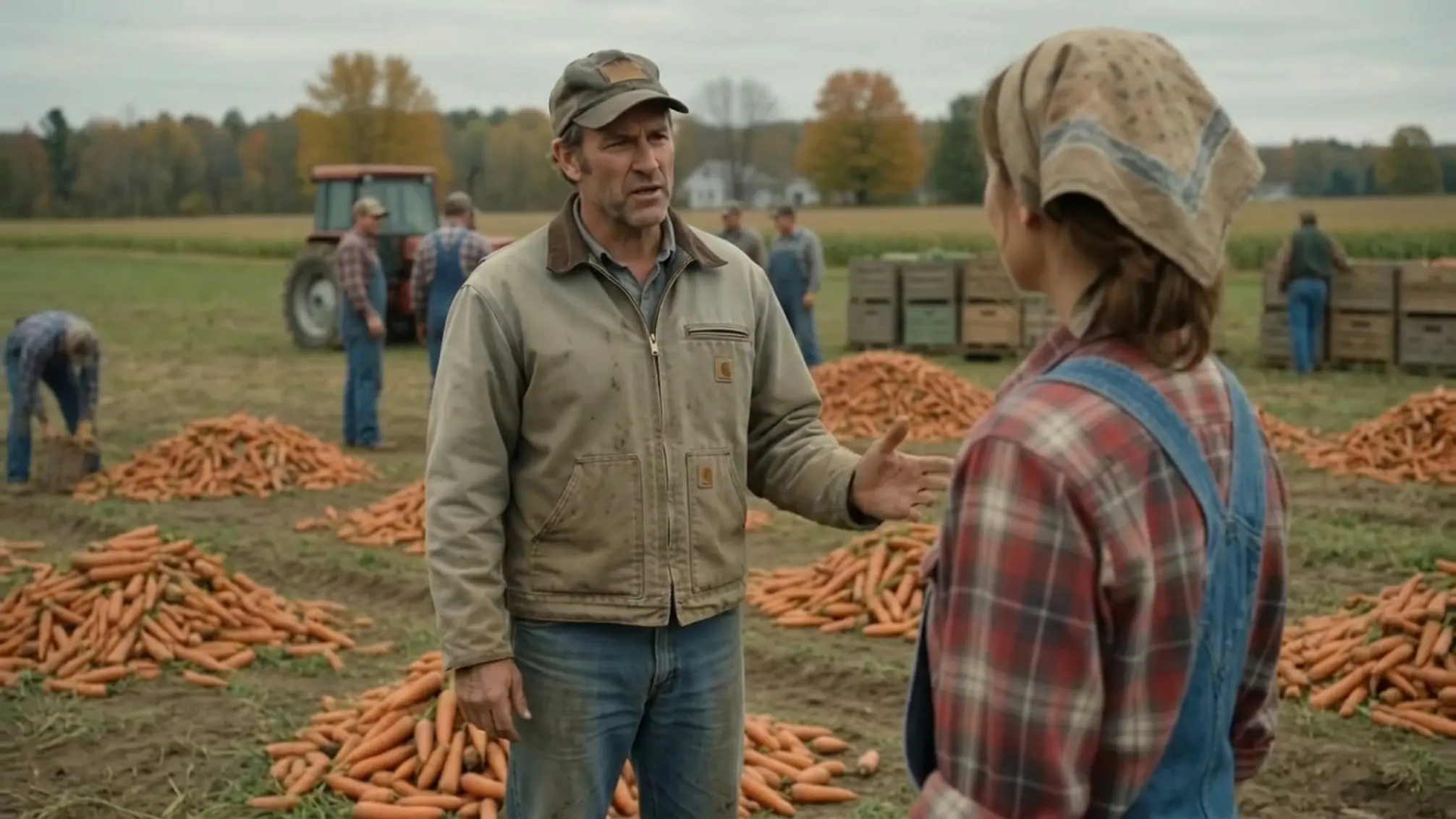
“They rejected the shape, sir,” Della said. “Not the quality.”
The farmer shook his head and stepped closer, his dusty canvas jacket shifting in the cold wind. Around them, buyers loaded rusted tools, livestock gates, and old machinery into pickup trucks while the Holmgren family watched strangers divide what remained of their failing farm. Everyone understood why the cannery had rejected the carrots: they were forked, twisted, knotted, and impossible to send through an automated peeling line.
“You truly believe those carrots can support your farm?” the farmer asked.
Della raised the sixty-dollar ticket.
“I believe they can build something no one here has noticed yet.”
The man laughed again, but Della had already turned toward the abandoned crop.
What the crowd saw was forty tons of vegetables growing in the wrong shapes. What Della saw was winter feed for horses at a price so low that the arithmetic felt almost unbelievable. She had spent three months studying the problem before bidding, and the auction was not the beginning of her idea.
It was the final step.
Della had been raised on a cattle and hay farm in the hills outside Viroqua. Her father, Raymond Mayes, owned two hundred and eighty acres of steep Wisconsin ground that was better suited to grazing than row crops. He kept Hereford cattle, four horses, and a stack of green accounting ledgers filled with every dollar that entered or left the operation.
Raymond did not believe farming survived on hope.
“Land can be beautiful and still bankrupt you,” he once told Della. “Write down the numbers before you fall in love with the view.”
When Della was nine, he taught her to record feed costs, veterinary bills, fuel, seed, equipment repairs, and livestock sales. She sat beside him at the kitchen table each night, carefully copying figures while her siblings escaped outside to play. Raymond’s handwriting was small and exact, and he insisted that an honest ledger should make a farmer uncomfortable at least once a month.
“The ledger doesn’t care what you meant to do,” he said. “It records what you actually did.”
The horses interested Della more than the cattle. Raymond kept two Belgian drafts for pulling timber and working muddy ground where tractors became trapped. He also owned a patient mare named Pepper and a foal Della named Biscuit.
At thirteen, she trained Biscuit herself.
She borrowed a book from the town library and spent weeks watching the young horse before attempting to ride him. She learned the position of his ears when he was frightened, the tension in his back when he was uncertain, and the softer movement of his neck when he began to trust her. Raymond watched from the fence without interfering.
“That girl has an eye,” he told his wife.
“She has patience,” Della’s mother answered. “That is rarer.”
Della graduated from high school in 1958 and received a scholarship to attend the University of Wisconsin in Madison. She bought a suitcase, received a dormitory assignment, and held a bus ticket that should have taken her away from Viroqua. She never used it.
Her father’s health had begun deteriorating.
Della remained on the farm for one season, then another. By the early 1960s, she was managing the cattle beside Raymond, repairing fences, balancing accounts, and making decisions he no longer had the strength to carry out. When neighbors asked why she had abandoned college, she said only that the farm needed her.
The ledgers contained the longer explanation.
Raymond died in the winter of 1967 at sixty-two. He left Della the farm, the equipment, the horses, a mortgage-free deed, and fourteen thousand dollars in savings. He had spent decades refusing to borrow against the land, even during years when every banker in Vernon County encouraged expansion.
“A paid-for farm is the only thing a bank cannot take,” he told Della before his death.
She wrote the sentence inside the front cover of her own ledger.
Della had married Carl Vickers three years earlier. Carl farmed neighboring ground and respected her ability with horses, even though he possessed no particular gift with them himself. Their combined property covered more than four hundred acres, and together they imagined building a stable operation that could support both cattle and horses.
Carl died from a heart attack in 1969.
He was thirty-three.
Della was twenty-nine, widowed, and suddenly responsible for two farms, sixty cattle, aging equipment, and every decision that had once belonged to three people. Neighbors expected her to sell part of the land, lease the operation, or find a new husband willing to take control.
She did none of those things.
She hired one seasonal hand during planting and harvest, sold equipment the ledger proved unnecessary, and repaired everything else in Raymond’s old workshop. She continued managing cattle because they provided reliable income, but her attention increasingly returned to horses.
The problem was winter feed.
Hay prices changed with weather and demand. Commercial supplements were expensive, and boarding operations near La Crosse complained that keeping horses healthy through Wisconsin winters consumed nearly every dollar they earned during summer. Della suspected there had to be a cheaper source of nutrition.
In August 1971, she drove to a boarding stable operated by an American woman named Frances Oberlin. Frances had cared for horses for two decades and understood winter feeding better than anyone Della knew. She explained that root vegetables could supplement dry hay by providing moisture, energy, vitamins, and variety.
“Horses love carrots, beets, and turnips,” Frances said. “The trouble is paying produce prices for them.”
“What price would work?” Della asked.
Frances gave her a figure per fifty-pound bag.
Della returned home and opened the ledger. She calculated transportation, storage, spoilage, bagging, labor, and the cost of purchasing bulk vegetables directly from farms. Retail carrots were too expensive, but rejected carrots were another matter.
The local canneries discarded thousands of pounds each season.
The vegetables were often rejected for cosmetic reasons rather than quality. A carrot that bent around a rock could not pass through processing machinery, but it still contained the same nutrition as a straight carrot. Farmers received nothing for crops the cannery refused, and many plowed the rejected vegetables back into the soil.
Della began driving rural roads to see what was being wasted.
When she heard about the Holmgren farm, she visited secretly before the liquidation sale. Six acres of black soil held approximately forty tons of carrots, but the entire crop had been rejected because the roots were unusually crooked. Della pulled three from the ground and examined them.
One had divided into three thick branches.
Another curved almost completely around a stone.
The third looked so strange that no grocery store would display it.
Della wiped the soil against her sleeve and bit into it.
It tasted sweet and crisp.
That evening, she calculated the value of forty tons sold in fifty-pound bags at Frances’s suggested price. Even after accounting for fuel, sacks, storage, and expected spoilage, the potential profit exceeded anything Della had earned from cattle during a single winter.
The numbers looked too good.
She checked them twice.
Then she checked them a third time.
At the liquidation auction, nobody bid against her. The auctioneer combined the carrots with warped crates and a damaged root washer because separating them would have wasted time. Della won the entire lot for sixty dollars.
Her brother-in-law Gene approached after the neighboring farmer finished laughing.
“What exactly did you buy?”
“Forty tons of horse feed.”
“You bought carrots still buried in the ground.”
“I also bought the washer.”
“The washer is cracked.”
“I own a welder.”
Gene glanced toward her dented Ford pickup.
“You will need something larger to haul all this.”
“Yes.”
He scratched his jaw.
“I can borrow a flatbed.”
“Thank you.”
That was the final moment Gene doubted her plan.
They transported the root washer to Raymond’s old shop, a tin-roofed building with a concrete floor, an oak workbench, and tools accumulated over thirty years. A Lincoln arc welder stood against the wall beside a coffee can filled with welding rods. The washer’s drum contained a four-inch crack along an old seam, and the brush rollers had worn nearly to bare steel.
Della lit the wood stove and examined the machine for hours.
She did not ask whether it was broken.
She asked which parts still worked.
The frame remained solid. The crank mechanism moved smoothly after she cleaned and oiled the bearings. The drum could be welded, and the old brushes provided measurements for replacements.
Della sealed the cracked seam with Raymond’s welder and ground the metal smooth. She found stiff nylon brush stock at a farm-supply store in La Crosse, cut new sections, and attached them to the rollers. She fabricated a seal from discarded conveyor belting and modified the output chute using a sheet of steel left over from one of Raymond’s repairs.
The replacement materials cost seventeen dollars.
A new commercial root washer would have cost more than four hundred dollars and required a tractor power connection. Della’s repaired machine operated by hand, but it fit her operation because she had rebuilt it specifically for one purpose.
It washed crooked carrots directly into burlap bags.
Harvest took three weekends.
Della borrowed a two-row digger and worked beside Gene from dawn until the October light disappeared. Rain had softened the soil, allowing the roots to lift cleanly, but the volume was exhausting. Every crate filled faster than the flatbed could carry it away.
The carrots passed through the repaired washer surprisingly well.
Mud spun from the drum, water drained across the shop floor, and clean roots dropped through the modified chute into fifty-pound sacks. Some carrots resembled twisted fingers, others thick knots, but Della rejected only those damaged by rot.
She stored four hundred bags in the concrete root cellar beneath the farmhouse. The remainder went into rented cold storage at the Viroqua grain elevator. By early November, nearly forty tons had been washed, sorted, bagged, and recorded.
Total cost: approximately two hundred and forty dollars.
Della called Frances.
“I have the carrots.”
“How many?”
“Enough for several barns.”
Frances ordered two hundred bags and asked whether Della could deliver. Gene helped load the borrowed flatbed, and Della drove to La Crosse through cold morning fog. Frances opened several sacks, inspected the vegetables, and offered carrots to three horses.
The horses ate immediately.
Frances wrote Della a check large enough to recover nearly the entire investment.
Della still had more than one thousand bags in storage.
By February, every carrot had been sold to Frances and two additional horse operations. After subtracting all expenses, Della earned more than four thousand dollars from the sixty-dollar auction lot.
She entered the profit into the ledger.
Then she studied what the transaction had taught her.
The opportunity was not simply cheap carrots.
The agricultural system produced rejected goods that were worthless only within one market. Canneries needed vegetables shaped for machines. Horse owners needed nutrition at an affordable price.
Della could stand between those markets.
She began contacting produce farms across Vernon and Crawford counties. She told growers to telephone whenever a cannery rejected usable vegetables for cosmetic reasons. Della would inspect the crop, pay cash, and remove it quickly.
The arrangement solved problems for everyone.
Farmers received money instead of plowing crops under. Canneries avoided disposal complications. Horse owners purchased affordable feed, and Della controlled a supply network her competitors had never imagined.
In 1972, she used part of the carrot profit to purchase two mares from a dispersal sale. She chose animals with strong movement, calm temperaments, and bloodlines that complemented Pepper’s descendants. Della did not open a boarding stable because she disliked the service demands of caring for other people’s horses.
She built a breeding and training operation instead.
Her reputation spread slowly through Wisconsin and Minnesota. Della possessed an unusual ability to identify promising foals before their value became obvious. She watched balance, foot placement, confidence, and willingness to learn.
She never purchased an animal because it looked impressive while standing still.
“A horse earns its value in motion,” she told buyers.
By 1975, she owned seven horses.
By 1977, twelve.
By 1979, eighteen horses occupied the barns, and customers joined a waiting list that stretched fourteen months for foals from Della’s strongest bloodlines. She gradually sold the cattle because the ledger proved the horse operation produced better returns with lower feed costs.
The rejected-produce network continued growing.
When canneries rejected crooked carrots, undersized beets, forked turnips, or cosmetically damaged roots, Della’s telephone rang first. Her horses received nutritious winter supplements at a fraction of retail cost, and she resold excess supplies to other barns.
In 1974, she purchased the six Holmgren acres where the first rejected carrots had grown.
She paid forty-two hundred dollars in cash.
The land nobody wanted became the first property added to her farm.
Dale Kettner, the rugged neighboring farmer who laughed at the auction, heard about the purchase at the feed store. He did not congratulate her. He simply stopped making jokes about crooked carrots.
By the end of 1979, Della had more than forty thousand dollars in savings.
She carried no debt.
The farm, barns, horses, equipment, and additional land all belonged to her outright. The old root washer still operated in Raymond’s shop, its welded seam visible beneath years of scratched paint.
Then the agricultural crisis of the early 1980s reached Wisconsin.
Interest rates rose sharply. Farmers who had borrowed heavily during the prosperous 1970s watched loan payments become unbearable. Land values fell while debts remained high, leaving families owing more than their farms were worth.
Equipment auctions appeared across the county.
Some were voluntary liquidations.
Others were forced by banks.
Dale Kettner had expanded aggressively when credit was inexpensive. He purchased machinery, leased additional ground, and borrowed against future crop prices. He was not careless, but his operation depended on conditions remaining stable.
They did not.
By 1983, high interest rates and weak commodity prices had stripped away his margin. He sold equipment first, then livestock, but the bank eventually seized two hundred acres of his eastern fields.
Della did not celebrate.
She understood the difference between foolishness and vulnerability. Dale had trusted the financial system encouraged by bankers, government advisers, and equipment dealers. The rules changed after he had committed everything.
Her own operation remained stable.
She owed no interest.
Feed costs stayed low because the rejected-produce network continued supplying winter roots. When drought caused hay prices to surge, Della’s stored carrots, beets, and turnips protected her horses.
Customers kept buying.
The waiting list grew.
By 1984, Della’s savings reached nearly seventy-eight thousand dollars.
The following spring, the bank announced an auction for Dale’s two hundred acres. The east fields were level, productive, and naturally drained. Della had studied them for years and knew exactly how they could support expanded pasture and hay production.
The auction took place at the Vernon County fairgrounds.
Eleven bidders registered, including three investment companies from outside the region. Local farmers attended, but most lacked cash and could not secure favorable loans during the crisis.
Della received bidder number seven.
The auctioneer opened at two hundred and eighty dollars per acre.
Bidding rose steadily.
One neighboring farmer stopped at three hundred and ten. Another withdrew at three hundred and forty. At three hundred and seventy, only Della and two investment representatives remained.
The first company dropped out.
The remaining representative wore a sport coat and carried himself with the confidence of a man who believed local farmers could not compete with corporate money. He bid three hundred and ninety dollars per acre.
Della raised her card.
“Four hundred.”
The room became silent.
The representative looked at her, calculated the full price, and placed his bidding card on the table.
“Sold,” the auctioneer announced. “Two hundred acres to bidder number seven.”
Total price: eighty thousand dollars.
Della opened her checkbook.
People who remembered the crooked-carrot auction fourteen years earlier watched her write the entire amount without financing. Some had seen her hauling rejected vegetables through winter snow. Others had dismissed the horse operation as a widow’s hobby.
Now she was purchasing prime farmland while larger operations collapsed beneath debt.
Dale stood against the back wall.
Della looked toward him after signing the check.
Their eyes met.
He nodded once.
She returned the nod.
There was no triumph in the exchange. Dale had lost land he loved, and Della respected the grief behind his silence. But both understood that the money purchasing those acres had begun accumulating with forty tons of carrots he once called worthless.
Della expanded carefully.
She converted portions of the Kettner fields into pasture and hay ground, but only after the existing horse income could support the changes. She never borrowed for a building simply because a larger barn might impress customers.
Every decision entered the green ledger first.
Throughout the late 1980s and early 1990s, her operation continued growing. At its peak, she managed twenty-four horses and maintained a waiting list through both strong and weak economic years. She purchased a wood lot in 1991 and creek-bottom hay ground in 1993.
Both properties were paid for in cash.
Raymond’s workshop remained largely unchanged.
The wood stove still heated the room. The Lincoln welder rested beside the old coffee can. The repaired root washer stood in the corner and continued processing vegetables each fall.
Della had spent less than eighty dollars restoring it in 1971.
She used it for more than twenty years.
Her niece Carol began spending summers at the farm when she was seventeen. Carol possessed the same instinct for horses Della had displayed as a child. She could watch an animal move and recognize imbalance, fear, or potential before most experienced buyers noticed anything.
Della did not place her in charge of horses immediately.
She placed her in the workshop.
Carol learned to weld, maintain equipment, calculate costs, and read the green ledgers. She learned which canneries called when crops failed cosmetic inspections and how much spoilage to expect from each vegetable.
“You must understand cost before you understand value,” Della told her.
In 1995, the Vernon County agricultural extension office invited Della to speak about alternative farm income. She disliked public appearances, but she accepted because younger farmers were facing the same pressure to expand through debt that Raymond had warned against.
Della stood before a room filled with farm families and explained her operation plainly.
She said she began with mortgage-free land, a ledger, and a sixty-dollar bid at an auction. She said the farm crisis had not been caused solely by poor decisions or bad farmers.
Many families had borrowed under conditions presented as safe.
Then the conditions changed.
“The only protection against an interest rate that can change,” Della said, “is an operation that does not collapse when it does.”
She explained that rejected carrots had fed her horses for more than two decades. Commercial feed stores offered similar nutrition at several times the price. The yearly savings seemed small to people focused on a single season.
But savings accumulated.
“The difference between those two prices,” she said, “became the Kettner east fields.”
Nobody in the room laughed.
Frances Oberlin waited for Della in the parking lot after the meeting. She had purchased Della’s first two hundred bags of carrots nearly twenty-five years earlier.
“I tell the carrot story everywhere,” Frances said.
“I appreciate that.”
“What I appreciated most was that you never missed a delivery.”
Della smiled.
“That is the real carrot story.”
Carol assumed primary management of the horse operation in 1998. She continued using the green ledgers, maintained the rejected-produce relationships, and kept the root washer operational.
The machine still carried Della’s original weld.
Years later, visitors asked what Della had seen when she looked across the Holmgren field in 1971. They expected her to describe courage, intuition, or a secret business vision.
Della always answered with numbers.
She saw forty tons of usable feed.
She saw bags Frances was willing to purchase.
She saw a washer that required repairs rather than replacement.
She saw a market that rejected shape and another market that valued nutrition.
The sixty-dollar purchase did not create a fortune overnight. It created a small margin, and Della protected that margin instead of wasting it. The savings purchased mares, the mares produced valuable foals, the foals built a waiting list, and the waiting list generated the cash that survived the farm crisis.
One decision connected to the next.
The cannery had been correct that the carrots could not pass through its machinery. Dale had been correct that Della needed a larger truck. The auctioneer had been correct that most buyers saw little value in the crates and broken washer.
They were wrong only in believing one market’s rejection defined total worth.
To the cannery, the carrots were defective.
To horses in a Wisconsin winter, they were nutritious food.
To Della, they were numbers in a ledger that continued compounding long after the last bag was empty.
When the Madison investor lowered his bidding card in 1985, the fairgrounds fell silent. The same community that watched Della spend sixty dollars on crooked carrots now watched her write an eighty-thousand-dollar check for land once owned by the man who mocked her.
Della never needed to say that she had proven them wrong.
The check cleared.
The land became hers.
And the crooked carrots had already said everything.