The valley remembers things people forget. That’s what her grandfather used to say, standing on the porch in the blue hour before sunrise, watching the mist crawl out of the low places like something breathing. He said the land kept records, that if you watched long enough, you’d learn to read them. Marin Holloway was 14 years old, and she had been reading them her whole life.
The Holloway Farm sat on the eastern bend of the Cottonwood River in a stretch of Montana that most people drove through without stopping. Three hundred acres of hayfield pasture and the kind of timber that had been there before anyone came with a deed. The house was built in 1911. The barn leaned a little to the south now, and her father said it had been leaning that way since before he was born. Some things settle into their tilt and stay there.
That spring, the river ran lower than it should have. Not by much—three or four inches off the high water mark on the cottonwood by the ford. Most people wouldn’t have noticed. Marin noticed. She noticed the killdeer were nesting twenty yards farther from the bank than last year. She noticed the cattails on the south sloth had thinned out, and that the wet patch at the base of the lower pasture, the one that had been wet every May since she could remember, was dry on top and soft underneath. You could push a stick through it and feel nothing for the first six inches, then meet something cold and yielding below.
She wrote it all down in a green spiral notebook she kept in the kitchen drawer: dates, water levels, where the deer were drinking, which gates the cattle wouldn’t walk through, and which ones they crowded toward in the afternoon. Her grandfather had kept the same kind of notebook for fifty-three years. They were stacked in a wooden crate in the loft, all of them in his small, neat hand. She’d read every one. She wasn’t a strange child. She just listened more than she talked.
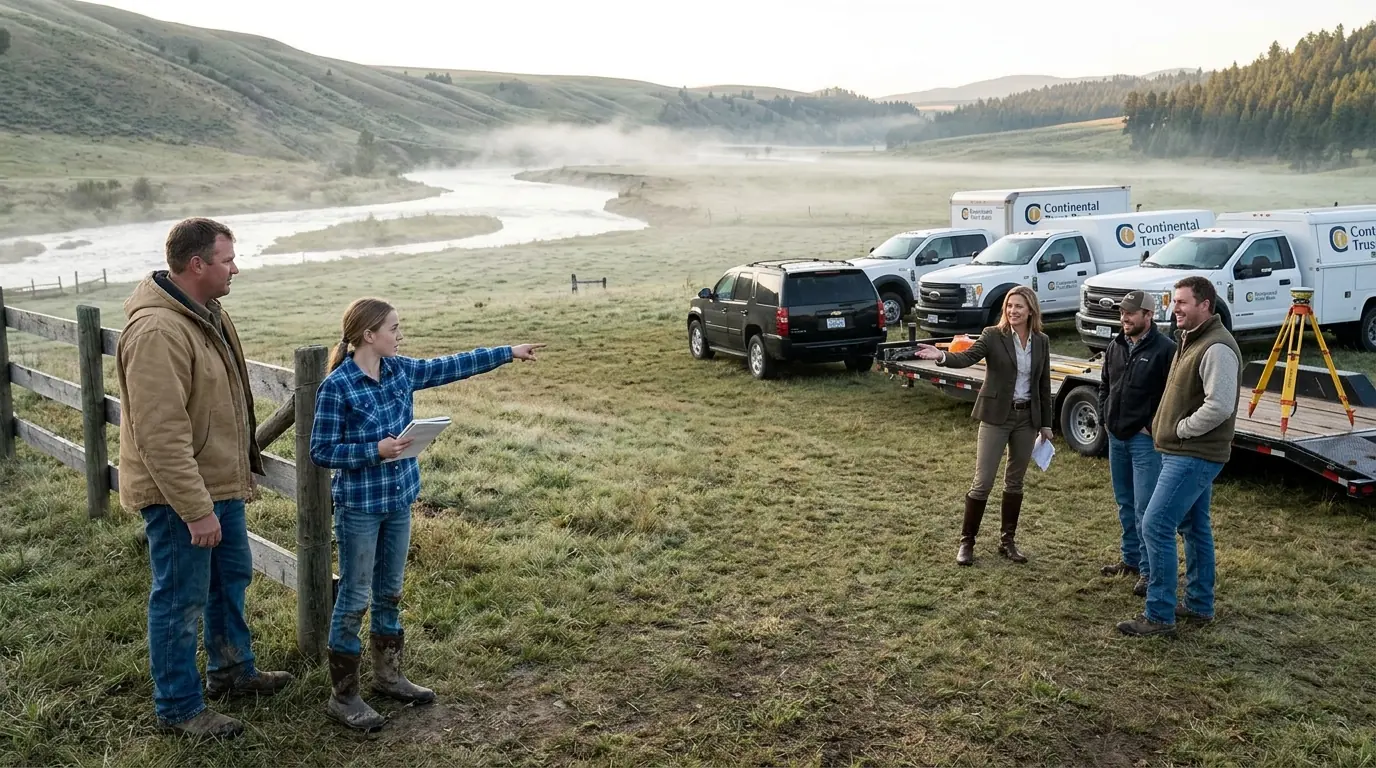
The trucks came in late April. Three white pickups with a logo on the door, a stylized shield with the words Continental Trust Bank, Commercial Real Estate Division. Behind the trucks came a low loader carrying a yellow surveyor’s rig, and behind that, a black SUV that didn’t look like it belonged on a gravel road. They stopped at the fence line where the Holloway property ended and the old Puit place began—five thousand acres.
The Puits had sold the previous fall after the last brother passed, and the heirs decided none of them wanted to come back to Montana. Continental Trust had bought the parcel outright through its commercial division. A long-term hold, the feed store said, with plans to develop and lease. The land had sat quiet through the winter. Now it wasn’t quiet anymore.
Marin watched from the kitchen window while she rinsed her cereal bowl. “They started early,” her father said behind her, pulling on his canvas jacket. “He was forty-six and looked older. He’d been running the place alone since her grandfather’s stroke two summers back.”
“It’s the bank’s land now. They’re putting in some kind of logistics hub, distribution, agricultural processing on the Puit land. On all of it,” her father added. She set the bowl in the rack. All five thousand acres. That’s what the man at the feed store said. The bank flew its people in from Denver.
She dried her hands on the towel and looked out at the white trucks again. Three men had gotten out and were standing near the corner post, one of them holding a tablet, gesturing at the slope that ran down toward the river bottom. The slope where the ground went soft in May. Dad M, that’s a bad place to build. He looked at her for a long second. He knew what she meant. He’d grown up on this land, too. But he was tired, and he had $800 of vet bills on the kitchen table. And he said, “It’s not our land, Marin. The bank can do what it wants with it.” She nodded. She understood, but she went and got her notebook anyway.
The first time she met them was a Tuesday. She was walking the fence line the way she did every week, checking for breaks in the wire and looking at the ground where the Ui cattle crossed. The three men in the white trucks had become four men and a woman, and they were standing around a folding table set up on the bank side of the fence with a roll of plans weighed down by riverstones.
The woman saw her first. She was maybe forty, blonde hair pulled back, expensive boots that hadn’t been broken in yet.
“Hey there, you live around here?” Marin pointed across the fence. “Right there.”
“Oh, perfect. We’re going to be neighbors, sort of.” She smiled, and it was a real smile, not unkind. “I’m Lauren Castile. I’m with Continental Trust, the bank that owns this parcel now. We’re project managing the development.”
Marin looked at the plans on the table. She couldn’t read them upside down, but she could see the layout: a long rectangular building marked Phase One down near the river bottom, with what looked like parking and a holding yard above it. Two more phases stretched up the slope toward the timber.
“You’re putting the main building down there,” Lauren said.
The processing facility. Yeah. We need rail access, and the spur line runs along the bottom. Why? Marin considered her words. Her grandfather had taught her that you only got one chance to be heard by people who weren’t listening, and you shouldn’t waste it on the wrong sentence.
“The river doesn’t stay where you think it does.” Lauren tilted her head, still smiling.
“What do you mean?”
“It moved twice in my grandfather’s lifetime. There’s an old channel under that bottom. You can see it in the spring. The grass comes in different. The ground soft a long way down, and it runs from the high pasture down toward our spring.”
One of the men, older, in a fleece vest with the bank’s shield on the breast, looked up from his tablet. “We’ve got a geotechnical survey scheduled for next week, drilling test pits across the whole footprint. Appreciate the heads up, though,” he said kindly. That was the part that hurt. He wasn’t sneering. He was being polite to a child.
The pits won’t be in the right places, Marin said to herself. The channel curves. It doesn’t run straight. She didn’t say anything. She had said her piece.
 They broke ground in June. The graders came first, peeling the topsoil off the building footprint and pushing it into long berms along the eastern edge. Then the excavators dug the foundation pad. They had to go down eight feet for the slab and the loading dock pits. At six feet on the riverside, they hit water. Not a lot—a seep, a wet darkening in the wall of the cut. Patel came back out. He looked at it, took readings, and told the foreman it was within tolerance. There was groundwater in any river bottom, and they would lay a drainage course and a vapor barrier and proceed.
The first hairline crack appeared in late August, eight weeks after the pour. It ran across the northeast corner of the slab, the kind of thing a finishing crew would have noticed and called within tolerance. By mid-October, it had widened to a quarter inch and grown two siblings, all running the same direction, all on the river side of the building. The steel went up that month, and the loading on the slab grew. The engineers came back. They argued about it. One blamed the concrete mix. Another blamed the curing. A third, a younger woman with a master’s from the Colorado School of Mines, walked the perimeter for two hours and then asked the foreman if anyone had drilled deeper than twelve feet anywhere on the bottom or off the grid. Nobody had.
By November, the cladding was halfway on, and Marin noticed the cattle had stopped drinking from the south trough—the trough fed by the spring at the base of the slope on the hollow side of the fence. The spring sat lower than the construction site. The bottomland sloped gently south-southwest, and the spring emerged at the toe of that slope on her family’s land, downgradient of the bank’s footprint. The spring had run clean her whole life. Her father tasted the water that morning and spat it out. It had a metallic edge to it, faint but unmistakable. He called the county extension office. They came out and took a sample. Two weeks later, the report came back: elevated turbidity, trace petroleum compounds, suspended sediment consistent with disturbance of an upstream aquifer.
Her father read the report twice and then went out and stood on the porch for a long time. When he came back in, he said, “Get your notebook.”
The meeting was held at the county extension office on a Thursday in early December. Marin’s father drove her in. She wore a blue flannel shirt and her good boots. Her notebook was on her lap. Lauren Castile was there, and the older man in the fleece vest whose name turned out to be Derek Holm, vice president, commercial real estate. Patel was there. So was the young engineer from the Colorado School of Mines, Ms. Aguilar, and a man from the Department of Environmental Quality, the county commissioner, and a lawyer for Continental Trust who didn’t say much.
The meeting was about the spring, about the contamination, about what was going to happen next. Ms. Aguilar spoke first. She had run her own analysis. She had looked at historical aerial photographs going back to 1954. She had pulled the original soil survey from the 1970s. She had identified on her own initiative a buried paleo channel running diagonally beneath the building site, curving through the footprint in long S-shapes oriented in places forty degrees off the test grid. Patel’s twelve-foot pits had landed on either shoulder of the channel, missing it laterally.
The building’s foundation had been placed across the deepest part of the channel, not parallel to it. The slab cracks were the result of differential settlement. The contamination of the Holloway Spring, which sat downgradient of the site, was the result of construction runoff entering the buried channel at the cut and being transmitted downhill through the gravel to the spring’s outlet on the Holloway property.
She had a map. She put it on the table. Marin looked at it. The channel on Ms. Aguilar’s map, drawn in red, ran exactly where her grandfather had walked her when she was nine. There was a silence in the room. Derek Holm cleared his throat. “I’d like to ask whether anyone at any point mentioned the existence of this channel before construction began.” Patel looked at his hands. Lauren Castile looked at Marin. Marin didn’t say anything. She didn’t need to. Her father did quietly: “My daughter told you in April.”
Things moved quickly after that. The Department of Environmental Quality issued a notice. Continental Trust had to halt construction and commission a full hydrogeological study. The cost estimate when it came in was just over four million dollars. On top of the seventeen million the bank had already sunk into the project, the slab would have to be removed. The building would have to be redesigned or moved or both. The Holloways’ spring would be remediated at the bank’s expense, and the family would receive a settlement for the loss of use.
But that wasn’t the part that mattered. The part that mattered was the second meeting, held in January at the same extension office. Ms. Aguilar was there, as was Derek Holm, and a man named Vance, who had flown in from the bank’s regional headquarters in Denver. He introduced himself to Marin by name and shook her hand. He had brought a roll of new plans. He laid them on the table and asked if she would walk him through what she knew about the bottomland—not the channel. The other things: the frost pockets, the drainage, the places her grandfather had marked.
She looked at her father. He nodded. She opened her notebook. She talked for an hour and ten minutes. They took notes. Ms. Aguilar asked questions, and Marin answered them in the short, calm sentences her grandfather had taught her. When she pointed at a spot on the plans where they were proposing to put a retention pond and explained why the ground there wouldn’t hold water in August, Vance wrote it down without arguing.
When the meeting ended, Derek Holm stayed behind. He stood for a moment, looking at the green spiral notebook in her hands. “How long have you been keeping that?” he asked.
“Since I was eight. And before that, my grandfather—he started in 1971.”
He nodded slowly. He looked tired in a way he hadn’t looked in April. “We should have asked you,” he said, “in the spring, when you came to the fence.”
She thought about it, then gave him the small, even nod her grandfather used to give when there wasn’t anything more to say. He held out his hand. She shook it.
By the next spring, the new plans had been finalized. The processing facility was rebuilt on the upper bench, three hundred yards east of the original site, on firm ground that drained naturally to the north. The bottomland was left alone. The bank signed it into a conservation easement, partly as a goodwill gesture, partly because the engineers had finally understood that you couldn’t build there for any amount of money the bank could lend itself. The buried channel ran where it had always run. The killdeer came back to nest in their old places.
Marin turned fifteen in May. In June, she came home from school and found a thick envelope on the kitchen table. Inside was a copy of the new site plan, professionally bound with a note from Ms. Aguilar, paperclipped to the cover. “We named the watershed feature after your grandfather, the Holloway Paleo Channel. It’ll be in the county records now.” Her father read the note over her shoulder. He didn’t say anything. After a while, he went outside and stood on the porch in the blue hour, watching the mist crawl out of the low places. She joined him there, the way she always had. The river ran where it ran. The land kept its records. And somewhere in a bank’s office in Denver, on a wall behind a vice president’s desk, there was a hand-drawn map of a Montana valley, and a little girl’s name was written in the corner where everyone who walked into the room could see. Some knowledge doesn’t appear in reports, but sometimes, if you listen long enough, it finds its way into them anyway.