For five years, everyone in Red Hollow watched Sarah Mercer plant trees on land they were certain would never grow anything again.
At first, people laughed.
Then they shook their heads.
Eventually, most simply stopped asking.
The ground had been stripped, crushed, and abandoned after years of industrial use. Heavy machinery from an old gravel operation had compacted the soil until even weeds struggled to push through it. Pale dirt showed across the hills in broad scars. Deep tire tracks remained long after the machinery disappeared, and whenever rain came, the water rushed across the hardened surface instead of soaking in.
Nothing stayed.
Not moisture.
Not grass.
Not hope.
Yet Sarah kept planting.
She planted until thousands of seedlings died.
Then she planted again.
She changed spacing.
Changed species.
Changed irrigation.
Moved trenches.
Added mulch.
Built windbreaks.
Tracked rainfall.
Measured soil moisture.
And when people told her she was wasting money, she simply returned to work.
By the fifth year, the number reached twenty thousand trees.
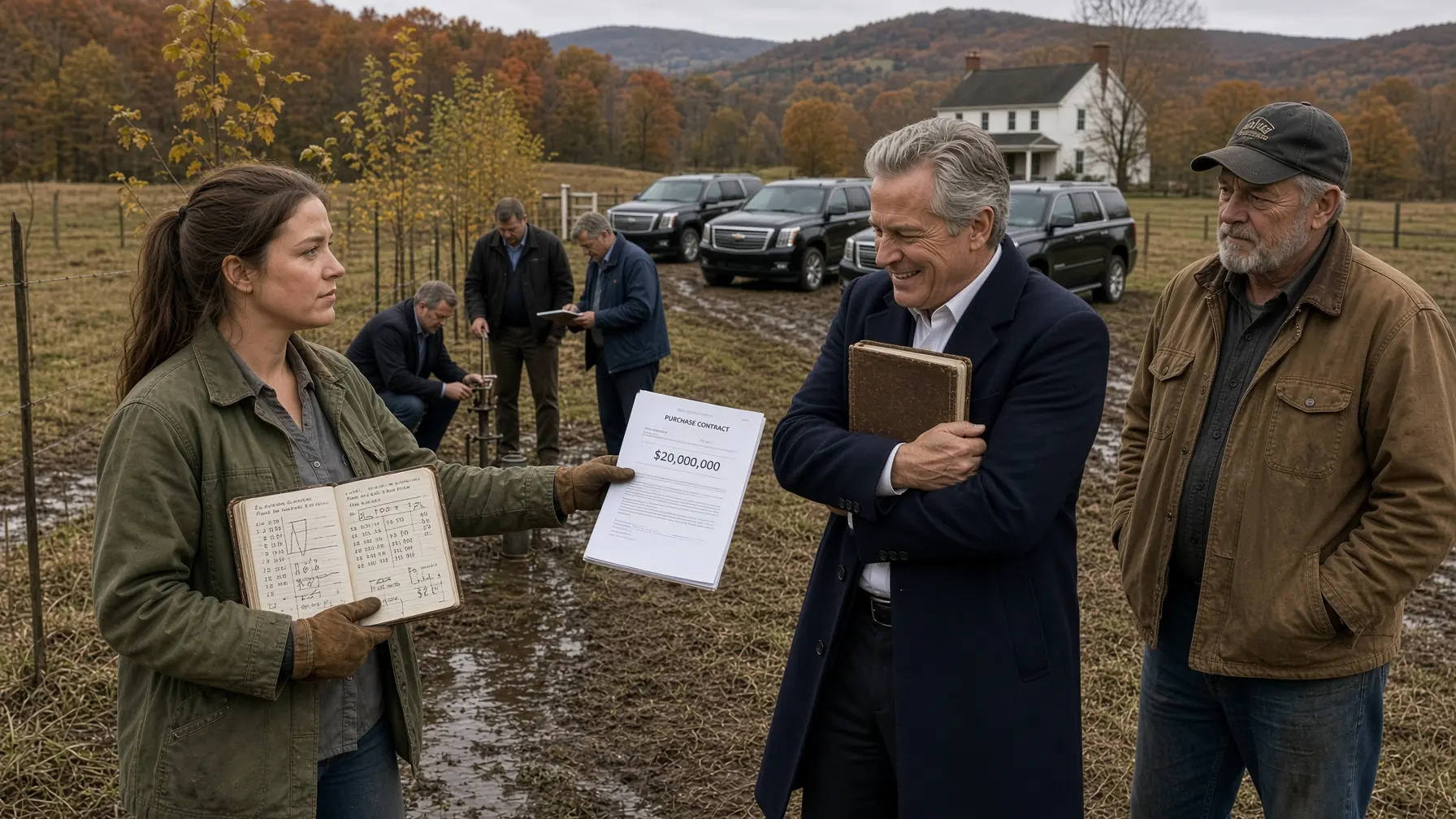
That was when the black SUVs arrived.
Six of them.
They rolled slowly through Sarah’s gate on a cool October morning and stopped near the old farmhouse.
Surveyors stepped out.
Environmental consultants followed.
Then attorneys.
Finally, from the lead SUV, billionaire developer Adrien Vale emerged wearing boots too clean for the mud and the relaxed expression of a man accustomed to solving difficult problems with money.
He had come carrying an offer.
Twenty million dollars.
And strangely, he was barely interested in the trees.
What Adrien Vale wanted was what those trees had created underneath them.
Sarah Mercer had never planned to become a forester.
At thirty-two, she had no romantic vision of building a woodland empire. She had spent years saving money while working agricultural consulting jobs and helping farmers improve damaged fields. When the abandoned property outside Red Hollow came up at county auction, she noticed it mainly because everyone else had given up on it.
Three hundred acres.
That was a lot of land for a price Sarah could almost afford.
There was an old farmhouse near the eastern boundary, a collapsing equipment shed, several broken fences, and a shallow drainage channel cutting through the lower section.
The property had once supported pasture.
Then came the gravel operation.
Heavy equipment stripped portions of topsoil, compacted other sections, and left behind broad zones where almost nothing grew.
When the company closed, maintenance ended.
Erosion did the rest.
By the time the county seized and auctioned the property, most residents of Red Hollow considered it a liability.
Heath Danner certainly did.
Heath owned a cattle ranch a few miles away and had lived in the valley almost his entire life.
When Sarah told him she had purchased the acreage, he stared at her for several seconds.
“You bought that?”
“Yes.”
“All three hundred acres?”
“Yes.”
He looked toward the pale hills.
“Why?”
Sarah smiled.
“I’m going to restore the ground.”
Heath laughed.
Not cruelly.
At first.
“Restore it to what?”
“I don't know yet.”
That made him laugh harder.
“You spent most of your savings on three hundred acres of baked clay and gravel, and you don't know what you're going to do with it?”
“I know the first part.”
“What’s that?”
“Make the ground work again.”
Heath shook his head.
“Nature already voted.”
Sarah looked toward the hills.
“No.”
“She just stopped getting help.”
Heath would repeat that conversation around town for months.
The young woman who bought dead land without knowing what she planned to grow became an easy story.
One rancher joked that Sarah was farming rocks.
Another said her best crop would be dust.
Heath eventually came up with his favorite line.
“She’s planting firewood for the next generation.”
Sarah heard it.
She did not argue.
She had not bought the land to prove Heath wrong.
In fact, she was not yet certain he was wrong.
Before planting anything, Sarah spent weeks walking.
After rain, she walked.
During dry weather, she walked.
At sunrise.
At dusk.
Sometimes in the dark with a flashlight.
She carried a notebook and marked everything.
Where water pooled.
Where it ran.
Where the ground stayed damp for a day.
Where it dried within hours.
Where grasses survived.