“Pull harder, kid! Maybe you hooked the whole farm!”
Dale Mercer laughed so loudly that two cattle lifted their heads from the pasture beyond the pond. He stood on the dry side of a split-rail fence, his heavy body leaning into the top board, one finger pointed toward the narrow figure straining at the edge of the muddy water. His gray beard jumped with every laugh. Beside him, Otis Reed wore the thin smile of a man who had come to observe somebody else's mistake and intended to get his afternoon's worth.
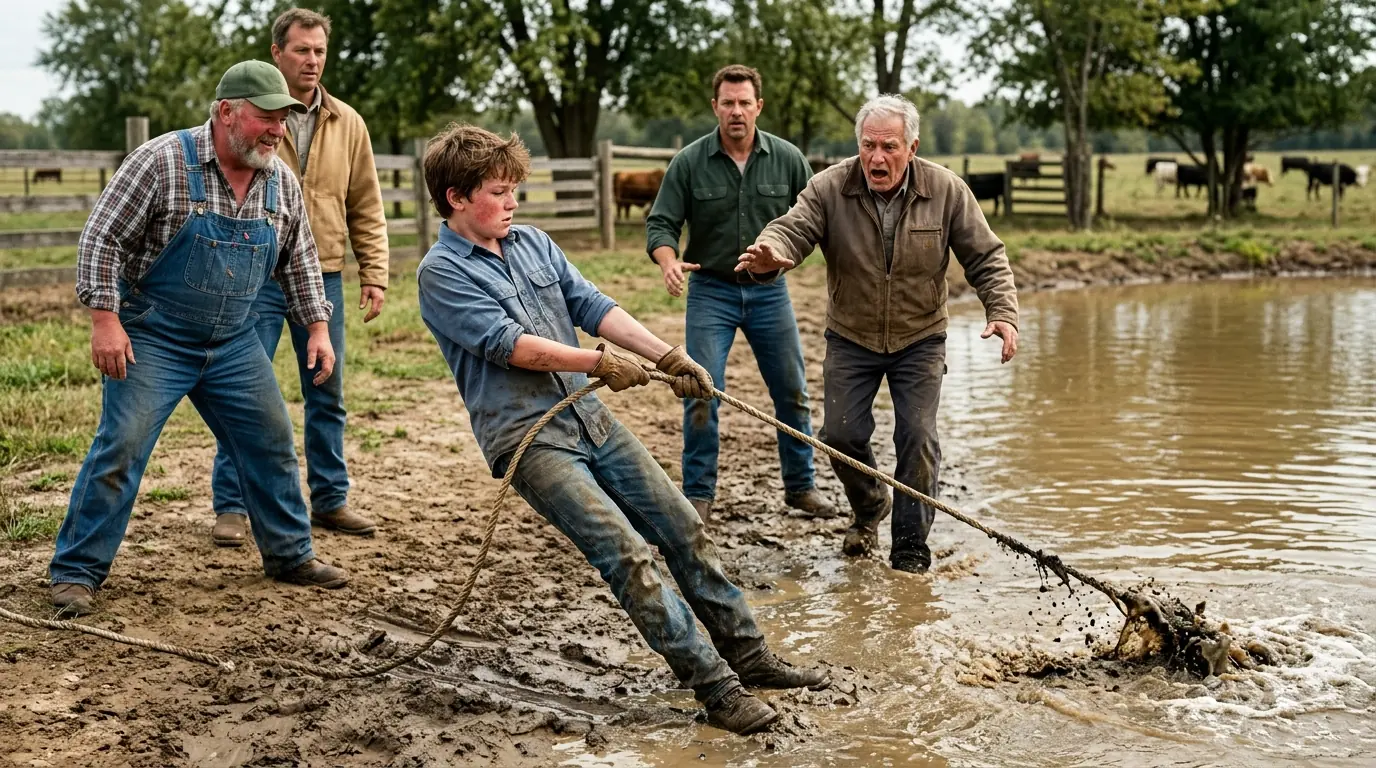
Eli Voss did not answer. He was thirteen years old, slim and freckled, and the thick rope in his hands seemed determined to drag the rest of him into the pond. He leaned back until his shoulders nearly touched the slope behind him. His brown boots cut twin trenches through the mud. Under the faded blue sleeves of his work shirt, his arms trembled. Whatever held the submerged end of the rope was astonishingly heavy, and the brown water refused to give him even a glimpse of it.
His father stood several yards away with the helpless expression of a man trying to decide whether pride or danger had reached his son first. Daniel Voss had spent the whole afternoon helping repair a pasture gate and had only come down to the pond because he'd heard Dale laughing. His dark green work shirt was damp across the back; his jeans still carried a line of pale dust from the cattle lot. He knew Eli's stubbornness well enough to respect it, and he knew water well enough to fear it.
At the fence stood Samuel Voss, Daniel's father, seventy-two years old, silver-haired and weather-cut, wearing a faded brown jacket despite the late-summer warmth. He had been still for several minutes. Unlike the others, he was not watching Eli's feet or the taut line of rope. He was staring at the pond's surface, his eyes searching the little rings that formed when something moved far below.
A deep scraping sound came through the water.
Samuel's expression changed. It was not the cautious puzzlement of a farmer hearing machinery he could not identify. It was recognition, immediate and terrible. His face drained of color. His lips parted, but no words emerged.
Eli planted his heels and pulled again.
To understand why the boy was still hanging on, and why the old man looked as if the past had risen to meet him, it was necessary to go back to the beginning of that summer, when the pond had seemed no more dangerous than a place where thirsty cattle gathered and red-winged blackbirds argued in the reeds.
The Voss farm occupied a broad tract of rolling pasture in the American countryside, far enough from town that the road carried more feed trucks than commuters. Its white farmhouse stood behind tall shade trees, with a long gravel drive running past a machinery shed and toward the cattle lots. Daniel raised beef cattle and made hay on the ground his father had worked before him. The operation was large enough to demand constant attention and small enough that one bad season could upset the household's finances for years. In dry weather the ponds mattered almost as much as the fences. Every animal needed water, and every gallon had to come from somewhere.