Harold Granger leaned across the wooden fence and pointed toward the bronze turkeys moving through Mara Ellison’s wheat. Two ranch hands stood behind him, smiling as if they had arrived to watch a traveling circus rather than inspect a struggling farm. The lowering Kansas sun turned the field gold, but even warm light could not conceal the thin stalks, uneven rows, and bare patches left by years of exhausted soil. Mara stood among the birds in a faded blue dress, a beige apron, and dusty boots, holding a long wooden staff as though it were the only line separating her land from the men waiting to take it.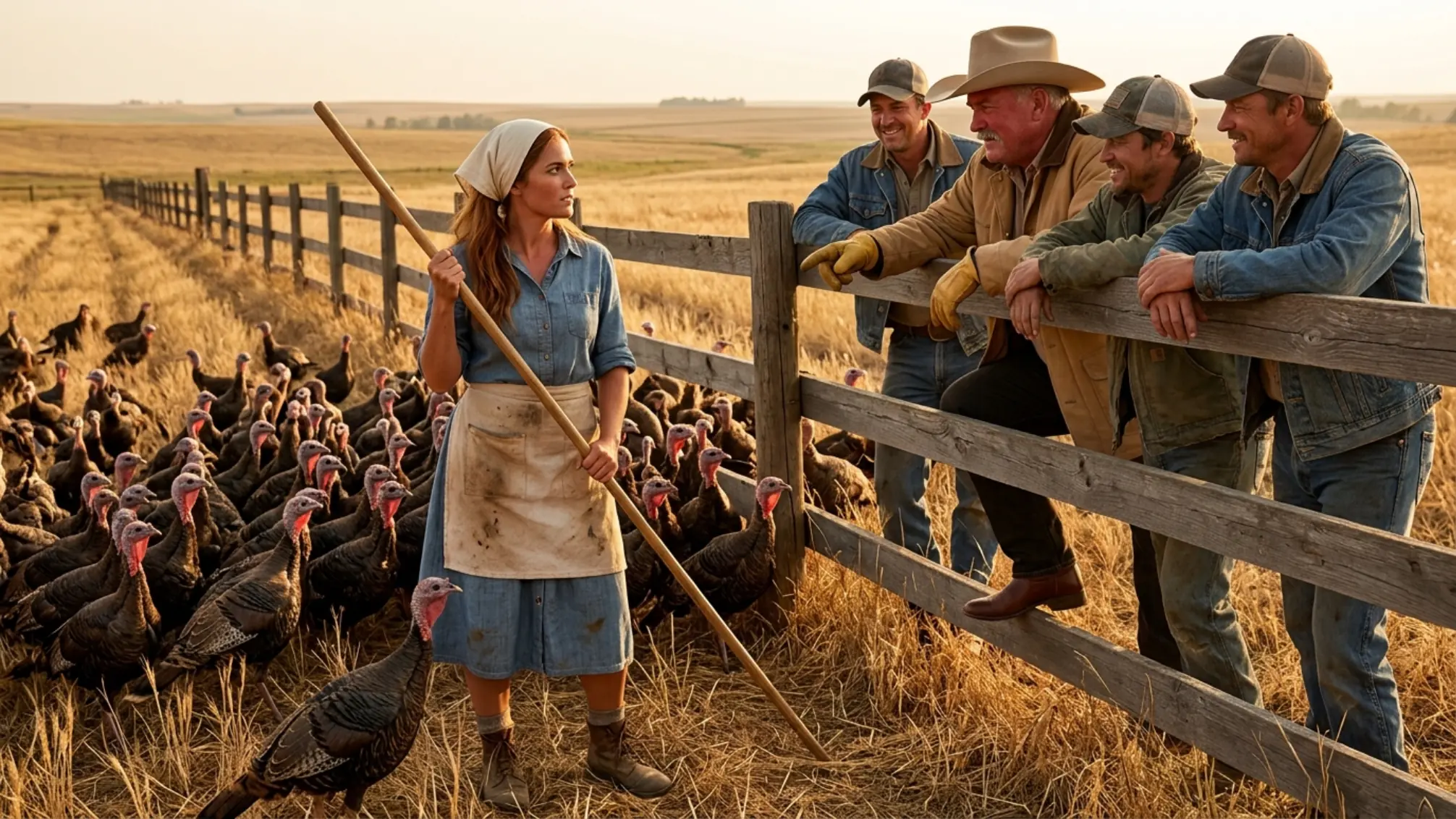
“Five hundred turkeys in dying wheat,” Harold called. “Sell now before you lose everything.”
Mara walked toward the fence without lowering the staff. “They don’t eat the wheat. They eat what’s killing it.”
Harold’s smile disappeared. “Your note comes due soon, and then this land becomes mine.”
“Come back when the grasshoppers arrive,” Mara replied. “Then watch whose field is still standing.”
The ranch hands stopped laughing.
Harold studied the thirty-one-year-old widow as though deciding whether grief had made her brave or simply irrational. Six months earlier, Mara’s husband, Russell, had died from a sudden heart attack at the kitchen table while reviewing seed prices. Since then, Harold had approached her three times with offers to purchase the five-hundred-acre farm. Each proposal was slightly lower than the last because he believed time, debt, and loneliness were negotiating on his behalf.
Mara understood his strategy.
Harold owned the largest cattle operation in Millard County, controlled two grain elevators, and held a seat on the board of the bank carrying her farm note. He never threatened her directly because men with his influence rarely needed to. He simply mentioned the coming payment, the falling wheat yield, and the inconvenience of managing hundreds of acres alone until surrender sounded like common sense.
“You’ve had your fun,” Harold said. “Those birds won’t save you.”
Mara lifted her chin. “Then you have nothing to worry about.”
Harold walked away from the fence, but his confidence remained behind like a stain. Mara listened until the sound of his truck disappeared along the county road. Then she turned toward the turkeys and resumed guiding them between the rows.
The flock had not been an impulsive decision.
Three weeks after Russell’s funeral, Mara discovered an old leather journal inside the bottom drawer of her grandmother Cecilia’s cedar chest. The cover was soft from decades of handling, and several pages had been repaired with strips of yellowing tape. Cecilia had farmed the same land during the 1930s and 1940s, when drought, dust, and insects destroyed entire communities.
Mara expected recipes, weather notes, or family records.
Instead, she found eleven years of detailed agricultural observations.
Cecilia had raised bronze turkeys beside her wheat. Each morning, she released the birds into selected sections and recorded where they traveled, what insects they consumed, how the soil changed, and whether crop damage increased or declined. Her language was simple, but the patterns were unmistakable.
Fields visited regularly by the turkeys suffered fewer pest outbreaks.
They required less purchased fertilizer.
Their soil held moisture longer.
The wheat produced stronger yields after several seasons.
One sentence appeared repeatedly throughout the journal.
The land does not work on our schedule.
Mara read every page in one night.
By sunrise, she had decided to risk what remained of Russell’s savings on five hundred bronze turkey poults. The farm-supply dealer asked her three times whether she had made a mistake with the number. Mara confirmed it each time.
The birds arrived badly.
Sixty-three died during transport. Another forty were lost during a brutal August heat wave. Mara spent nights sleeping inside the converted equipment barn because young birds weakened quickly, and she feared missing the earliest signs of illness.
By September, approximately three hundred seventy remained.
The county noticed.
People slowed their vehicles near Mara’s fence. Men at the Corner Café joked that grief had turned Russell Ellison’s widow into a poultry farmer. Women at the grocery store lowered their voices and said she was trying to remain busy because accepting her husband’s death would destroy her.
Mara heard every story.
She answered none of them.
Each morning before sunrise, she released the flock. The turkeys spread through the field, heads lowered, searching the soil and lower stems. They consumed beetles, larvae, insect eggs, and anything else that moved beneath the wheat.
Mara walked beside them carrying Cecilia’s journal and a black composition notebook. She counted insects in marked soil samples, measured damaged plants, recorded bird losses, and compared every observation with her grandmother’s notes.
The first season produced no miracle.
The wheat improved slightly, but not enough to silence the county. After expenses, Mara barely covered the interest on the bank note. Harold’s second offer arrived through an attorney before Christmas.
She placed it unopened inside the stove.
The second year began with disaster.
An unexpected freeze swept across western Kansas in late March. Temperatures dropped nearly forty degrees overnight, and the secondary shelter Mara had constructed was not strong enough to protect the entire flock. She found more than one hundred birds dead in the corners the following morning.
For the first time, she considered quitting.
Mara sat on the barn floor surrounded by feathers, overturned feeders, and the silent bodies of animals she had worked for months to keep alive. Her back ached, her hands were split from winter, and the bank balance was lower than it had ever been.
She thought of Harold’s offer.
Selling would have ended the fear. She could have purchased a smaller home in town, found work at the county office, and lived without waking each morning wondering which machine, animal, or payment would fail next.
Then she remembered Russell’s final conversation with her.
They had been standing near the western field after noticing another weak harvest. Russell admitted the soil was exhausted and said they had been asking more from the land than they returned to it.
“We need to change how we listen,” he told her.
Mara had laughed gently. “Land doesn’t speak.”
“It does. Farmers just get too proud to admit they stopped hearing it.”
She rose from the barn floor.
Her neighbor, Carl Dues, arrived an hour later after seeing the damage from the road. He found Mara carrying living birds from the secondary shelter into the main barn despite a back so stiff she could barely stand upright.
Carl did not question the plan.
He put on his gloves and helped.
By April, Mara had two hundred fifty-eight birds.
It was not enough to cover five hundred acres as Cecilia recommended, but it was what remained. Mara changed the rotation, concentrated the flock in the most damaged sections, and continued recording everything.
County inspectors arrived that spring.
The senior inspector, Mr. Garfield, walked the field with a clipboard and described the turkey manure as contamination. He called the disturbed rows evidence of improper cultivation and photographed the shelter where the birds had died.
“The birds fertilize the soil,” Mara explained.
“That is not a recognized county method.”
“It was recognized for thousands of years before companies started selling fertilizer in bags.”
Garfield wrote something without looking at her.
His report called the operation outdated, unsanitary, and inconsistent with accepted wheat-management standards. It recommended conventional pesticides, commercial fertilizer, and removal of most of the flock.
The report became public.
Harold’s third offer arrived two weeks later.
This one was lower than the others.
Mara read it at the kitchen table, then opened Cecilia’s journal. An entry from 1938 had been written in cramped handwriting during one of her grandmother’s worst seasons.
People doubt what they cannot see working. The work is in the ground.
Mara wrote beneath it:
Still true.
The summer drought reduced her second harvest to the lowest yield in farm records. Mara managed to make the autumn payment only after a young loan officer granted her a sixty-day extension.
Harold opposed the decision during the bank meeting.
Mara learned that later.
At the time, all she knew was that the extension bought her another spring.
Year three began quietly.
When the ground softened in March, Mara returned to the marked sampling locations. During the first year, a square foot of soil often contained more than a dozen pale larvae capable of damaging wheat roots and stems.
The second-year numbers had been lower.
In the third year, several samples contained only one or two.
Mara dug again.
Then again.
The pattern remained consistent across the field.
She sat in the cold soil with her notebook balanced on one knee and wrote:
Significant reduction in larval density. Flock effective. Cecilia was right.
After hesitating, she added:
I was right to trust her.
Spring rains arrived at the proper time. The wheat emerged stronger, fuller, and greener than it had in years. The stalks stood evenly across areas that had once appeared nearly dead.
Even Carl admitted the change could no longer be dismissed.
“Your wheat looks better than mine,” he said one morning at the fence.
“The soil needed time.”
“People are going to say you got lucky.”
“They’ve been saying that since before it improved.”
A second county inspection produced a different result. Mara presented three years of notebooks, sample locations, pest counts, bird-rotation schedules, and harvest comparisons.
Garfield examined them for nearly an hour.
“These measurements are not standardized.”
“They were taken in the same locations, by the same method, for three seasons. The trend is clear.”
He had no answer to that.
The revised report described her operation as experimental and recommended observation rather than correction. It was not an apology, but it was the first official document that did not treat her as confused.
Then the grasshoppers came.
The outbreak began fifteen miles west in early July. A farmer named Bill Renick lost forty acres overnight. The insects stripped his wheat until only bare stems remained.
By the end of the week, six farms had reported severe damage.
Crop-dusting planes filled the sky, releasing pesticides over thousands of acres. The treatments killed insects they reached, but new waves continued moving east with the wind.
People compared the sound to radio static.
Mara listened to emergency reports from her kitchen.
Each day, the infestation moved closer.
Eight miles.
Five.
Three.
Carl called on Thursday evening.
“They reached the Henderson farm.”
“How fast are they moving?”
“You may have two days.”
Mara looked through the window at her strongest wheat harvest since Russell’s death. Every debt, every bird lost to cold, every insult, and every morning spent digging in the soil had led to this crop.
Two days could erase it.
She had two hundred thirty-eight turkeys remaining.
Not enough to stop a living cloud.
Mara sat at the kitchen table with Cecilia’s journal open before her. There were no entries describing an invasion this large. Her grandmother had documented ordinary pest suppression, not a countywide outbreak.
For the first time in three years, the journal offered no direct answer.
Mara closed it.
She had already completed the work that could be done.
Whatever happened next had been decided by seasons of preparation, not by one final desperate action.
At dawn on Friday, she released the flock.
Then she waited.
Harold arrived shortly before nine with his son Evan and two ranch hands. He parked near the same fence where he had laughed at her birds months earlier.
Mara walked toward them.
“You came back,” she said.
“I thought you might need witnesses when the field disappears.”
Evan looked uncomfortable. He was twenty-four and had spent two years slowing his truck near Mara’s property to watch the flock. Unlike his father, he had never laughed.
Mara tightened her grip on the wooden staff.
“You should watch carefully.”
Harold nodded toward the western horizon. “I intend to.”
Carl arrived later and stood near Evan without speaking.
At approximately ten thirty, the sound reached them.
A low, continuous clicking moved across the plains. The western field shimmered as thousands of grasshoppers rose, landed, fed, and rose again.
Harold’s expression changed.
Even he had never witnessed an infestation of that scale.
The insects reached the far fence shortly before noon.
They poured through.
Mara’s turkeys reacted immediately.
The loose flock tightened. Birds nearest the western edge raised their heads, changed direction, and moved toward the incoming insects. Within seconds, hundreds of bronze bodies formed a shifting line through the wheat.
They fed with an intensity Mara had never observed.
The grasshoppers entered the field, but something unexpected happened.
They did not settle.
On neighboring farms, each wave had stopped because generations of insects already occupied the soil. The arriving adults joined existing populations, fed, reproduced, and expanded.
Mara’s field held no such foundation.
For three seasons, the turkeys had consumed eggs, larvae, juveniles, and the insects needed to maintain the cycle. The grasshoppers moving through her wheat found food, but not the dense established population that caused the swarm to remain.
The birds attacked the edges.
The insects continued east.
Evan was the first to understand.
“They’re passing through.”
Harold stared at the field. “No.”
“They aren’t stopping,” Evan said.
The leading wave crossed the western section, causing visible damage. Wheat heads shook, several stalks collapsed, and insects covered the air.
But the field remained standing.
The swarm moved across the center acreage and reached the eastern boundary. Within hours, the largest concentration had entered the neighboring property.
Silence fell along Mara’s fence.
Harold looked at his ranch hands, but neither man smiled.
Mara opened the gate and walked into the field. She examined chewed leaves and partially damaged heads. The loss was real, especially in the western quarter.
Yet wheat surrounded her in every direction.
Alive.
Golden.
Standing.
Carl removed his cap.
Evan walked several steps into the field, staring at the turkeys continuing to hunt among the rows.
Harold remained behind the fence.
Mara returned carrying one broken wheat stalk. She stopped in front of him.
“You said the birds wouldn’t save me.”
Harold’s face hardened. “One unusual outcome does not prove your system works.”
“Three years of records prove it.”
“You were lucky.”
“My luck has soil samples, pest counts, and harvest records.”
His ranch hands looked away.
Harold pointed toward the damaged western section. “You still lost part of the crop.”
“Eight percent by my estimate.”
“My north field lost thirty-five.”
Evan turned toward his father. “And the Hendersons lost nearly everything.”
Harold’s eyes narrowed. “Stay out of this.”
“No,” Evan said. “You tried to buy her land while telling everyone she was incompetent. She did something none of us understood, and it worked.”
Mara watched father and son face each other.
Harold lowered his voice. “You think following turkeys through wheat makes you a farmer?”
“No. Asking why they were there might have made me one sooner.”
Harold left without another word.
By Saturday morning, cars lined the county road. Farmers who had lost crops stood at Mara’s fence, studying wheat they expected to find stripped bare.
Bill Renick arrived alone.
“I should have asked what you were doing two years ago.”
“You can ask now.”
She invited him inside.
The kitchen table became a classroom.
Mara showed farmers Cecilia’s journal, her notebooks, pest counts, bird-rotation schedules, and the mistakes that nearly ended the experiment. She did not promise quick results.
“The first year will look wrong,” she warned. “The second may look worse. The work happens before you can see it.”
Evan returned every Tuesday.
He read the journal first, then Mara’s notebooks. She taught him how to sample soil, recognize healthy flock behavior, and record failures honestly rather than hiding them.
Harold called after discovering his son’s visits.
“Stop filling his head with this nonsense.”
“Your son asked to learn.”
“He has responsibilities on my operation.”
“He comes during his own time.”
“This county is watching you.”
Mara looked through the window at the living field.
“They watched me when they thought I was failing too.”
Harold remained silent.
“You were wrong about the birds,” she continued. “You were wrong about the soil, and you were wrong about me. What bothers you most is that your son noticed before you did.”
She ended the call.
That autumn produced the strongest harvest on Mara’s property in twelve years. She walked into the bank and paid the remaining farm note in full.
No extension.
No board approval.
No Harold Granger.
The land belonged completely to her.
Agricultural researchers arrived the following month after the county report described her field’s survival as anomalous pest resistance. An entomologist named Dr. Sandra Yi examined Cecilia’s journal and immediately recognized the importance of the records.
“Your grandmother documented biological pest suppression decades before universities formally named the method.”
“She called it paying attention.”
The researchers requested permission to copy both sets of records.
Mara agreed on one condition.
“Cecilia receives full credit. Her work is not a historical footnote.”
Dr. Yi accepted.
Two years later, a university paper listed Cecilia Anne Ellison and Mara Louise Ellison as the originating field practitioners. The report documented a major reduction in destructive pest populations, improved soil condition, and higher long-term wheat yield.
Farmers from six counties joined a new extension program based on their work.
Mara insisted the materials use plain language.
She also required every participant to maintain records.
“Do not write only when things work,” she told them. “A dishonest notebook is worse than no notebook.”
Harold finally returned five years after his first offer.
He parked near the road and stood at the fence without entering. Age had softened his shoulders, though pride remained visible in the way he held himself.
“My south quarter has severe pest pressure,” he said.
Mara waited.
“Evan believes we should introduce a flock.”
“He is correct.”
Harold looked across her field. “I would like your advice.”
The words appeared physically difficult for him.
Mara opened the gate.
“Come inside. I’ll make coffee.”
They sat at the same kitchen table where Harold had once dropped his purchase offer. This time, Cecilia’s journal and Mara’s notebooks rested between them.
Harold listened.
Not patiently waiting for his turn to speak.
Actually listening.
Mara never sold the farm.
She expanded the flock, restored the soil, and taught dozens of families how to reduce their dependence on expensive chemicals. Evan developed his own successful rotation and eventually led the county extension program.
Visitors often asked Mara when she knew the turkeys would save her wheat.
She always gave the same answer.
“I didn’t know.”
They usually appeared disappointed.
People preferred stories in which courage meant certainty. Mara understood that true courage was often the opposite.
She had been terrified.
She had started with inherited evidence, incomplete knowledge, a failing field, and a bank note controlled by a man waiting for her to surrender. She continued because abandoning the farm felt worse than risking failure.
The grasshopper plague did not create her success.
It revealed work already completed beneath the surface.
For three years, the county laughed because it could see turkeys but could not see the disappearing larvae, interrupted breeding cycles, improving soil, or the patient intelligence contained in an old woman’s journal.
Harold believed Mara was wasting time.
In reality, she was preparing for a disaster no one else knew was coming.
When the grasshoppers arrived, every neighboring farmer reached for emergency solutions.
Mara’s solution had already been walking through her wheat for three years.