The auctioneer had barely finished saying “sold” when Grant Voss started laughing.
Banning stood near the back of the crowd with her bidder’s card still raised against her chest. Dust moved around her boots, and beyond the equipment yard, ripe wheat bent under a warm late August wind.
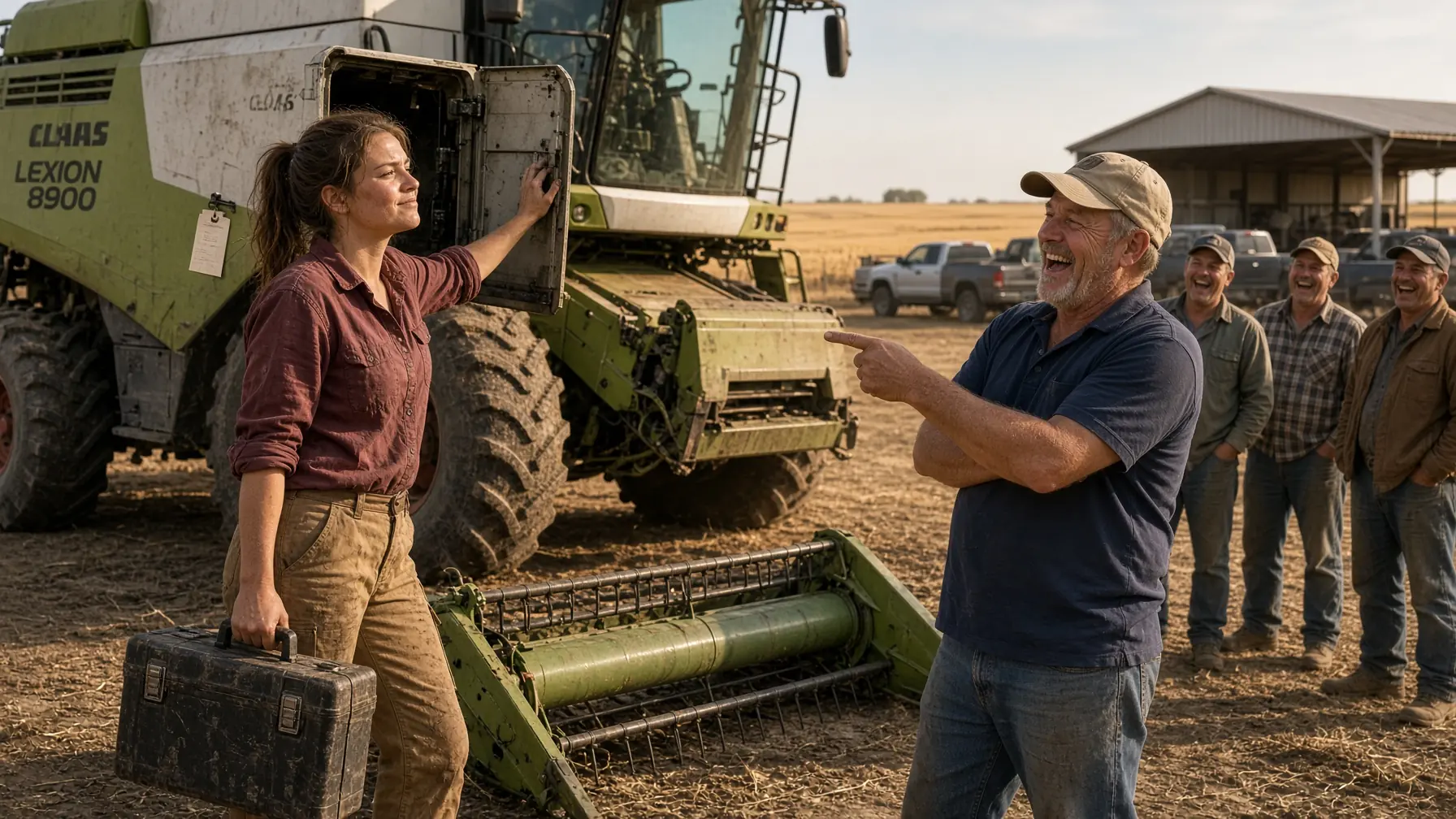
For a moment, she could hear nothing except the number repeating in her head.
Forty-six thousand seven hundred dollars.
Her number.
Her machine.
Then Grant turned far enough to make certain she could see his expression.
“Well,” he said, “somebody’s about to get an expensive education.”
Three neighboring farmers stood behind him. One smiled immediately. Another looked toward the enormous green-and-white combine and shook his head.
Banning lowered her card.
The 2024 CLAAS LEXION 8900 stood silent beside its detached draper header, dust dulling the panels that should have caught the afternoon light. It had been silent when she first walked around it. Silent when the auctioneer described it. Silent while men discussed its value as though the machine had already been taken apart.
According to the sale information, it had not run for eleven months.
Now it belonged to her.
She tucked the bidder’s card into her shirt pocket and walked toward the clerk’s table before anyone could ask whether she understood what she had done.
She understood enough to be frightened.
That was one reason she had bid carefully.
Two days earlier, Banning had been sitting in her rented workshop, looking at a broken zipper on her compact tool case.
The zipper had begun sticking that spring. She had meant to replace the case, but there was always something more useful to buy.
A meter.
A replacement lead.
Fuel.
Insurance.
The case still closed if she held one corner straight and pulled slowly.
She was working it back and forth when a message arrived with the auction listing.
At first, she assumed the machine would be beyond her reach.
She opened the listing anyway.
The photographs showed the combine in the same yard where it would be sold, several miles outside Haven Crest, North Dakota. In the first image, sunlight reflected from the cab. In the second, dust covered the rear panels.
Banning enlarged the third photograph.
Then she stopped moving the zipper.
The description was brief in the way descriptions became brief when the seller did not want to promise anything.
Non-running.
Available for inspection during the preview period.
Buyer responsible for removal.
She read the listing again.
Then she called the auction office.
The woman who answered sounded busy, but she did not rush Banning off the phone.
“Do you know whether it will be started during the sale?” Banning asked.
“It won’t be represented as running.”
“Can buyers inspect it beforehand?”
“Tomorrow afternoon.”
“Cab access?”
“With someone from the yard present.”
“Service information?”
“What we have will be available.”
Banning wrote down the hours.
After the call, she sat still for nearly a minute.
She had spent most of the past year telling herself not to look at equipment she could not afford.
This time, she was not sure what she could afford to ignore.
At twenty-nine, she had learned that knowing how to work did not automatically give a person the means to work independently.
She had spent seasons on harvesting crews, long days around farm machinery, and winters earning money wherever her skills were useful. She could operate equipment, recognize when something needed attention, and keep records well enough that other people eventually handed her the records they had neglected.
She was reliable.
Employers liked that.
Reliable people were useful to keep.