By the third day of rain, the roads outside Harlan, Iowa had stopped looking like roads and started looking like arguments between gravel and water.
Ditches brimmed dark and full. The edges of cornfields softened. Every low patch in every soybean field took on a deceptive skin—flat from a distance, glossy under the September sky, and hungry beneath the surface. Men with decades of work in their shoulders drove slower. Women who had lived on the land long enough to know that September should not feel like late April watched the clouds and tightened their mouths. Farm dogs hated the smell of the mud. Pickup trucks carried it into every gravel yard in the county.
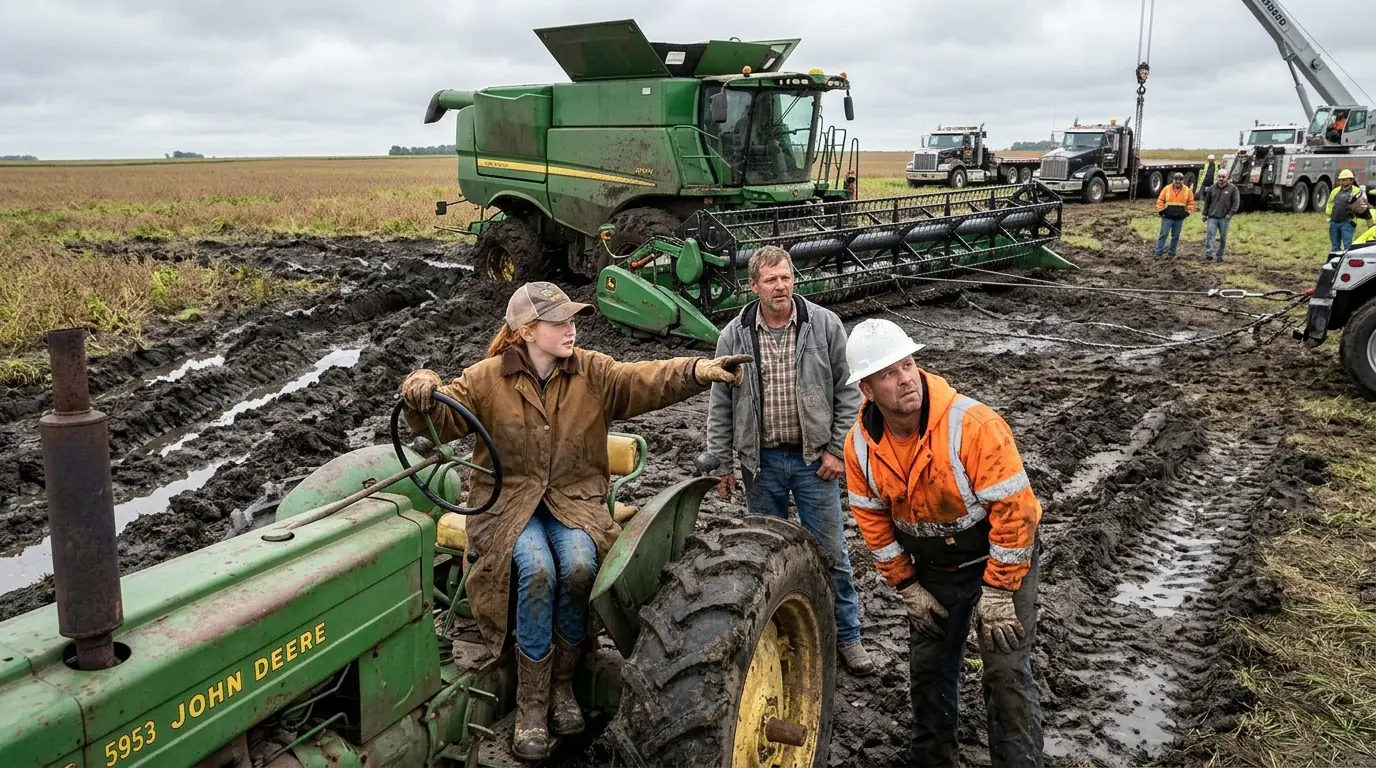
At the Granger place, three miles east of Harlan, twelve-year-old Willa Mae Granger stood on the back step in an oversized brown work coat and watched rainwater stripe the yard black.
She was a small girl even for twelve, all elbows and quickness, with a freckled face, bright green eyes that noticed too much, and long red hair she kept tucked beneath an old seed-corn cap whenever she meant business. The cap had once belonged to her mother. The coat had belonged to her uncle. The muddy boots on her feet had belonged to no one specifically, which was how most boots on a family farm eventually ended up.
From the step she could see the machine shed, the hay barn, the windbreak of cottonwoods to the north, and the faint silhouette of the old tractor sitting inside the open lean-to nearest the gravel lane.
Granny Green.
Nobody had named it in any official way. The name had simply attached itself over the years because the tractor was old, weathered, dependable in its own stubborn fashion, and treated with more tenderness than some living relatives. It was a 1953 John Deere Model 50 with faded green paint, a repaired metal seat, one enormous rear wheel weight bolted on crookedly years earlier, and an exhaust stack that leaned just slightly off true like a man listening carefully.
Willa loved every part of it.
Her father said that was because she had inherited the wrong sort of romanticism.
Her grandmother said it was because a good old machine taught patience to children who otherwise thought the world could be rushed.
Willa privately believed the real reason was simpler. Modern machines were impressive. Granny Green was understandable.
A person could stand beside the old tractor and feel, even before turning a wrench, that every piece served a purpose and expected to be treated with honesty. Willa liked things that honest.
Behind her the kitchen screen door banged.
“Don’t stand there letting the weather insult you,” her grandmother called.
Willa looked back. “It’s not insulting me.”
“It insults everybody if it goes on long enough.”
Vera Granger was seventy-four and still carried herself with the narrow, durable strength of someone who had spent a lifetime lifting milk cans, feed sacks, and family expectations in about equal measure. She wore a blue cardigan over a housedress, a pair of old men’s wool socks, and the expression of a woman willing to tolerate weather but not dramatics.
She held out a mug of hot cocoa, because in the Granger house practical people did not always announce affection but they often heated it.