When Maya Doyle paid twenty dollars for land covered in other people’s farm waste, her neighbors decided she had finally run out of good sense. By October, the jokes had become a habit, and Nathan Briggs arrived at her fence ready to tell another one. Maya let him finish before driving her garden fork beneath the green leaves. What came out of that ground would force every man watching to reconsider something he had paid to throw away.
“Twenty bucks for a manure dump, and now you’re growing weeds?”
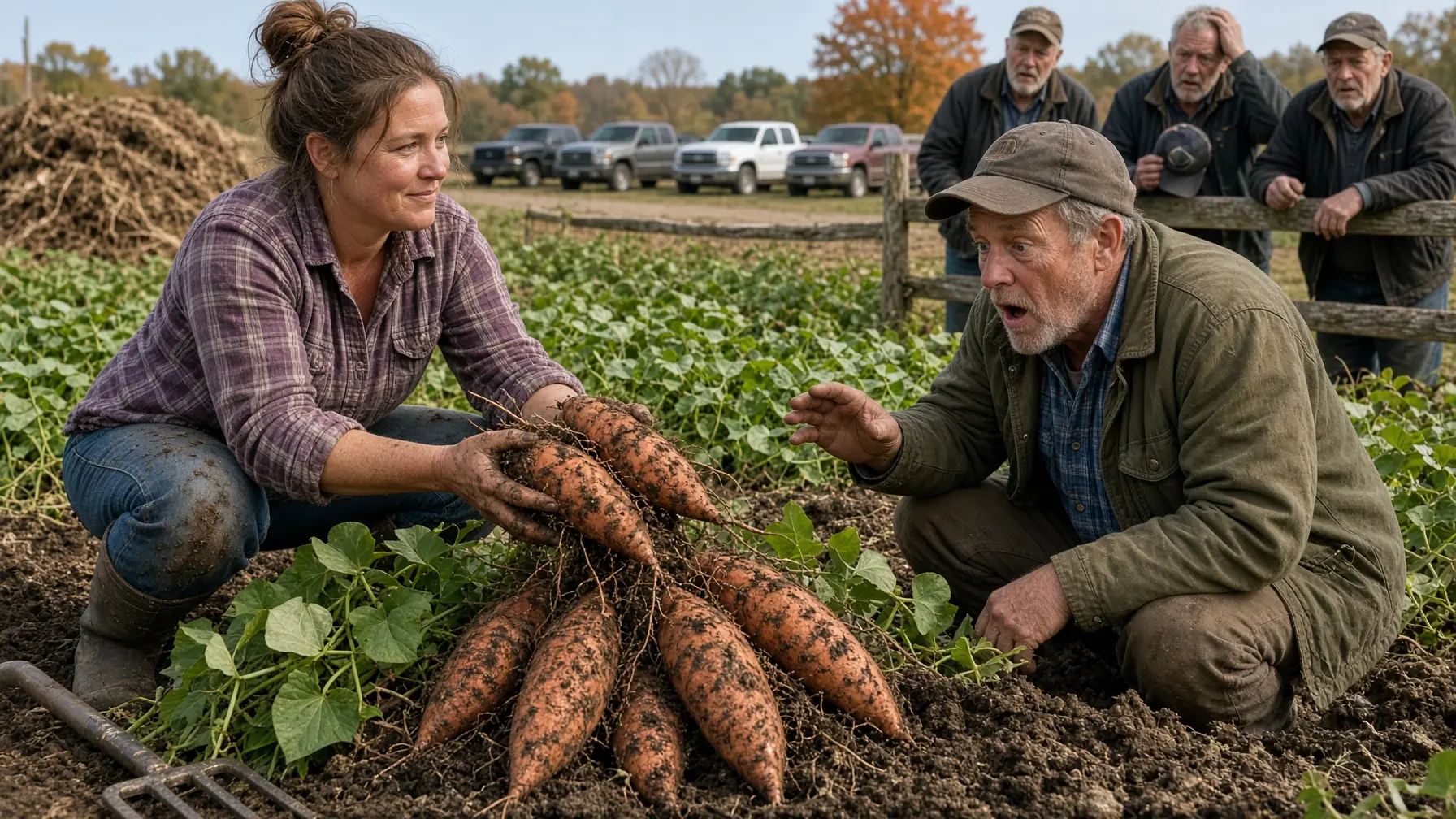
Nathan Briggs pointed toward the old mound of hay near the fence, grinning beneath the brim of his faded baseball cap. Three neighboring farmers stood beside him, their pickup trucks parked along the county road, and two of them chuckled before Maya Doyle looked up.
She stood inside the fence in a faded purple checked shirt, worn jeans, and muddy brown rubber boots. Her brown hair was gathered in a loose bun that had begun to come apart, and a few strands clung to her cheek where she had wiped it with a damp wrist.
At forty-one, Maya had neither the money nor the patience to make a performance out of being underestimated. She had already spent too many mornings working while other people explained what would never work.
This morning, however, she had invited them.
Nathan nodded toward the thick vines spreading behind her.
“You could’ve saved yourself the trouble. That stuff grows along every ditch.”
Maya lowered her eyes to the plant beside her boot. She had marked it with a short piece of twine the previous evening, after walking the rows and choosing the place where she wanted to begin.
The twine was still there.
So was the faint tremor in her fingers.
She tightened her grip on the fork.
“Come closer before you call them weeds.”
Nathan stepped toward the fence, still smiling. One of the other men carried an empty produce crate against his hip, though he had told her over the telephone that he was bringing it for the laugh.
Maya planted her boot against the fork and pressed.
The tines entered the soil with a soft, damp sound.
She worked them deeper, keeping the fork far enough from the crown that she would not pierce what lay beneath it. Then she leaned back slowly, using her weight rather than jerking the handle.
The soil rose.
Nathan’s smile remained for another second.
Then the lifted earth broke apart.
Seven months earlier, that spot had looked less like land than a place everyone had agreed to forget.
Old hay lay flattened in gray-brown heaps. Torn vegetable sacks caught along the fence. There were blackened squash, stalks from a cleared market garden, manure mixed with bedding, and layers of rotting plant material that had been pushed together each time somebody needed somewhere convenient to unload.
The neighboring farms had used the parcel for years.
Sometimes they had permission.
Sometimes they had merely noticed nobody stopped them.
By the time Maya first walked through it, the owner had moved away and wanted the nuisance removed from his name. The land was too awkwardly shaped to interest the larger operations, too cluttered to show well, and too neglected for anyone to imagine using it without first spending money.
Maya had come because she could not afford the parcels people called good.
Her own growing operation had been squeezed onto borrowed ground behind an old shed. She sold vegetables when she had them, took repair and cleaning work when she did not, and kept a notebook in which every expense had to justify itself before she wrote it down.
That spring, the borrowed ground was being taken back.
There was no hostility in the decision. The family who owned it needed the space, and they had warned her as kindly as they could.
Kindness did not make another piece of land appear.
For several weeks, Maya drove county roads after finishing work, looking at neglected corners and vacant strips. She called numbers painted on signs, asked questions at feed stores, and learned how quickly people lost interest once they understood her budget.
Then somebody mentioned the dumping ground.
“Don’t bother,” the man at the feed store told her. “You’d need to haul half the county off it.”
Maya asked who owned it.
He gave her a number, then added, “I’m serious.”
“So am I.”
She visited on a March afternoon with a shovel, a pair of gloves, and no expectation that she would find a bargain. She expected another problem dressed up as an opportunity.
From the road, the place looked exactly as described.
Up close, it looked worse.
There were loops of baling twine embedded in the heaps, pieces of plastic blown into the grass, a bent metal trough, and a broken pallet that shifted dangerously when she touched it with her boot. Along the lower edge, winter water had collected in a shallow depression.
Maya stood still for a long time.
Then she pushed her shovel into the oldest pile.
The upper layer was coarse and recognizable, full of stalks and weathered stems. Beneath it, the material changed.
She dug deeper.
Dark crumbs fell from the blade.
Maya crouched, pulled off a glove, and rubbed a little between her fingers. It smelled earthy beneath the sour odor of the newer waste.
She dug another hole several yards away.
Then another.
By the fourth, she had stopped thinking about hauling everything away.
She was thinking about separating what could be used from what should never have been there.
Nathan found her near the fence while she was scraping soil into a reused container.
He had farmed next door long enough to believe that anything happening along his boundary was partly his business. He was sixty-three, with gray stubble, thinning hair, and a habit of making a question sound like a verdict.
“What are you doing?”