Danny Pruitt heard the laughter before he reached the registration table.
It followed him across the dusty equipment yard at the Siebert Sale Barn outside Colby, Kansas, on a hot July morning in 1977. He was sixteen years old, lanky from a recent growth spurt, sunburned across the nose, and wearing work boots that had belonged to his older brother and were still half a size too large. Tucked against his chest was an old metal coffee tin containing exactly three hundred forty dollars in carefully saved bills, and beneath one arm he carried a small notebook filled with measurements, serial numbers, and handwritten notes.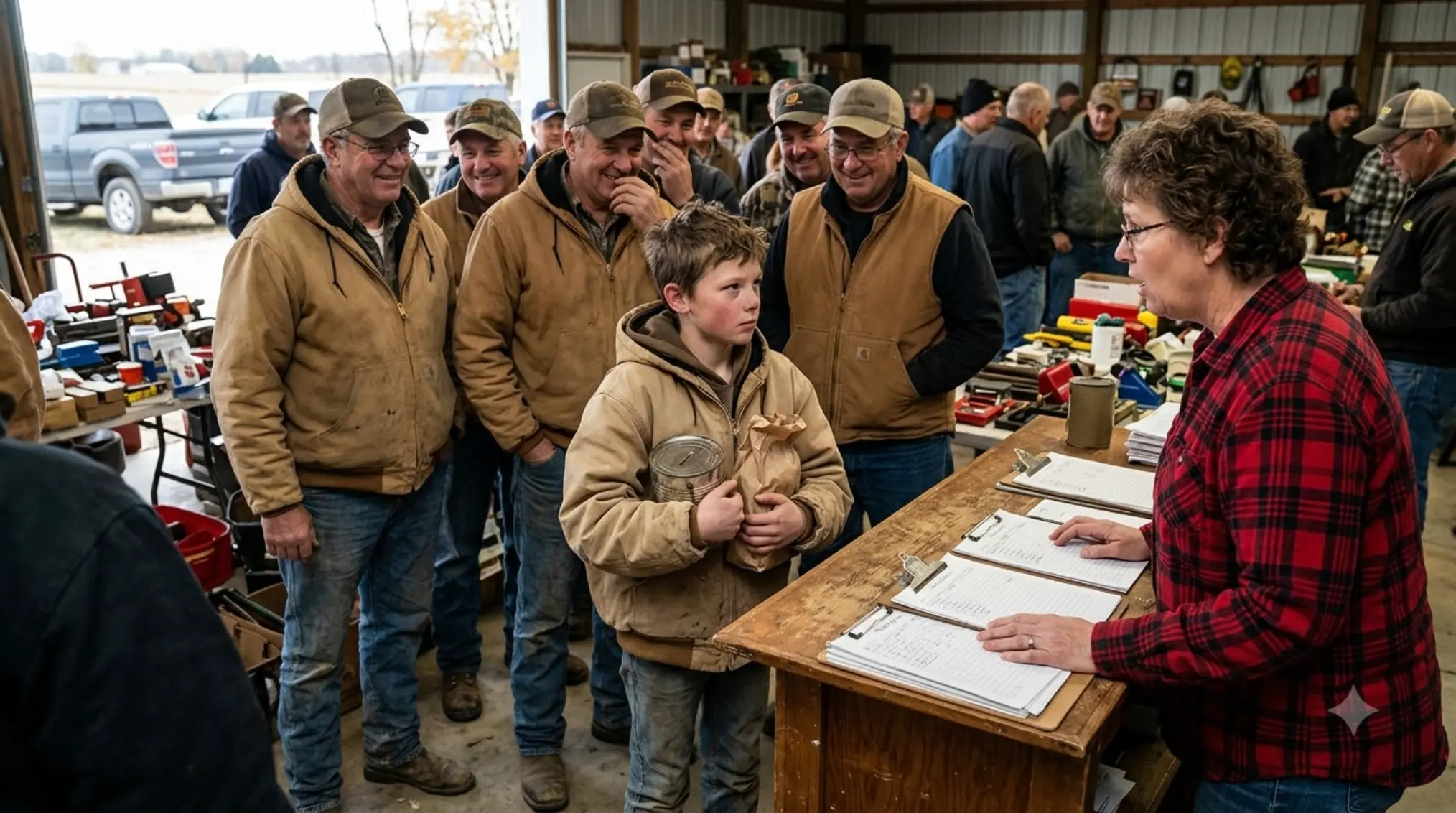
The men standing near the registration shed had been buying farm machinery longer than Danny had been alive.
Most of them recognized one another.
They were farmers, dealers, mechanics, estate buyers, and men who attended auctions even when they had no intention of purchasing anything because an equipment sale was as much a social event as a business transaction in western Kansas. Some leaned against pickup beds drinking coffee. Others studied auction catalogs with pens tucked behind their ears.
Then they noticed Danny.
Ray Denton, a used-equipment dealer from Colby, looked toward him and smiled.
“Somebody’s boy playing farmer.”
A few men chuckled.
Danny heard every word.
He kept walking.
That was something his grandfather had taught him without ever saying it directly: when somebody underestimated you, explanations were usually less useful than results.
Danny reached the registration table and placed the coffee tin on the counter.
The clerk looked first at the tin.
Then at Danny.
“Registering to bid?”
“Yes, ma’am.”
“How old are you?”
“Sixteen.”
That earned another glance.
Danny gave his name, address, and the information required for registration. The clerk opened the coffee tin and counted the cash while several men watched with growing amusement.
Three hundred forty dollars was not much money at a serious farm-equipment auction.
A good tractor could sell for several thousand.
Even tired machinery often brought more than Danny possessed.
Ray Denton stood twenty feet away and shook his head.
“What’s he planning to buy with that?”
Danny heard that too.
He said nothing.
Because he already knew exactly what he wanted.
Lot 14.
A 1953 Oliver 88 row-crop tractor.
It sat near the northern end of the auction yard, partly shaded by the side of the sale barn. Most of its original green paint had faded or peeled away. One rear fender was missing, the seat was cracked, and the sheet metal bore the dents of twenty-four years of ordinary farm work.
But none of those problems explained why serious buyers were ignoring it.
The front axle did.
The tractor leaned slightly to one side.
Anyone familiar with farm machinery could see it immediately.
The left front wheel sat several inches out of alignment, creating the appearance of an axle bent badly enough to suggest either a collision, rollover, or years of abuse.
Repairing structural axle damage could cost more than the tractor was worth.
That was why the auction catalog estimated Lot 14 at only two hundred to four hundred dollars.
And even that estimate seemed optimistic.
Ray Denton had inspected it for less than a minute before moving on.
A parts dealer from Goodland had looked underneath, shrugged, and written something beside the lot number.
Two experienced wheat farmers had walked around it and agreed that the engine might still be worth salvaging.
Danny had spent twenty-two minutes examining it.
He started with the engine.
His grandfather’s compression gauge came out of the small tool bag he had carried on the bicycle that morning. Danny tested each cylinder carefully and wrote the readings in his notebook.
Healthy.
Surprisingly healthy.
The oil showed no water contamination.
The transmission gears visible through the inspection cover looked worn but serviceable.
Hydraulic lines were old but intact.
Then Danny crouched beneath the tractor and studied the front axle.
That was when several men started openly laughing.
“A compression gauge,” one said.
Another answered, “Kid came prepared.”
Danny ignored them.
He ran his fingertips over the kingpin assembly.
Then he removed a folding ruler.
He measured the lateral cant at the wheel flange.
Four and one-quarter inches.
Danny measured again.
Exactly the same.
His heartbeat changed.
Not because he was nervous.
Because he recognized the number.
Two winters earlier, after his grandfather Roy Pruitt died, Danny had spent weeks reading the old service bulletins Roy stored in binders above the workbench.
Roy never threw technical information away.
If Oliver issued a maintenance update, Roy kept it.
Farmall bulletin?
Filed.
John Deere correction?
Filed.
Bearing tolerance revision?
Filed.
Some farmers considered the papers clutter.
Roy called them memory.
One bulletin from 1956 dealt specifically with the 1952 and 1953 Oliver 88 front axle.
Danny remembered it because the repair seemed almost absurdly simple compared with the symptoms.
A worn kingpin bushing could shift tolerance far enough to create a visible axle cant.
From a distance, it looked exactly like structural damage.
But the axle itself remained straight.
The bulletin gave a measurement range.
Four to four and one-half inches of lateral displacement under the described wear condition.
Danny had measured four and one-quarter.
The axle was not bent.
The bushing was worn.
A replacement cost around twelve dollars.
Three hours of work.
Maybe less.
Danny stood slowly and closed his notebook.
Around him, experienced buyers saw a damaged tractor.
Danny saw one inexpensive bushing.
That difference was worth money.
Roy Pruitt had begun teaching Danny about machines when the boy was eight.
Not because Roy thought his grandson would become a mechanic.
Roy simply believed children should understand the things their families depended on.
“Machines don't care how smart you think you are,” Roy once told him while rebuilding a carburetor. “They only care whether you understand what’s wrong.”
Danny remembered asking how you learned that.
Roy had handed him a wrench.
“Start paying attention.”
That was Roy’s teaching method.
Danny held flashlights.
Cleaned parts.
Sorted bolts.
Watched.
Asked questions.
Sometimes Roy answered.
Sometimes he said, “Look again.”
By twelve, Danny could perform compression tests.