The farmer stopped laughing before Rowan Mercer opened the barn doors.
Something had chirped on the other side.
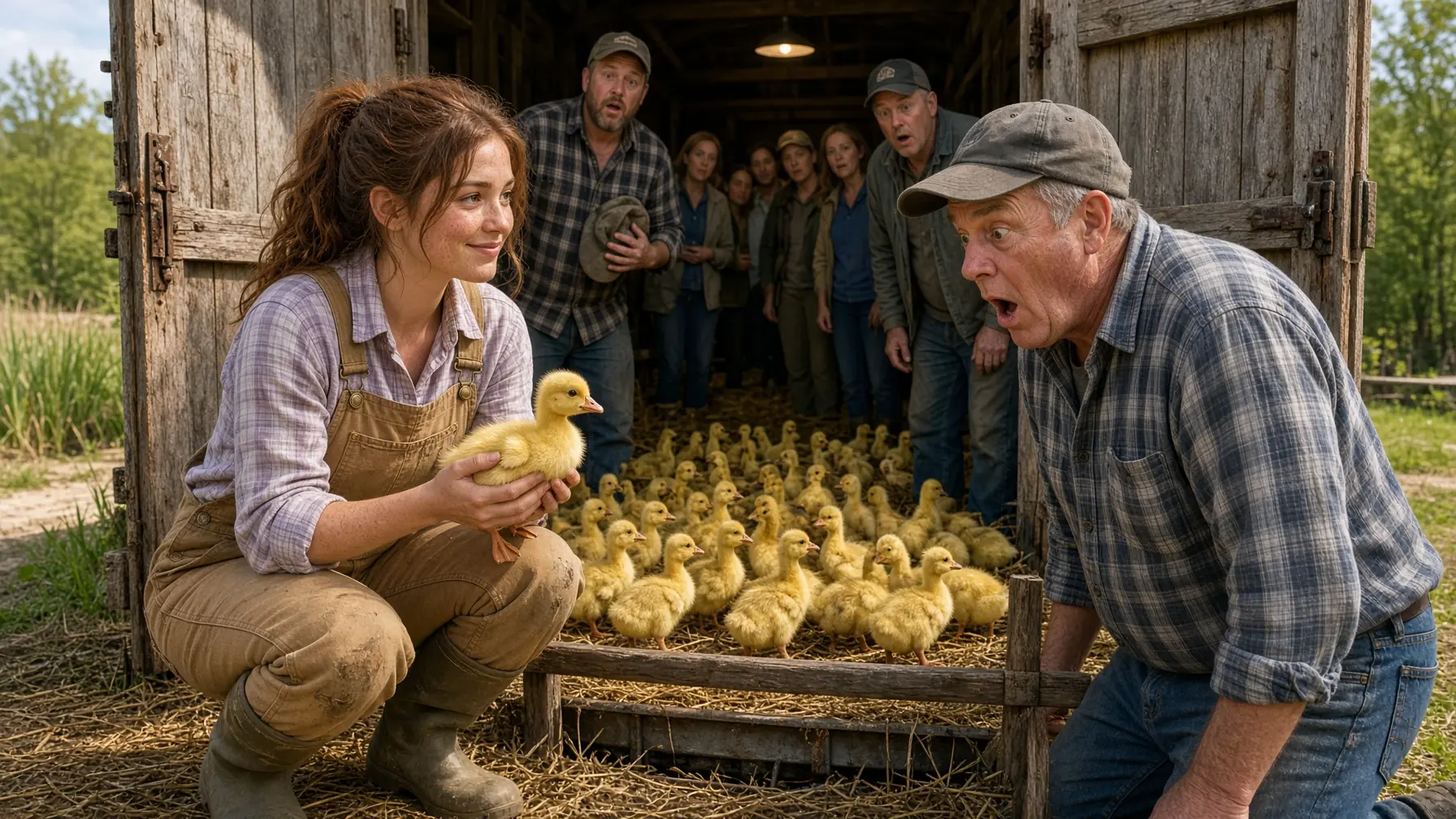
It was a small sound, nearly lost beneath the wind moving through the reeds, but Rowan saw him hear it. His grin remained for another second, fixed awkwardly beneath the brim of his baseball cap, while the two men behind him glanced toward the wooden doors.
“Still babysitting those rotten eggs?” he had asked when she crossed the yard.
Now he watched her hands.
Rowan stood beneath the weathered lintel in muddy rubber boots, her faded lavender checked shirt visible above the front of her tan canvas overalls. At twenty-six, she was young enough that some people in Caldwell Flats still referred to her farm as her father’s place, even when they were standing on land she worked alone.
“You came all this way,” she said. “Take a look.”
The farmer folded his arms.
“Three hundred and fifty eggs out of a ditch. What a damn waste.”
Several townspeople had followed the three neighboring farmers through the open gate. They stood behind them beside the pasture fence, pretending they had stopped by out of ordinary curiosity, though Rowan recognized the woman who had called her experiment a public embarrassment outside the feed store.
Another chirp rose from inside.
Then several more.
Rowan rested both hands on the door handles.
Before she pulled, she looked toward the narrow kitchen window across the yard. From here she could just see the corner of a notebook lying open on the table.
Its first page contained a number written in pencil.
For weeks, that number had followed her everywhere. It had been repeated at the feed counter, across neighboring fences, in the grocery checkout line, and once by a stranger who thought she would find the joke funny.
But the first time Rowan wrote it down, nobody had been laughing.
She had been sitting on her kitchen floor with ditch water drying on her sleeves, trying to decide which eggs she could afford to give a chance.
The rain had stopped less than an hour earlier.
Outside, water still ran across the gravel road in thin brown streams. The drainage ditch beside the lower pasture had overflowed overnight, carrying reeds, branches, a broken feed sack, and pieces of pale molded trays into the grass.
Rowan had gone down there to clear the culvert.
She had taken a shovel, a length of hooked wire, and the last pair of work gloves without holes in the fingers. The morning had already begun badly: the tractor battery was weak, a section of fencing needed repair, and the barn’s rear gutter had come loose enough to knock against the wall whenever the wind shifted.
She had been halfway down the pasture when she saw the first egg.
It rested against a clump of flattened grass, larger than a chicken egg, its pale shell streaked with mud. At first she assumed it had washed down from a nest.
Then she found another.
Then a third, held in the fork of a twig.
She followed the scattered pieces of tray toward the road.
Beyond the culvert, where the ditch curved behind a line of leafy trees, eggs lay clustered among the reeds. Some were broken. Some had disappeared beneath shallow water. Others remained lodged in sections of packing tray that had caught against the bank.
Rowan put down the shovel.
A battered truck was parked farther up the road, its rear doors open. Two men were collecting damaged cartons from the shoulder, moving with the dull impatience of people who had already decided the morning was beyond saving.
One of them saw her looking.
“Stay out of there,” he called. “There’s broken shell everywhere.”
“What happened?”
“Load shifted. Some went out when we opened up.”
He pointed toward the mud as though the explanation should end the conversation.
Rowan picked up a tray fragment with four unbroken eggs still seated inside it.
“What kind?”
“Goose.”
She looked back toward the ditch.
The man wiped his hands on his trousers. “They were headed for a hatchery. Been sitting out here since before daylight. Don’t get any ideas.”
“Were they being incubated?”
He gave her a tired look.
“They were hatching eggs. That’s all I know.”
The other man came over carrying a crushed carton. He inspected the eggs in Rowan’s hands, then shook his head.
“We’re writing off what hit the ditch.”
“So you’re leaving them?”
“We’re collecting the packaging.”
He said it without cruelty. To him, the eggs were damaged cargo, and the cargo had become somebody else’s paperwork.
Rowan looked at the mud-covered shells again.
“How long were they in the water?”
Neither man answered directly. One said the accident had happened during the rain. The other said some trays had landed above the waterline. Both repeated that there was no point.
Finally, the first man shrugged.
“If you want the intact ones, take them. We’re not putting them back on the truck.”
Rowan should have gone home.
She knew that afterward.
She should have cleared the culvert, repaired the fence, charged the tractor battery, and spent the day on work that would produce a predictable result. There were enough things on her farm already waiting for time and money she did not have.
Instead, she climbed down the bank.
The mud sucked at her boots. Water ran cold through the fingertips of her gloves. Every few steps she found another section of tray, another intact shell, another possibility she could not bring herself to leave beneath the reeds.
By the time the neighboring farmer drove past, she had filled a plastic crate.
He slowed his pickup beside the ditch and lowered the window.
“What are you digging for?”