When two pickups unloaded containers of crushed eggshells beside Clara Bennett’s barn, her neighbors came over to laugh. They called it garbage, said she was paying for it with her tomatoes, and waited for her to admit that she had made a mistake. Clara knew the shells would give her more work before they gave her anything else—but there was one small part of the pile nobody could see.
“Lady, you let them dump all their garbage here?”
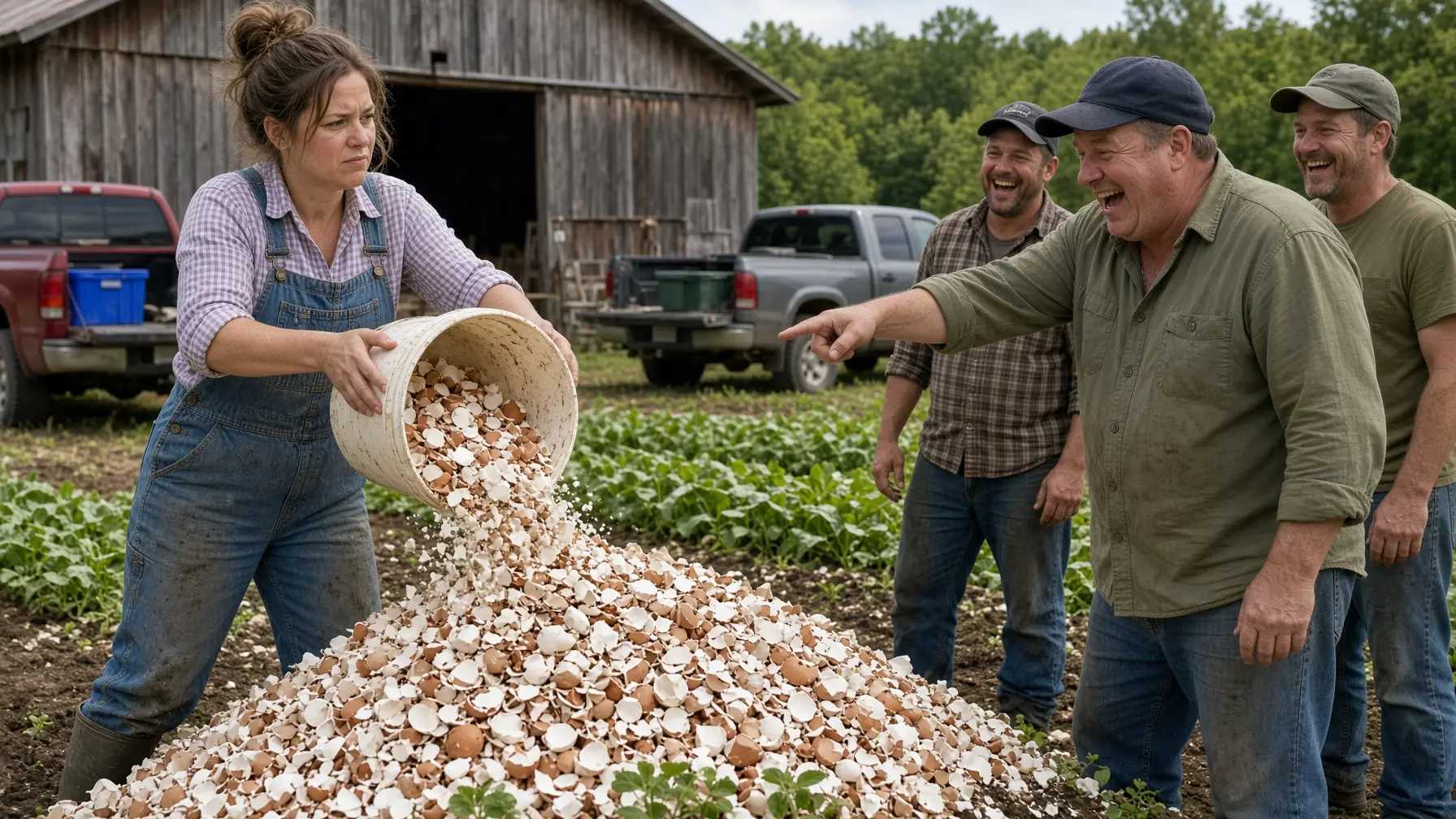
Mike pointed at the growing mound while Clara tipped another container.
The shells rattled against one another, pale fragments sliding over the top before scattering down the sides. Dust clung to the cuffs of her faded lavender checked shirt, and a thin piece of shell caught against the front pocket of her denim overalls.
She shook it loose.
Mike laughed.
Beside him, one of the two neighboring farmers folded his arms and grinned.
“Hell, she’s paying them in tomatoes.”
Clara set the empty container on the ground.
At thirty-eight, she had become good at recognizing when a question was not really a question. Mike had not come to find out what she was doing; he had brought an audience to make sure everyone remembered his reaction.
“It’s free,” she said. “And I’ve got a use for it.”
Mike tipped his navy cap back.
“What, growing chickens?”
The men laughed.
Clara looked at him for a moment, then turned toward the next container.
One of the pickup drivers stood on the tailgate, waiting to pass it down. He had stopped smiling when Mike’s laughter began, but Clara gave him a nod that meant he should continue.
The container was heavier than the last.
She took it with both hands and carried it toward the pile.
Mike watched.
“You know free doesn’t mean useful.”
“I know.”
“Then why take it?”
Clara put the container down.
“If you want an answer, I’ll give you one. If you want another joke, you’ve already got two men helping.”
The second farmer’s grin faded slightly.
Mike looked toward the green crop rows beyond the barn.
He was around fifty-five, stocky, wearing an olive work shirt and jeans that had been washed enough times to turn soft at the knees. He had farmed in the area longer than Clara had been an adult, and he treated that fact as a qualification for nearly every conversation.
“I’m trying to save you some trouble,” he said.
Clara glanced at the enormous pile.
“You came after the trucks arrived.”
“Well, I couldn’t save you from saying yes.”
“No.”
She picked up the container again.
“But you can save me some time by letting me finish.”
The driver lowered his eyes to hide a smile.
Mike saw it.
His expression hardened, and Clara regretted giving him another person to resent. She had work to do; she did not want the afternoon to become a contest over who could make whom feel small.
She emptied the container.
More fragments slid down the mound.
From the barn doorway, the old radio she used while working played so quietly that she could barely distinguish the voice from the birds. The farm around them remained green and busy, with hoses laid beside the vegetable beds, crates stacked under cover, and leaves shifting along the tree line.
Nothing about it looked abandoned.
Nothing about Clara looked idle.
Still, Mike kept glancing at the eggshells as though they explained the whole place.
One of the neighboring farmers asked, “How much are you getting?”
“This load,” Clara said.
“Just this?”
“For now.”
Mike gave a short laugh.
“For now. That’s how it starts.”
Clara looked at him.
“How what starts?”
“People finding someone who’ll take what they don’t want.”
She felt the remark more sharply than the chicken joke.
That possibility had occurred to her.
It was one reason she had asked questions before agreeing to the delivery. It was also one reason she had decided she would take a single load before committing herself to anything larger.
But Mike’s voice made caution sound like something only he possessed.
She wiped her palms against her overalls.
“I said yes to these shells. I didn’t say yes to being anyone’s dumping ground.”
Mike shrugged.
“Hope they heard the difference.”
“They did.”
He looked toward the drivers.
Neither answered.
Clara did not ask them to defend her.
She collected another container.
The men stayed several more minutes, repeating the same few concerns with different words. Then Mike announced that some people had actual work to do and led the others back toward their vehicles.
Clara watched them leave.
The younger driver looked at her.
“You want us to stop?”
She turned.
“Why?”
He nodded toward the departing farmers.
Clara looked at the half-empty pickup bed.
Then at the pile.
“No,” she said. “I want us to finish what we agreed.”
He nodded.
They went back to unloading.
By the time the last container was empty, Clara’s shoulders ached.
That was the first cost of the free material.
Not money.
Time, effort, and a part of the afternoon she had meant to spend checking the irrigation lines.