In the blistering summer of 1971, beside a cracked dry pond on a failed fifty-acre farm in southern Louisiana, twenty-three-year-old Marie Fontenot knelt in the first shallow pool created by her battered diesel pump and released a handful of live crawfish into the muddy water. Sweat darkened the back of her cream cotton blouse, her faded overalls were caked with clay, and loose strands of auburn hair clung to her sun-warmed face. Behind her, several older farmers stood beside a rusted pickup truck, watching as though they had gathered for the burial of her last good idea.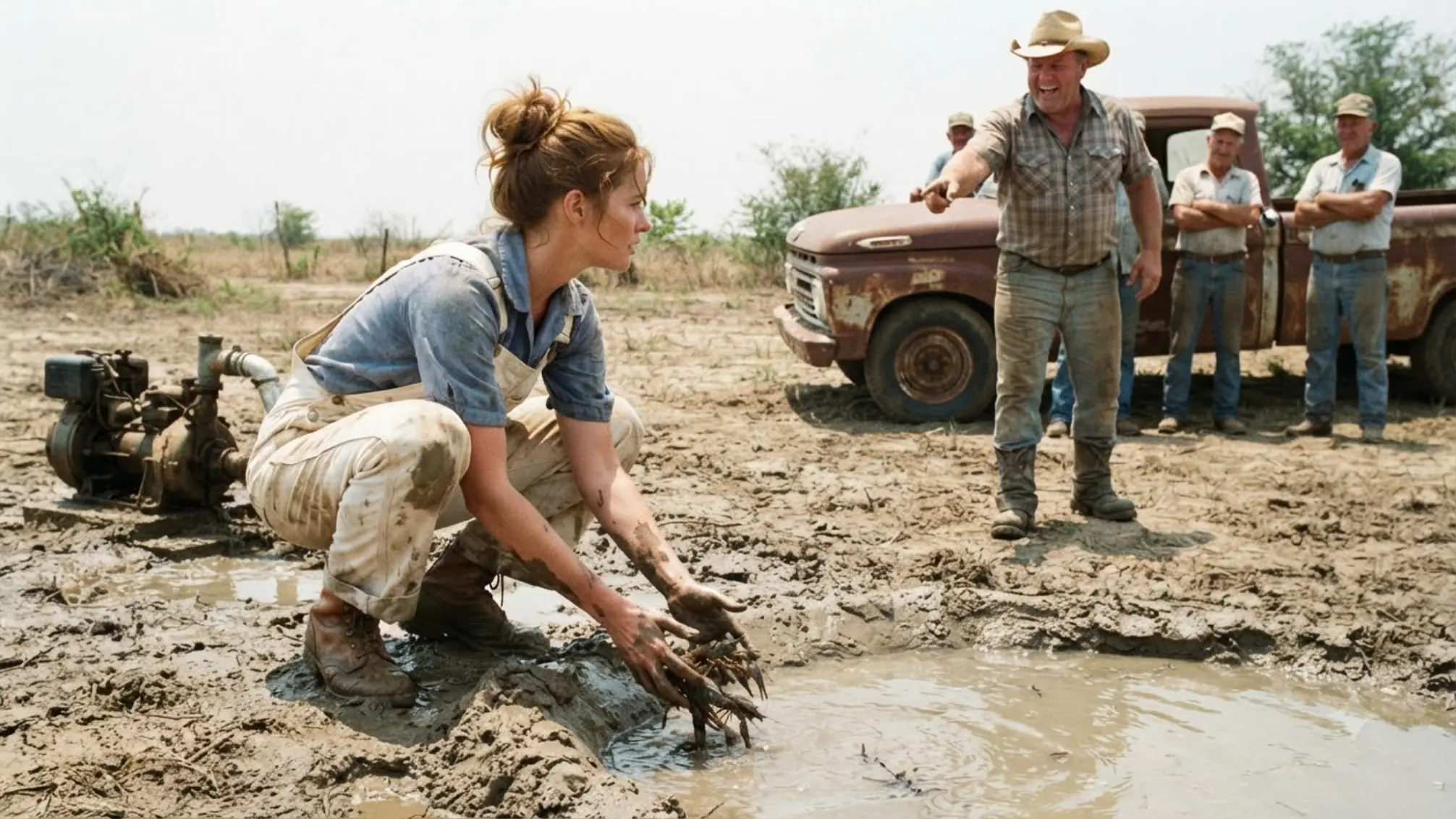
The men laughed harder after that.
They did not laugh because Marie’s idea was amusing. They laughed because certainty felt safer when shared by a crowd. Every man standing beside that truck had spent his life learning the accepted rules of farming in St. Martin Parish. Cotton required one kind of soil, soybeans another, and rice needed fields built to hold water without drowning the roots.
Marie’s land seemed designed to fail at all three.
The property had once belonged to Silas Marceaux, a tired farmer whose face carried years of disappointment. He had planted cotton first, then soybeans, and watched both crops rot during wet weeks before the summer sun hardened the ground into pale plates. The fifty acres were covered with shallow basins that trapped water just long enough to damage a crop, then cracked open when the heat returned.
At the center lay the ghost of an old pond.
Silas called the ground gumbo crack.
“Ain’t nothing ever grown here but heartache,” he told Marie when she came to see the property. “This soil don’t forgive.”
Marie walked the boundary alone. She examined the slope, the clay, the water stains on distant cypress trunks, and the shape of the low fields. Where Silas saw failed drainage, she saw natural containment. Where everyone else saw a dried pond, she saw a vessel waiting to be filled.
Nearly every dollar she possessed went into the purchase.
The title was signed on the tailgate of Silas’s pickup without lawyers, celebration, or witnesses beyond the notary. He accepted her cashier’s check so quickly that it looked as though she had handed him freedom rather than money. As he drove away, Marie heard him chuckling through the open window.
She stood alone in the dust, holding the deed to land no one else wanted.
A year earlier, she had owned half of a productive farm with her husband, Paul Fontenot. At least, she believed she owned half. Marie rose before dawn, kept accounts, repaired irrigation gates, harvested beside the hired men, and cooked meals large enough to feed the entire crew.
When the marriage ended, the land remained with Paul.
His family’s name appeared on the original deed, and the local attorney explained that years of Marie’s labor did not give her the legal ownership she assumed marriage had promised. Paul kept the dark soil, the tractor, the storage shed, and the farm equipment. Marie left with several dresses, a small portion of the joint savings, and a dusty wooden box filled with her grandfather’s journals.
Paul considered the notebooks worthless.
Marie did not.
Her grandfather, Joseph Arseneaux, had been an unusual farmer even by Louisiana standards. He kept records of rainfall, moon phases, insect cycles, soil color, and the dates crawfish first appeared along drainage ditches. His journals contained few calculations about profit, but page after page described how living systems responded to drought, flooding, decay, and renewal.
“The land is not your enemy,” he used to tell Marie. “Most men fail because they spend all season shouting orders at something older than their name.”
Joseph believed every field functioned like a body. Waterways were veins, soil was flesh, and decaying plants returned nourishment rather than becoming waste. He listened before planting. His neighbors called him peculiar until his harvests arrived.
The night after Marie purchased the property, she spread his notebooks across the floor of her rented room. A bare bulb hung overhead, illuminating faded leather covers and the elegant handwriting of a man dead nearly eight years. Marie read until the sounds of the town disappeared outside her window.
Near midnight, she found an entry dated 1934.
That summer had brought one of the worst droughts her grandfather remembered. His neighbors sold cattle cheaply and abandoned cracked ponds they considered useless. Joseph had written:
A vessel remains a vessel when it is empty. The water will return. The question is what you will have waiting when it does.
Marie read the passage three times.
Then she found his notes on rice fields and crawfish.
Rice grew during the warm months in shallow flooded ground. After harvest, farmers usually drained the fields and considered the remaining stalks waste. Joseph observed that when water returned over the cut rice stubble, the decaying plants fed insects, microorganisms, and crawfish.
One field could produce rice in summer and crawfish in winter.
The rice would feed the crawfish. Their burrowing and waste would enrich the soil for the next rice crop. Instead of forcing the land to produce one harvest, Marie could build a cycle in which each season prepared the next.
The shallow basins everyone hated were already shaped for it.
Her land was not useless.
It had been misunderstood.
Marie spent part of her remaining money on a secondhand diesel pump that coughed black smoke whenever it started. She bought mismatched pipes and connected them from the bayou to the largest dry basin. For weeks, she repaired weak levees by hand, lifting wet clay with a shovel and packing it beneath the sun.
The work was brutal.
Her palms blistered until the skin split. Her back ached each morning before she left bed. Mosquitoes surrounded her at dusk, and mud pulled at her boots until every step felt like a struggle against the field itself.
People slowed their trucks along the parish road to watch.
Some shook their heads. Others waved with exaggerated sympathy. A few men offered to purchase the land for less than Marie had paid, explaining that they were trying to save her from losing everything.
She refused each offer.
The day the pump finally sent water flowing into the basin, Marie stood ankle-deep in the mud and listened. The gurgling pipe sounded rough, mechanical, and imperfect. To her, it was the first note of a song no one else could hear.
Water alone would not create a crop.
Marie still needed rice seed, fuel, and several sacks of brood crawfish. Her savings were nearly gone, so she visited the parish farmers’ cooperative and asked for a small line of credit.
The co-op manager, Étienne Boudreaux, wore authority like a pressed shirt. He had spent twenty years approving loans for established farmers who planted familiar crops in familiar fields. Marie sat across from his desk and explained the entire system carefully.
She described the summer rice.
She described re-flooding after harvest.
Then she explained how the crawfish would feed on the decaying stubble and create a second winter income.
Boudreaux leaned back and sighed as if a child had asked him to finance a toy.
“Your former husband plants what works,” he said. “He listens to the agricultural extension office. He uses proper fertilizers and proper equipment.”
Marie remained still. “Paul has good land.”
“And you have fifty acres of sour mud.”
“I have shallow basins connected to a bayou.”
“You have failed drainage.”
“I can use it.”
Boudreaux leaned forward. “You want me to extend credit so you can fill a dead field with water and bugs.”
“Crawfish.”
“Bugs.”
The word was deliberate.
He told her the water would escape, the soil would remain too acidic, the rice would produce poorly, and the crawfish would disappear into the mud. Funding such a plan, he said, would violate his responsibility to the cooperative.
Marie gathered her papers.
At the door, Boudreaux softened his voice into something almost paternal. “You have already lost one farm. Don’t lose what little you have left trying to prove something.”
Marie turned back.
“I’m not trying to prove anything to Paul.”
“Then who?”
“The land.”
The bank rejected her next.
No collateral, no established yield, no husband, and no history of independent farm income. The loan officer advised her to seek employment at a cannery until she recovered financially.
Marie returned home and opened the shed where she kept her grandfather’s old pickup truck.
The paint had faded from blue to gray. The passenger door closed only when lifted from the handle, and the engine needed several attempts before starting. Joseph had taught her to drive in that truck.
Selling it felt like losing him twice.
She placed an advertisement anyway.
The money bought rice seed, fuel, and several sacks of brood crawfish from an old basin trapper named Lucien Darbonne. Lucien did not laugh at her plan. He only examined the field, spat into the mud, and told her she would need more patience than money.
“Crawfish don’t care about your schedule,” he said.
“Neither does rice.”
Lucien smiled. “Maybe you understand more than you look like you do.”
Marie planted the first ten acres by hand. She waded through warm shallow water, broadcasting seed in wide arcs while birds circled overhead. At night, exhaustion made her hands tremble too badly to hold a cup.
The rice emerged thinly.
Some areas remained bare. Weeds crowded the weaker plants, and one broken pipe allowed water to fall below the required depth for several days. By harvest, Marie’s yield reached barely half the parish average.
The farmers at the feed store needed no words.
Their expressions said they had warned her.
Paul came by once after hearing about the poor crop. He stood at the edge of the field wearing clean boots and looked toward the short rows.
“You could sell now,” he said. “Before taxes come due.”
“To whom?”
“I might take it.”
“For what I paid?”
He laughed. “It isn’t worth that anymore.”
Marie studied the man she once believed would grow old beside her. “Then why do you want it?”
Paul’s smile disappeared.
She walked away before he could answer.
After harvesting the rice, Marie re-flooded the basin. The cut stalks softened beneath the water and began breaking down. She placed handmade cylindrical traps throughout the field and marked each one with small white floats.
Winter arrived quietly.
While neighboring farms lay drained and brown, Marie crossed her field in a narrow flat-bottomed pirogue. Morning mist covered the water. Her first trap felt almost empty when she lifted it.
Two small crawfish clicked against the wire.
The second trap held one.
Cold doubt moved through her stomach.
Marie had spent nearly every dollar, sold her grandfather’s truck, and endured an entire year of ridicule. If the crawfish failed, she could not afford the next planting. Taxes would come due before spring.
She sat motionless in the pirogue.
For the first time, she wondered whether everyone had been right.
Then she remembered another line from Joseph’s journal:
The first season is a question. The land rarely answers loudly.
Marie reached for the third trap.
It resisted.
She pulled harder, expecting the wire to be caught in vegetation. When the trap broke the surface, water poured around a writhing mass of deep-red crawfish.
It was full.
Marie laughed aloud.
The sound traveled across the empty winter field.
The fourth trap was nearly as heavy. The fifth held fewer, but the sixth was packed. By noon, the bottom of the pirogue moved with clicking claws and red shells.
Marie brought the first harvest to a local seafood buyer.
He examined the crawfish skeptically, then selected several from the basket. They were large, clean, and healthy. He offered a price slightly above market and promised to purchase more if the quality remained consistent.
That winter, Marie harvested almost eight hundred pounds from the ten-acre basin.
It was not a fortune.
It was enough.
Enough to pay property taxes.
Enough to buy pump fuel.
Enough to purchase rice seed without asking Boudreaux for credit.
Most importantly, it proved the system could work.
The second year produced more rice because the soil had begun changing. Organic material from the previous crop softened the hard clay. Crawfish burrows improved water movement, and the field held moisture more evenly.
The winter harvest reached nearly fifteen hundred pounds.
Marie expanded into a second basin.
She never borrowed money. Profit from one pond funded the next. Every expansion moved more slowly than her ambition wanted, but it remained hers.
By the fifth year, all fifty acres participated in the cycle.
Marie grew rice through summer and harvested crawfish through winter. When rice prices fell, crawfish income protected her. When seafood buyers paid less, rice carried the farm.
Her costs stayed low.
She owned no massive tractor and no expensive combine. She purchased seed, fuel, replacement pipe, and wire for traps. Most of the fertility came from the system itself.
The land changed visibly.
The pale cracked surface became darker and softer. Frogs returned. Birds gathered around the flooded fields. Rice yields climbed until they matched the parish average, then exceeded it.
The men who once laughed began asking questions without admitting curiosity.
They slowed their trucks longer.
Some counted the white trap floats scattered across her winter ponds. Others asked buyers how many pounds Marie delivered. At the co-op, whispers replaced jokes.
Three thousand pounds one season.
Five thousand the next.
A restaurant supplier from New Orleans visited after hearing about the size and clean flavor of her crawfish. He walked the levees with Marie, inspected the water, and offered to purchase her entire winter harvest at a premium price.
Marie signed the agreement at her kitchen table.
Within two years, she built a simple house on the property using farm profits. Within four, she purchased another twenty acres of failed lowland from a farmer who had mocked her beside the first pond.
He did not laugh while signing the deed.
Paul returned after her name began appearing in agricultural newsletters.
He arrived in a new pickup and walked toward the porch with the confident smile he once used when expecting forgiveness.
“I always knew you were stubborn enough to make something happen,” he said.
Marie looked across the field. “You said the land was worthless.”
“I was trying to protect you.”
“You offered half what I paid.”
“That was business.”
“And this is my farm.”
Paul shifted uncomfortably. “We could work together.”
“No.”
“You haven’t heard what I’m offering.”
“I heard you when the field looked dead.”
He left without finishing his proposal.
The deepest vindication arrived seventeen years after Marie purchased the land.
A clean sedan bounced down her gravel drive one spring morning. Étienne Boudreaux stepped out wearing pressed trousers and polished shoes entirely unsuited for the mud.
Marie met him near the porch.
He removed his hat.
For several moments, he only stared at the green rice stretching across shallow shimmering water. Frogs croaked from the ditches, insects moved above the plants, and white floats marked traps being prepared for the next season.
“I reviewed your co-op accounts,” Boudreaux said. “You purchase seed and fuel. Very little fertilizer. No major equipment loans.”
Marie waited.
“Then I looked at your deposits.”
He turned the hat slowly in his hands.
“Your profit per acre is higher than the Prevost brothers. They farm more than a thousand acres with three new combines.”
Marie looked toward her fields.
Boudreaux finally met her eyes. “How did you know?”
“Know what?”
“That this would work.”
“I didn’t.”
His brow furrowed.
“I listened. I tested ten acres. I watched what changed. Then I expanded.”
“Everyone said the land was dead.”
“It was never dead.”
Boudreaux lowered his eyes.
Marie continued, “It was thirsty. It was hungry. People kept demanding that it become something it was not.”
He stood silently for a long time.
Then he said the three words Marie had never expected to hear from him.
“I was wrong.”
The admission carried seventeen years of certainty.
“I was wrong,” he repeated, “and I’m sorry.”
Marie nodded.
“If you ever need credit,” he said, “for land, equipment, anything—you come directly to me.”
She smiled, not cruelly, but with the peace of someone who had stopped waiting for permission long ago.
“Thank you, Mr. Boudreaux. But I don’t believe I’ll need it.”
Marie eventually expanded from fifty acres to one hundred and fifty, purchasing every parcel with cash. She never became the largest landowner in the parish, nor did she want to. Her strength came from efficiency, diversity, and understanding every corner of the farm she operated.
Farmers began visiting her openly.
They asked about water depth, trap spacing, rice varieties, and how long stubble should remain before re-flooding. Marie answered freely, even when the visitor had once laughed at her.
She did not teach them a trick.
She taught them to see the farm as a system.
Several neighboring properties adopted rice-and-crawfish rotation. Then more followed. Winter fields that once remained empty became covered with trap floats, creating another source of income for families vulnerable to unpredictable crop prices.
The practice spread throughout the region.
Years later, an elderly Marie sat on her porch beside a granddaughter with the same auburn hair she had worn twisted above her neck that first summer. Between them rested Joseph Arseneaux’s oldest journal.
Marie guided the girl’s finger across the faded handwriting.
“What did your grandfather leave you?” the child asked.
Marie looked over the flooded fields.
“Not land.”
“Money?”
“No.”
“A secret?”
Marie smiled.
“He taught me that empty and useless are not the same thing.”
Beyond the porch, workers lifted traps from a pond that Silas Marceaux once believed could grow nothing but heartache. Rice stubble moved beneath the water, crawfish clicked inside wire cages, and birds settled among the levees.
The men beside the rusted truck had looked at Marie and seen a young divorced woman wasting her last dollars.
They looked at the cracked basin and saw the ending of a failed farm.
Marie looked at the same ground and saw a beginning.
She did not defeat the land.
She stopped fighting it.
And the dry pond they mocked became the foundation of the most profitable farm system in the parish.