Della Voss had stopped explaining the goats to people who counted them before looking at them.
They saw fifty-five thin animals and the forty dollars she no longer had. They saw a twenty-four-year-old widow standing on a farm that needed more than she could afford to give it.
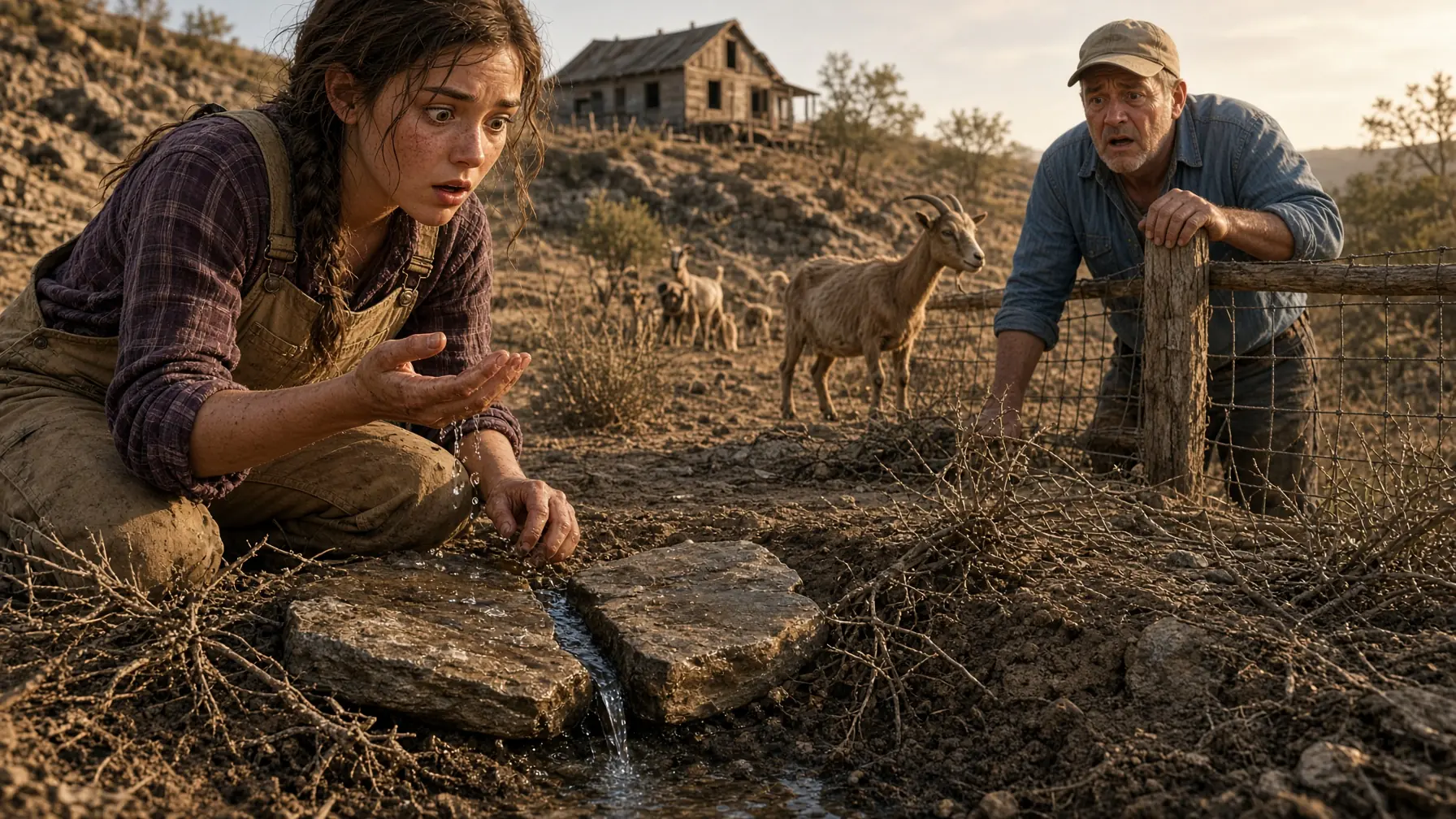
What they did not see was why she kept watching the eastern draw.
The goats went there first.
Not every one of them, and not always by the same route. But when she opened the grazing area, several worked their way toward the shallow fold in the hillside, disappearing between thorn bushes and tangled vines that had defeated more of her afternoons than she cared to count.
Della followed them with a small feed bucket in her hand.
She had no grand theory.
She wanted to know what they were finding.
That late afternoon, the neighboring rancher leaned against her wire fence and laughed at a goat chewing a thorny vine.
“Your last forty dollars,” he said. “For fifty-five dying goats?”
Della watched the animal pull.
The vine stretched.
A thorny length came free, exposing a small patch of bare earth near the draw.
“They eat what cattle leave behind,” she said.
The rancher looked at the rocky hillside.
He had heard her explanation before.
He was not there to reconsider it.
Three mornings earlier, Della had been sitting at the farmhouse kitchen table with an envelope open beneath her hand.
The house leaned slightly in ways visitors noticed and she had learned to work around. One window stuck in damp weather. A cupboard door would not remain closed unless she lifted it as she pushed.
There were more urgent repairs.
There were always more urgent repairs.
The envelope belonged to the pile that explained why most of them waited.
Della read the page again, though nothing on it had changed since the first reading. Numbers did not become kinder through repetition.
She knew what she owed.
She knew what was available.
The space between those facts was the problem.
On the table beside the letter sat a folded cloth, a half-empty cup, and the small collection of coins she emptied from her pockets the evening before. They looked absurd beside the amount printed on the page.
She gathered the coins anyway.
Not because she believed they solved anything.
Because she disliked leaving useful things scattered while telling herself she had nothing.
The forty dollars were in her wallet.
She counted them before putting them back.
Two bills.
Not enough to change the farm’s situation.
Enough to make one more ordinary purchase and return home with slightly less room to move.
She closed the wallet.
For a long time after her husband died, Della had treated every decision as something she needed to make correctly on the first attempt.
There was no second income of confidence.
No person at the other end of the table who could look at a mistake and say they would work around it.
She knew other people could help.
She also knew asking was different from having somebody already there.
At first, neighbors offered advice with genuine kindness.
Take your time.
Do not make any big decisions.
Let things settle.
Then bills continued arriving, and the same people began asking what she intended to do.
Della understood why.
Life could not remain suspended simply because she was not ready for it to proceed.
Still, she sometimes wanted to ask how she was supposed to take her time while everything else kept demanding an answer.
She folded the letter.
The paper had begun to soften along the same creases.
Then she put it away and went outside.
The eastern hillside waited beyond the fence.
Scrub covered ground that looked smaller from the porch than it felt when she worked on it. Thorn bushes caught at her sleeves. Vines tangled around other vines, hiding broken branches and loose stone beneath them.
She had tried clearing some by hand.
At the end of one long afternoon, she stepped back to look at what she accomplished.
A patch.
A small one.
Enough to prove she had worked.
Not enough to change the view.
That was when the neighboring rancher stopped along the fence.
He was around fifty, stocky, with gray stubble and a beige baseball cap that had faded more at the front than the back. His blue work shirt carried the relaxed wear of clothing chosen because he knew what the day would ask of it.
He looked at the cleared patch.
Then at the rest of the hill.
“You’ll wear yourself out.”
Della leaned on the tool in her hand.
“I noticed.”
He did not smile at the answer.
“You need equipment.”
“I need a lot of things.”
“Then start with what makes sense.”