“Lot seven.”
The auctioneer slapped one hand against the side of the faded green tractor.
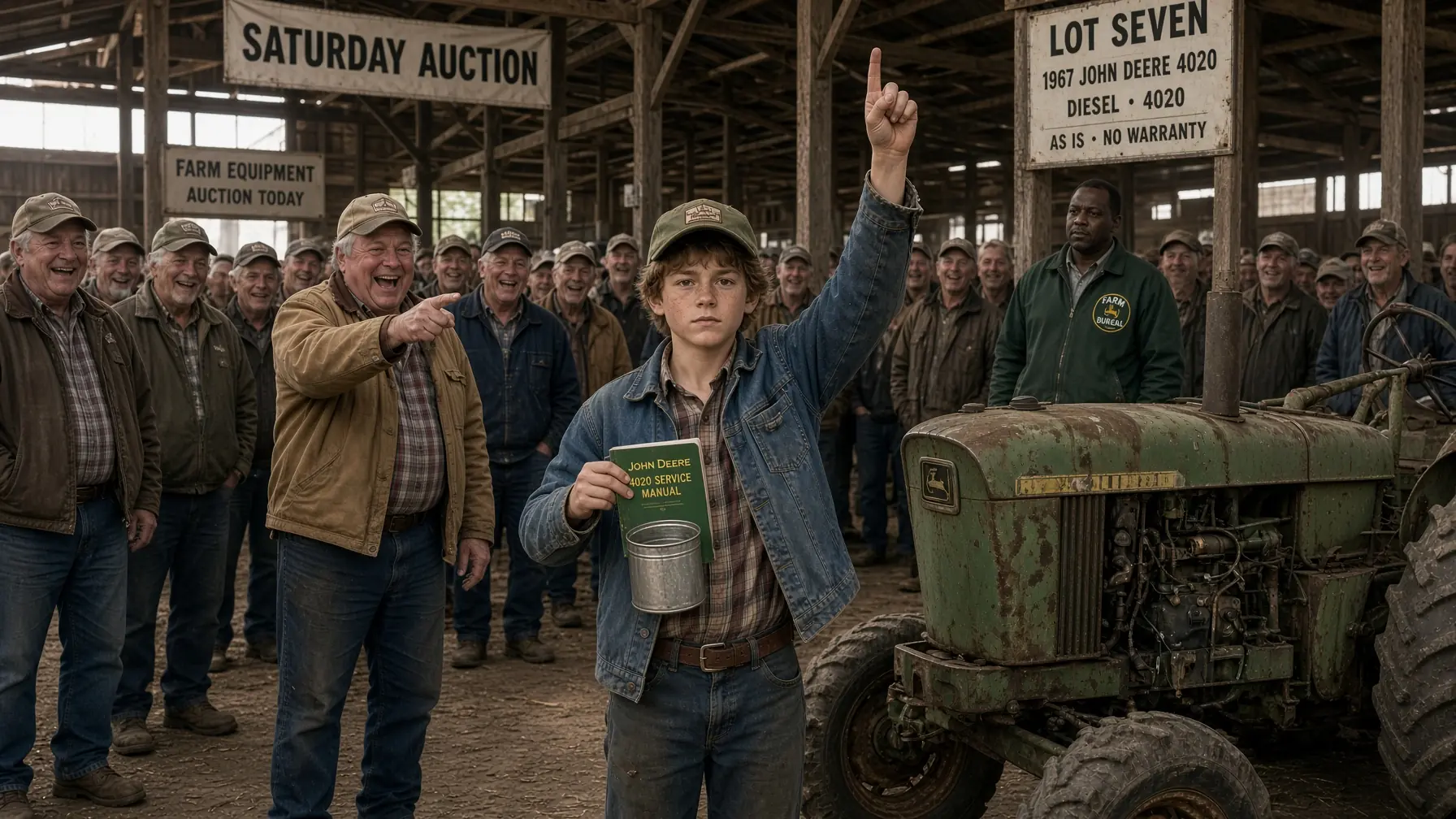
“1967 John Deere 4020.”
A few men in the barn immediately started smiling.
Everyone there already knew the machine.
Seized engine.
Rusted sheet metal.
Cracked rear tire.
Twenty years sitting behind an equipment shed without turning a wheel.
The auction listing did not even pretend otherwise.
PARTS ONLY.
The auctioneer looked over the crowd.
“Who’ll give me two hundred?”
Before anyone else moved, Floyd Meeker lifted his paddle.
“Two hundred.”
He laughed while saying it.
A few men around him joined in.
Floyd owned more equipment than half the farmers in Harmon County combined and enjoyed reminding people of it.
He pointed toward the John Deere.
“Scrap steel might cover the hauling.”
More laughter.
Then a hand went up near the center aisle.
Small hand.
Thin wrist.
Everybody turned.
A twelve-year-old boy stood beside an old metal tin.
The barn went completely quiet.
The auctioneer blinked.
“Son?”
The boy kept his hand raised.
“Two-fifty.”
For one second nobody reacted.
Then Floyd Meeker laughed so loudly the sound bounced from the rafters.
“Boy, that tractor hasn’t run in twenty years.”
The child looked at him.
No embarrassment.
No hesitation.
His name was Noah Price.
And when he answered, Floyd stopped laughing.
“I know exactly why it hasn’t run.”
Noah paused.
“And I know exactly how to fix it.”
At the back of the barn, James Okafor, director of the Harmon County Farm Bureau, lowered the auction program he had been reading.
For the rest of the sale, he barely watched the auctioneer.
He watched Noah.
Because twelve-year-old boys did not usually bid their savings against grown men for tractors older than their parents.
And they certainly did not speak about seized diesel engines as though they had already opened them in their minds.
What James did not know yet was that Noah had spent the previous three months preparing for that exact tractor.
And what nobody in the barn understood was that if Noah failed, his grandmother might lose far more than a few hundred dollars.
She might lose the farm.
My name is Noah Price.
I was twelve years old when I bought that tractor.
Four months earlier, my grandfather died.
His name was Earl Price.
Grandpa Earl had farmed ninety-five acres in Harmon County for most of his adult life.
Corn.
Soybeans.
Hay.
A few cattle.
Nothing glamorous.
It was the kind of farm where every machine had been repaired too many times and every tool had somebody’s initials scratched into the handle.
Grandpa knew every acre.
He knew which low field held water after a heavy rain.
Which fence post leaned every winter.
Which section of soil needed lime before the test results arrived.
And he knew machines.
Not the way dealership salesmen knew machines.
He knew them the way a man knows something after spending fifty years depending on it.
He could hear a tractor crank from across the yard and tell whether the battery was weak or the starter was dragging.
He could touch a hydraulic line after ten minutes under load and tell whether a pump was working too hard.
When I was nine, he taught me how to rebuild a lawn mower carburetor.
At ten, I helped him repair a generator.
At eleven, he let me tear down his old chainsaw engine by myself.
Whenever I rushed, he would tap the service manual with one finger.
“Read first.”
Whenever I guessed, he would say:
“Measure.”
Whenever something did not fit, he would tell me:
“Metal doesn't lie, Noah. People get impatient. Parts don't.”
The summer before he died, Grandpa spent six weeks teaching me one particular engine.
A 1967 John Deere 4020.
He did not own one anymore.
But he had an old service manual from his mechanic days.
The cover was stained with grease.
Pages were torn.
Several diagrams had his handwriting beside them.
At night we sat at the kitchen table while Grandma Ruth watched television in the next room.
Grandpa would open the manual.
“Tell me the fuel path.”
I would.
“Again.”
I would do it again.
“Now lubrication.”
Then cooling.
Injection timing.
Cylinder sleeves.
Compression.
We studied common failures.
He showed me how years of moisture could seize wet sleeves.
How diesel contamination could ruin an injection pump.
How an engine that looked completely dead might still have a sound crankshaft beneath the problem.
One evening I asked:
“Why are we studying a tractor we don’t own?”
Grandpa smiled.
“Because people throw good machines away when they don’t understand why they stopped.”
Then he tapped the page.
“Those old 4020s don't die easy.”
“What happens to them?”
“They get left behind.”
I remembered that sentence.
Especially after he was gone.
Grandpa Earl died in June 2023.
Suddenly.
No long goodbye.
No final lesson.
One morning he was working.
Then he wasn’t.
Grandma Ruth Price was sixty-eight.
After the funeral, everybody told her the same thing.
“Don't make any decisions yet.”
“Give yourself time.”
“Maybe lease out the farm.”
“Maybe sell some acreage.”
“Maybe this is your chance to slow down.”
But farms do not slow down because somebody is grieving.
Fence breaks anyway.
Cattle still eat.