The first man started laughing when Merritt Ashcom pulled the wooden ruler from her tool pouch. By the time she knelt beside the front wheel of the faded green Oliver 88, three more farmers had gathered behind him, and all four were openly enjoying what they believed was the funniest sight at the Sybert Sale Barn that summer. A fifteen-year-old girl in a denim jacket was measuring a tractor that men with thirty years of farming experience had already dismissed as scrap. Merritt heard every laugh, but she never looked away from the kingpin housing.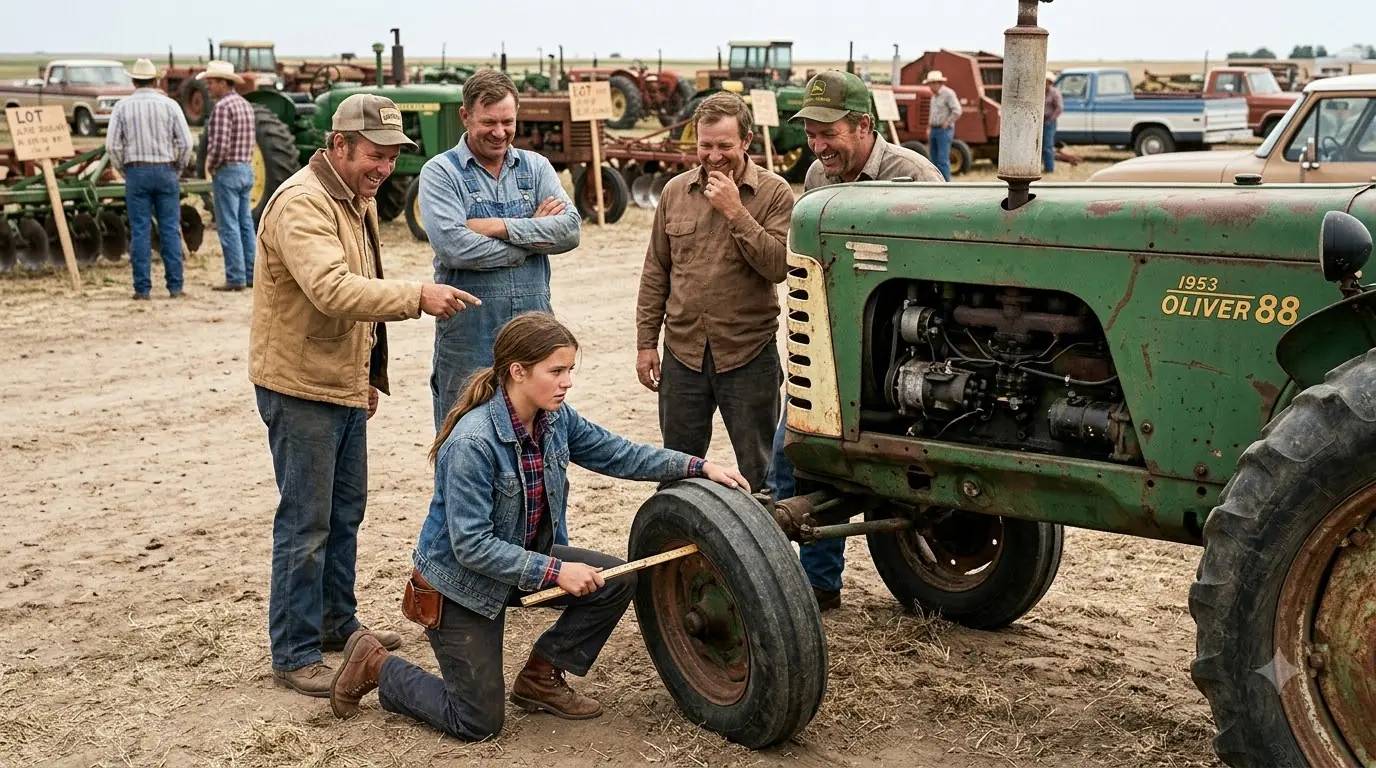
It was late July of 1978 in Sheridan County, Kansas, and the morning heat had already begun lifting dust from the auction yard. Rows of tractors stretched across the packed dirt: red Farmalls with sun-faded paint, old John Deeres with cracked seats, combines stripped for parts, cultivators, augers, pickups, wagons, and implements arranged beneath handwritten lot signs. Merritt had pedaled sixteen miles before sunrise on a green Schwinn bicycle to get there. In the basket on her handlebars she had carried a Folgers coffee can containing every dollar she had managed to save since she was eight years old.
Two hundred forty dollars. Mostly ones and fives, some tens, and three twenties folded flat at the bottom. To the farmers around her, it was a child’s savings. To Merritt, it might be the difference between keeping her family’s land and watching a banker place a foreclosure notice on it before winter.
Her family needed a tractor. Their Allis-Chalmers WD had thrown a connecting rod through the engine block in April, and the repair estimate was more money than Merritt’s mother could possibly spare. The Ashcom farm had a $3,200 loan coming due in October, and the only realistic way to make the payment was to harvest the wheat planted across the family’s 180 acres. No tractor meant no harvest. No harvest meant no loan payment, and no loan payment meant losing ground that Merritt’s great-great-grandfather had first broken with mules in 1897.
That arithmetic had followed Merritt during every mile of the bicycle ride. She had thought about her mother, Eleanor, sorting mail at the Hoxie post office before dawn and coming home at noon to handle farm books at the kitchen table. She had thought about her father, Clayton, who had died in a farm accident four years earlier when Merritt was eleven. And she had thought about her grandfather Elias Ashcom, the man who had taught her enough about machinery that she believed Lot Seventeen was not what everyone else thought it was.
The auction catalog described the tractor simply: 1953 Oliver 88 row crop, gasoline engine running, front axle showing impact damage, sold as is. Its estimated value was between $200 and $400. That description had scared away most serious buyers before the auction even began. A tractor with a bent front axle could swallow more money in repair work than the entire machine was worth.
Merritt had arrived an hour before registration because she wanted time with the tractor before the crowd became too large. She found Lot Seventeen parked near the end of the north row, its green paint faded, rear fenders scarred by decades of work, one section of sheet metal missing, and the front wheel leaning sideways at an angle that immediately suggested a violent collision. She did not begin with the engine. She began with the wheel.
She crouched beside the axle, opened her ruler, and measured the lateral displacement from the kingpin housing to the wheel flange. Four and one-quarter inches. Merritt checked it again. The second measurement was exactly the same.
That was when the first farmer laughed. He wore a tan canvas jacket despite the building heat and pointed directly at the crooked wheel as though Merritt needed help finding the obvious problem. “Girl, put that ruler away,” he called. “Anybody with eyes can tell you that axle’s ruined.”
The other farmers laughed. Merritt kept measuring.
A second man folded his arms over a faded denim shirt. “What are you going to do, measure it straight?”
The third shook his head. “Kids see somebody holding a wrench once and think they’re mechanics.”
The fourth man, wearing a dirty baseball cap, leaned toward the others. “Somebody better tell her tractors don’t care how hard you stare at them.”
Their laughter rose again. Merritt finally lifted her eyes from the axle and looked at them. Her face remained calm.
“You think the axle is bent?” she asked.
The first farmer slapped his thigh. “Honey, I don’t think it. I can see it.”
Merritt folded the ruler halfway. “Then you should bid on something else.”
The men laughed harder.
“What makes you so sure?” the man in denim asked.
Merritt glanced back at the wheel. “Because that displacement is four and a quarter inches.”
“So?”
“So the axle isn’t bent.”
The farmers stared at her for a moment, then burst out laughing again.
The first one pointed toward her. “Listen to this. Fifty years of farming says that tractor got hit hard enough to twist the front end, and she’s telling us a ruler says different.”
Merritt stood slowly. She was not tall, and the men surrounding her made her look even smaller, but she never backed away. “Then keep laughing,” she said. “You’re staring at eleven dollars and forty cents of damage and calling it a dead tractor.”
That changed the laughter. It did not stop completely, but it sharpened. Men nearby began turning toward the conversation because there was a difference between watching a child embarrass herself and watching somebody say something specific enough to be proven wrong.
The first farmer narrowed his eyes. “Eleven dollars?”
“Eleven forty for the bushing assembly,” Merritt replied. “Assuming the part price hasn’t changed much.”
“Bushing?”
“Kingpin bushing.”
The denim-shirted farmer looked toward the wheel again. “That wheel’s sitting four inches sideways.”
“Four and a quarter,” Merritt corrected.
“You just said that.”
“It matters.”
The farmers exchanged glances.
Merritt crouched again and touched the housing with two fingers. “Oliver had a problem in the 1952 and 1953 production years. High-hour tractors could develop lateral movement in the kingpin assembly. It looks exactly like impact damage if you don’t know the service bulletin.”
The man in the dirty cap stopped laughing first.
“What bulletin?”
“1956 field service bulletin. Paragraph three, subsection B.”
That was not an answer the men had expected.
Merritt reached into the canvas satchel beside her and removed a photocopied page from one of her grandfather’s binders. She did not hand it over. She simply held it against her knee and pointed to the paragraph she had memorized weeks earlier.
“Four to four-and-a-half inches of lateral wheel displacement,” she said. “No structural failure in the axle. Replace the kingpin bushing, inspect the housing, reset alignment.”
The farmer in denim stared at her. “Where’d you get that?”
“My grandfather.”
That name mattered in Sheridan County.
Elias Ashcom had farmed for more than forty years and had once been known throughout the area for being able to diagnose machinery by sound. He had served as a mechanic during the Second World War before returning to Kansas, and he maintained his own tractors long after many neighbors had begun relying almost entirely on dealerships. He believed a farmer who could not understand his equipment eventually became dependent on somebody else’s schedule, prices, and honesty.
Merritt had been the only grandchild who followed him into the equipment shed.
She had first wandered inside at eight years old while hiding from her older sisters. Elias was bent over the open hood of a John Deere B adjusting a carburetor. Without looking at her, he had asked for a three-eighths-inch wrench.
Merritt handed him the wrong one.
“That’s half-inch,” he said.
She stared at the tray.
“Try again.”
She did.
That second wrench was correct.
Nothing dramatic happened after that. Elias simply kept asking her to hand him things, and Merritt kept returning to the shed. By the end of that summer, she knew where every common wrench lived in his toolbox.
The next summer, he started explaining why he chose each one. Then he began explaining what he was doing with them. Carburetors, ignition timing, valves, compression, fuel delivery, cooling systems, bearings, tolerances, metal fatigue. Merritt discovered that machinery made sense to her in a way many other things did not.
Elias never praised her merely for being interested. If she made a mistake, he told her. If she guessed, he asked her to prove it. If she did not know, he expected her to say she did not know.
“Knowing what you don’t know,” he told her once, “is worth more than pretending you know everything.”
By twelve, he trusted her to perform compression tests under supervision. By thirteen, she was rebuilding carburetors. By fourteen, she could adjust valves with the slow precision required to avoid turning a small error into a large repair.
For her fourteenth birthday, Elias gave Merritt her own compression gauge. It was wrapped in brown paper, and he had scratched her initial into the brass handle. Merritt treated it like jewelry.
Elias died in October 1976 from a heart attack in his sleep. He was sixty-four. Merritt was thirteen.
After his funeral, she inherited his wooden red-oak toolbox and the service-bulletin binders he had accumulated over decades. Oliver, John Deere, Farmall, Allis-Chalmers, and dozens of manufacturers had sent dealers technical notices describing defects, field failures, updated repair procedures, and changes that rarely appeared in ordinary owner manuals. Elias had kept almost all of them.
At the bottom of his workbench, wrapped in wax paper, Merritt also found an envelope.
Her name was written on the front.
Underneath it, Elias had written: Open only when you need it most.
For twenty-one months, Merritt did not open it. She carried it occasionally, then returned it to a safe drawer. On the morning of the auction, she placed it inside the breast pocket of her brother’s old work shirt.
She still did not know whether that morning qualified as “when you need it most.”
Across the auction yard, another man had been watching Merritt examine Lot Seventeen. Boyd Tremaine was fifty-two years old, owned Tremaine Farm Equipment in Hoxie, and had spent nearly two decades selling new tractors to farmers across three counties. He wore a pressed white shirt, a bolo tie, polished boots, and a silver-banded Bulova watch.
Boyd had known Elias Ashcom.
They had never liked each other.
Years earlier, at a county wheat growers’ meeting, Elias had publicly criticized the aggressive financing of new machinery. He said some equipment dealers were not selling tractors so much as selling debt, convincing farmers to finance machines they did not need while their old equipment still had useful life.
Everyone knew which dealer he meant.
Boyd had never forgotten.
When Boyd saw Merritt beside the Oliver 88 with Elias’s old compression gauge, the resentment came back immediately.
“Well, look at this,” he said loudly enough for nearby farmers to hear. “Eli Ashcom’s granddaughter is playing mechanic.”
Heads turned.
Boyd walked closer.
“You know what that gauge is actually for, girl?”
Merritt stood.
“Yes, sir.”
“Or are you copying things you saw your grandfather do?”
Several men laughed.
Merritt looked at Boyd’s face.
“Would you like me to show you how to use it?”
For half a second, Boyd did not react.
Then the men around him laughed again, but this time some of them were laughing at him.
Boyd’s expression tightened.
Before he could answer, a seventeen-year-old boy stepped through the crowd.
Nolan Tremaine.
Boyd’s son.
Merritt knew Nolan from school.
A year earlier, during lunch, Nolan had mocked her family’s financial trouble loudly enough for several tables to hear. He had said the Ashcoms were going to lose their farm because Merritt’s father was dead and her mother could not handle the money.
Merritt had cried that day.
Nolan remembered.
He smiled at her now.
“Dad, don’t bother. Last year I told her they were going to lose the farm and she cried in the cafeteria.”
A few men laughed automatically.
Merritt felt heat move up her neck.
She was fifteen years old, standing alone among dozens of adult men while a classmate turned her father’s death and her mother’s financial problems into entertainment. Her first instinct was to walk away. Her second was to say something cruel enough to hurt Nolan the way he had hurt her.
She did neither.
She looked at him.
“I remember.”
Nolan’s smile widened.
Merritt continued, “I was fourteen.”
“So?”
“If you said it today, I’d handle it differently.”
Nolan waited for more.
None came.
Merritt knelt beside the tractor again and resumed checking the steering assembly.
The yard became strangely quiet.
Boyd looked at his son.
Nolan looked uncertain.
Neither had gotten the reaction they wanted.
From the shade of the sale barn, a man named Harlan Briggs watched everything.
Harlan was forty-eight years old and owned a small used-equipment business outside Hoxie. He walked with a pronounced limp and carried a cane because both bones in his right leg had been badly broken sixteen years earlier.
He knew Elias Ashcom better than Merritt realized.
When Boyd laughed at her, Harlan remained still. When Nolan mentioned the cafeteria, Harlan’s hands tightened around his cane. When Merritt answered without attacking him, Harlan finally started walking.
Merritt heard his cane before she saw him.
“You’re measuring for the bushing,” he said.
She turned.
“Yes, sir.”
“Four and a quarter?”
Merritt stared at him.
“How did you know?”
Harlan smiled faintly.
“Elias told me about that bulletin in 1963.”
Her expression changed immediately.
“You knew my grandfather?”
“I did.”
He nodded toward the Oliver.
“He once missed an Oliver 88 at an auction because he didn’t know about that defect. After he found the bulletin, he told me he would never make that mistake twice.”
Merritt looked down at the ruler.
Harlan studied her face.
“I’m not going to bid against you.”
She looked back up.
“Why?”
“Because I don’t want the tractor.”
“That hasn’t stopped some people.”
Harlan almost smiled.
“No. It hasn’t.”
Then his expression became serious.
“But you do have competition.”
He turned slightly and nodded toward the fence.
A man in a clean canvas work shirt and expensive boots stood about thirty yards away watching Merritt.
“Caldwell Meacham,” Harlan said. “North Platte, Nebraska.”
Merritt waited.
“He buys Oliver 88s.”