Everyone laughed when Clara Jennings planted dead sticks in the mud.
The men stood along the fence line in faded overalls and sweat-darkened caps, shoulders shaking beneath the April rain while Clara waded knee-deep through six inches of black water behind her grandmother's farmhouse. Two hundred gray-brown cuttings stood around her like the remains of some strange drowned orchard, leafless, crooked, and so lifeless that even Clara had to keep reminding herself why she had carried them there.
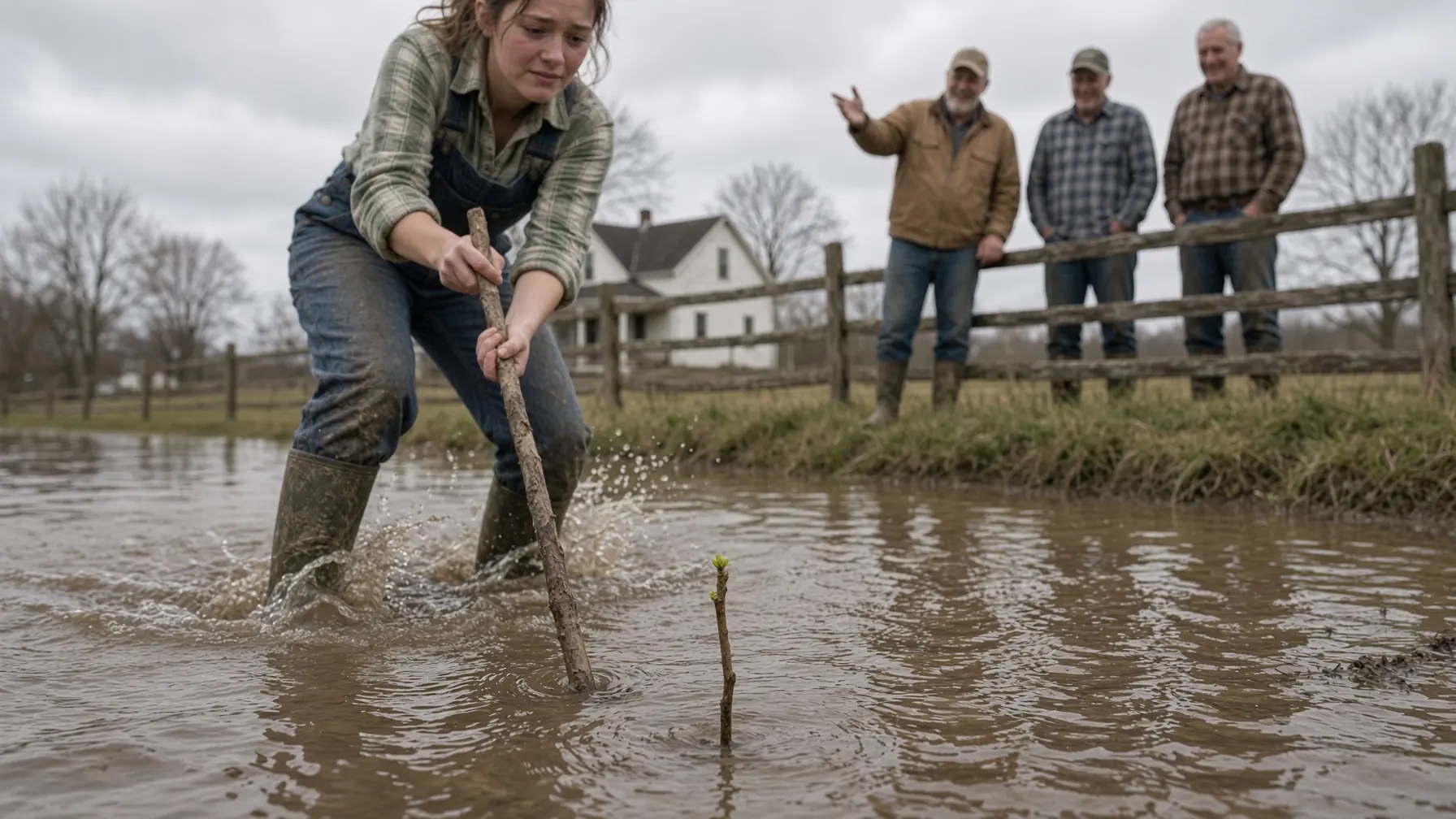
One of the men cupped his hands around his mouth. “You planning to grow fence posts, Clara?”
Another answered before she could. “Fence posts got a better chance. At least they know they're dead.”
The laughter rolled across the flooded bottomland.
Clara did not look up. She pushed another cutting into the mud until twelve inches disappeared beneath the surface, twisted it once the way her grandmother's note had instructed, then pressed the mud firmly around the stem with both hands.
She was nineteen years old, barely five feet two, with brown hair pasted to her cheeks by rain and a cotton dress hidden beneath borrowed farm overalls. Her hands were small, soft in the places a farmer's hands should have been hard, and by late afternoon both palms had split open where wet wood and grit rubbed the skin raw.
At the fence, Harold Vance wrote something on his clipboard.
The county extension agent had come in his government Ford after hearing that Evelyn Jennings's granddaughter was planting woody cuttings directly into standing floodwater. He wore rubber boots too clean for the field, thick glasses speckled with rain, and the expression of a man who had arrived not to learn what Clara was doing but to document why it was wrong.
He called to her once. “Miss Jennings, that's enough.”
Clara planted another stick.
Vance frowned and stepped closer to the water. “You're exposing dead plant material to anaerobic soil. If those cuttings aren't already gone, they'll rot before they establish anything.”
Clara kept working.
Someone at the fence said, “Tell her in plain English, Harold.”
Vance raised his voice. “They will die.”
This time Clara looked up.
Rain ran from the end of her nose. Behind Vance, the farmers waited for a reaction, and beyond them her father stood beside his truck with both hands shoved into his coat pockets.
Ben Jennings was not laughing.
That hurt more.
Clara wiped mud across her forehead without meaning to. “Then they'll die in the ground.”
Vance stared. “What?”
“They'll die in the ground instead of in my attic.”
“Your attic?”
Clara pushed herself upright. “My grandmother left them.”
That changed nothing for the farmers. If anything, it invited another ripple of amusement, because everyone in Mercer County remembered Evelyn Jennings, and almost everyone had a story about her.
Evelyn planted by moon phases when the almanac disagreed. She talked to rose bushes as if they were stubborn children. She saved rainwater in barrels when there was a perfectly good hand pump beside the kitchen door. Women in town had called her eccentric to her face and a witch when she was not there.