By the second week of October, the apples beneath the north block of Carter Orchard no longer smelled like apples.
The sweet, sharp scent of freshly picked fruit had disappeared days earlier. What remained was the heavy fermented smell of thousands of bruised Galas, Fujis, and Honeycrisps that had split open in the wet grass after almost two weeks of rain. Fruit flies hung above the worst piles, yellow jackets crawled through broken skins, and mice had begun appearing along the fence line before sunset. The Carters normally would have driven a tractor through the rows, swept the fallen fruit together, loaded it into wagons, and hauled it away, but the orchard floor had become too soft to support heavy equipment without tearing deep ruts through the soil.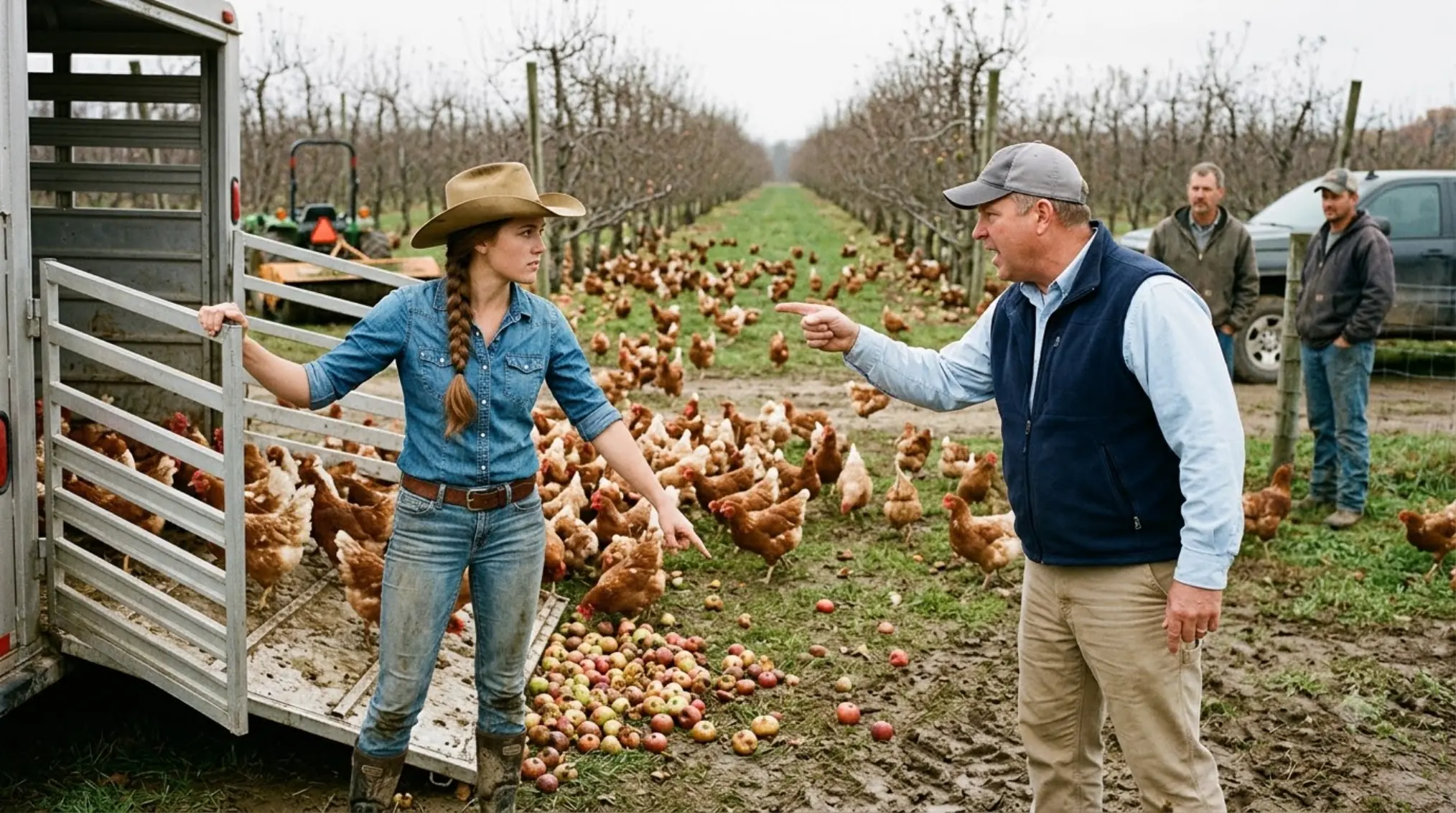
Emily Carter stood beside the open livestock trailer and watched her father look at the mud.
Mark Carter had farmed apples in western Michigan for most of his adult life. He understood tree spacing, pruning, spray timing, harvest crews, packing losses, fuel bills, storage temperatures, and the thousand ordinary problems required to keep 140 acres producing marketable fruit. What he did not understand was why his twenty-four-year-old daughter was preparing to release five hundred laying hens beneath the trees his father had first planted in 1968. Emily understood exactly why, which was why she lifted the trailer latch before Mark could ask her one more time whether she was certain.
The first chickens rushed down the ramp in a noisy brown-and-white wave.
Within seconds, the narrow orchard lane filled with flapping wings, scratching feet, and sharp bursts of clucking. Some birds immediately pecked at the fallen apples, opening bruised skins and scattering fruit pulp into the grass. Others chased insects that fled from beneath the rotten fruit, while several hens scratched through damp leaves around the tree rows. Emily stood at the trailer gate in a denim shirt, faded jeans, muddy boots, and a worn tan hat, watching the flock begin doing exactly what she had spent months predicting on paper.
A pickup stopped on the county road.
Then another slowed.
By afternoon, Mark had received three phone calls.
One neighbor asked if the chickens had escaped.
Another asked whether Emily had finally lost her mind.
The third caller laughed so hard that Mark held the receiver away from his ear.
Emily heard about the calls over dinner.
She did not look surprised.
Her mother, Susan, set a casserole on the table and glanced from Mark to Emily.
“Well?”
Mark sat down.
“Well what?”
“What do you think?”
Mark reached for his fork.
“I think there are five hundred chickens in my apple orchard.”
Emily looked at him.
“You agreed to the trial.”
“I agreed to twelve acres.”
“That’s where they are.”
Mark gave her a long look.
“I did not agree to becoming county entertainment.”
Emily smiled faintly.
“That part was free.”
Susan covered a laugh with her napkin.
Mark did not.
The chickens were only the visible part of an idea Emily had been carrying for years.
She had grown up in the orchard.
By ten, she could identify varieties before the fruit fully colored. By fourteen, she could drive a tractor between rows without clipping a branch. By sixteen, she had decided farming was the last thing she wanted to do with her life, which Mark accepted with the resignation of a father who understood that children sometimes needed distance before they could see what they had inherited.
Emily left for college.
She studied environmental systems, a phrase Mark described to neighbors as “something involving dirt and spreadsheets.”
During her final year, she worked on an agricultural waste project.
The project examined everything farms paid to remove.
Spoiled vegetables.
Cull fruit.
Manure.
Crop residue.
Food-processing waste.
Emily became obsessed with a simple question.
What made something waste?
Was it useless?
Or had the system surrounding it simply lost a way to use it?
That question followed her home.
Every autumn, Carter Orchard produced thousands of pounds of fruit that could not be sold.
Some apples fell before picking.
Some bruised during windstorms.
Some were damaged by insects.
Some were too small.
Some ripened too quickly.
Some were simply not worth paying a worker to pick.
The Carters saw those apples as a sanitation problem.
Emily saw calories.
Water.
Insect habitat.
Organic matter.
Nutrients pulled from the orchard soil and packed into fruit that the farm then paid to remove.
A few miles away, the Carter family also kept laying hens.
Those birds ate purchased feed.
Their manure accumulated in concentrated areas and had to be managed.
The eggs were sold at farm markets and several local stores.
On the accounting books, the orchard and poultry flock were separate operations.
To Emily, they looked like pieces of one unfinished system.
The orchard produced food it could not sell.
The chickens needed food.
The orchard had weeds and insects.
The chickens scratched weeds and hunted insects.
The orchard needed fertility.
The chickens produced manure.
The poultry property had concentrated waste.
The orchard had acres of ground where that fertility could be distributed naturally.
Emily drew the first plan at the kitchen table in February.
Mark was reviewing equipment costs.
Susan was sorting invoices.
Emily placed a folded orchard map between them.
“I want to move the laying flock through the orchard after harvest.”
Mark did not answer immediately.
He looked at the map.
Then at Emily.
“How many birds?”
“Eventually, five hundred.”
“You want to put five hundred chickens under apple trees.”
“Yes.”
“Why?”
“To clean fallen fruit, eat insects, reduce weeds, spread fertility, and lower feed use.”
Mark glanced toward Susan.
She continued sorting invoices as if nothing unusual had been said.
“We own sweepers,” Mark replied.
“They burn diesel.”
“We own mowers.”
“They burn diesel.”
“We have spray programs.”
“I know.”
“And we already have chickens where chickens belong.”
Emily opened a folder.
Mark leaned back and closed his eyes.
Susan stopped sorting invoices.
The folder changed the mood.
Emily’s grandfather had loved folders because folders meant numbers, receipts, maps, maintenance records, and enough preparation to make an easy refusal difficult. Emily had inherited the habit.
She laid out her plan.
Portable electric fencing.
Mobile coop.
Water trailer.
Predator netting.
Rotation schedule.
Food safety timing.
Soil protection.
A withdrawal period keeping birds out of the orchard months before the next harvest.
She had already contacted an extension specialist.
She had spoken with a poultry veterinarian.
She had worked out how long birds could stay in each paddock before scratching became excessive.
Mark read several pages.
Then he reached the question that mattered most to him.
“How much?”
“About eleven thousand dollars to set it up properly.”
Mark laughed once.
Not because it was funny.
Because it was painfully specific.
“And how much does eleven thousand save us?”
Emily met his eyes.
“I don’t know yet.”
Mark pushed the folder away.
“Then this isn’t a business plan.”
“It’s a trial plan.”
“That means you don’t know.”
“Correct.”
Mark stared at her.
Emily slid the orchard map back toward him.
“That’s why I’m asking for twelve acres, not one hundred forty.”
The kitchen became quiet.
After nearly a minute, Mark tapped the north block.
“You get this section.”
Emily smiled.
Mark raised one finger.
“You track everything.”
“Agreed.”
“Labor.”
“Yes.”
“Fuel.”
“Yes.”
“Feed.”
“Yes.”
“Eggs.”
“Yes.”
“Bird losses.”
“Yes.”
“Repairs.”
“Yes.”
“And if they damage irrigation lines, dig around tree roots, attract predators, create a food-safety problem, or destroy ground cover, the trial ends.”
“Agreed.”
Mark pointed at her.
“And I am not chasing chickens through an apple orchard.”
“Agreed.”
That promise lasted less than three weeks.
The first person outside the family to hear about Emily’s plan was Ray Donnelly.
Ray had advised commercial orchards in the county for almost thirty years.
He was not careless.
He was not stupid.
He knew insect pressures, fungal diseases, spray windows, chemical rates, and the timing mistakes that could destroy an entire year’s crop.
But Ray trusted tools with predictable inputs and outputs.
A sprayer released a known amount.
A mower cut at a chosen height.
A chemical targeted a specific pest.
Five hundred chickens did none of those things neatly.
Ray heard about Emily’s trial at a growers’ meeting in March.
“You’re doing what?”