“Sold for thirty-five dollars.”
The auctioneer’s gavel cracked against the wooden block, and laughter spread across the old freight depot before the echo died. Twelve-year-old Eli Hart stood at the edge of the crowd with his bidding hand still half-raised. He had just spent thirty-five dollars of the forty-one he owned on an enormous iron safe that four grown men could not have carried through the depot doors. Its door was chained shut with a brass padlock. The paint had peeled in black scales, rust crowded its seams, and the rotting oak skids beneath its feet looked older than Eli’s mother.
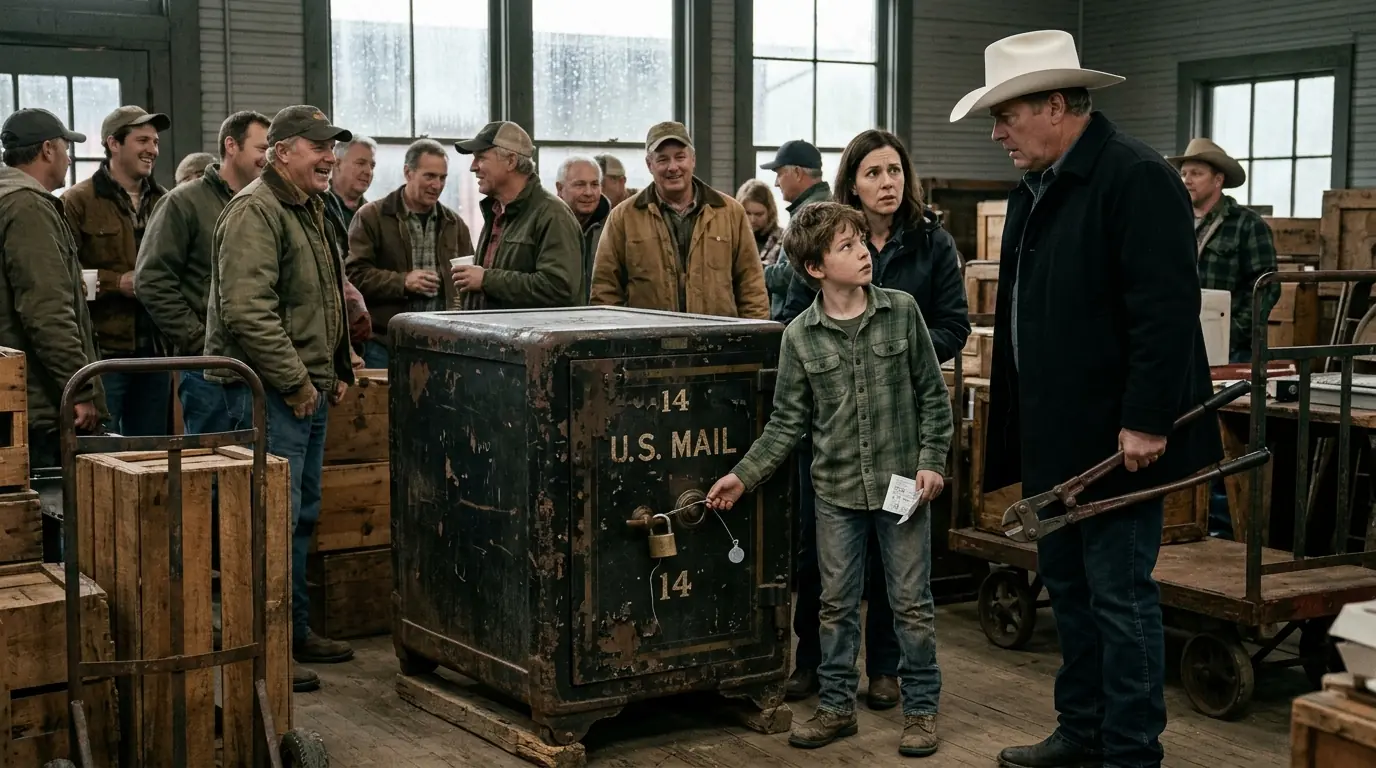
Gil Drummond tipped back a white Stetson so clean it appeared to have lived indoors. “Thirty-five dollars for a two-thousand-pound paperweight,” he announced. “Somebody call the boy’s mother before she hears about this.”
Laughter rolled under the high rafters. Men who had not bid a dollar on the safe enjoyed being suddenly certain what it was worth. Gil’s laughter carried above theirs because Gil owned the largest salvage yard in three counties and expected his opinions to travel farther than ordinary speech. He had been assessing rusty things in public for thirty years, and most people in Pike Hollow, Pennsylvania, gave him the last word on junk.
Eli lowered his arm. He had expected his mother to be angry; he had not expected the whole depot to take an interest in it. His ears felt hot, but he walked toward the platform and placed one palm against the safe’s cold iron door. Faded white stencil showed through the corrosion: U.S. MAIL. Beneath it was the number 14, not painted as decoration but once applied with official care.
The brass padlock was large enough to make the hasp look small. Through its shackle ran a twist of fine old wire ending in a gray lead button no larger than a quarter. The button was dull and pressed slightly crooked, its surface marked with impressions the crowd could scarcely see.
Gil came toward him with bolt cutters swinging from one hand. The steel jaws were broad enough to bite through the lock’s shackle if Gil leaned his considerable weight into the handles.
“Let’s see what the boy bought,” he said. “If a dead pigeon falls out, we’ll give it a funeral.”
Eli moved between him and the safe. He was slender, all elbows and determined eyes, and he knew the crowd could see how little physical difference his presence made. His voice was quiet anyway.
“Please don’t cut it, Mr. Drummond.”
Gil stopped, delighted by the chance to continue the show. “Afraid of what’s inside?”
“No, sir.” Eli glanced toward the lead button. “I need the lock to stay exactly as it is.”
The response puzzled some people and entertained others. Lyle Pruitt, the auctioneer, tapped his pencil on the sale sheet and called over the noise, “It’s yours, son. But the wrecking company takes this building Monday. Everything has to be out by four tomorrow afternoon.”