Nobody wanted the truck.
Not for eight hundred dollars.
Not for five hundred.
By the time the county auctioneer dropped the opening bid again, most of the farmers had already stopped looking at it.
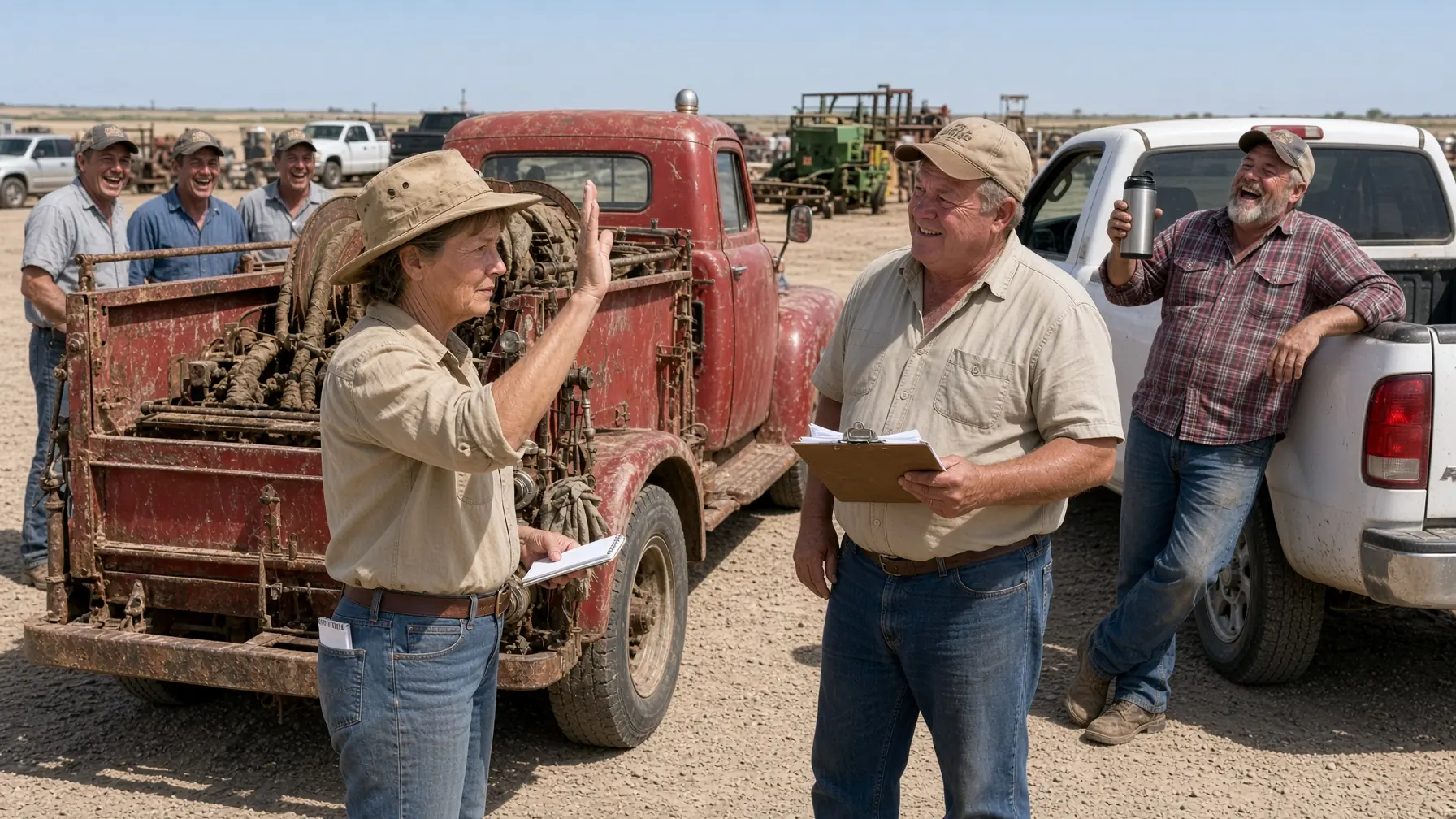
The old machine sat at the far edge of the auction yard between a stripped brush hog and a stack of rusted culvert pipe.
Once, it had been bright red.
Now the paint had faded until rust and red were almost the same color.
Both rear tires sagged into the gravel.
The hose reels were cracked.
The couplings had turned green.
Someone had wrapped a filthy rag around one discharge valve with duct tape and apparently decided that was good enough.
Dale Mercer, the county road supervisor, walked past it and shook his head.
“Tank's probably rusted through.”
A few men nearby nodded.
“Pump's seized too, I bet.”
A younger farmer laughed.
“That thing couldn't put out a campfire.”
More laughter.
Then a woman's voice came from the back.
“Two hundred.”
The auctioneer looked up.
So did everyone else.
Ruth Keller stood behind the crowd in a faded work shirt, old jeans, and a canvas hat that had spent more summers beneath the Kansas sun than some of the men laughing at her had spent farming.
Fifty-seven years old.
Widowed.
Thirty years working wheat ground north of Pratt.
She did not look embarrassed.
Did not smile.
Did not explain.
The auctioneer stared at her.
Then at the truck.
Then back at Ruth.
“Two hundred?”
“Yes.”
Nobody else raised a hand.
He brought down the clipboard.
“Sold.”
The laughter started immediately.
Harold Briggs leaned against his pickup.
He farmed east of Ruth’s place and considered himself qualified to comment on almost anything involving agriculture.
“Ruth Keller.”
He grinned.
“Buying herself a fire truck.”
Ruth walked past him without answering.
She signed the paperwork.
Paid two hundred dollars.
Then called her nephew.
Cole Keller arrived twenty minutes later.
Twenty-six.
Lean.
Sun-darkened.
Dirt on his jeans from repairing irrigation line all morning.
He walked around the old truck once.
Then again.
He pushed the running board with his boot.
The metal groaned.
Cole looked at Ruth.
“What exactly did you buy?”
“A truck.”
“I can see that.”
He pointed toward the rear tires.
“Those are nearly flat.”
“I noticed.”
“The hose is rotten.”
“I noticed.”
“That pump probably hasn't moved water in ten years.”
Ruth opened the side compartment.
“I know.”
Cole stared at her.
“You spent two hundred dollars on this?”
“Yes.”
“What do you need with a fire truck?”
Ruth looked inside the pump housing.
Then she said something Cole remembered years later.
“I didn't buy a fire truck.”
He frowned.
Ruth tapped the steel tank.
“I bought a pump and seven hundred gallons of water that can move.”
Cole waited for more.
There wasn't any.
“Hook it up.”
They towed the truck home.
On the way, they passed Harold Briggs's property.
Harold happened to be standing beside his fence.
When he saw the faded red truck wobbling behind Ruth's pickup, he lifted his coffee thermos like a toast.
Cole saw him laughing.
Ruth did too.
She kept driving.
The truck disappeared behind Ruth’s machine shed.
For the next several weeks, neighbors occasionally heard metal hammering.
An engine turning.
A pump coughing.
Water hitting dirt.
Nobody paid much attention.
Most assumed Ruth was wasting her time restoring an antique.
She wasn't.
That was the first thing Cole slowly understood.
Ruth never touched the faded paint.
She did not repair the siren.
Did not polish chrome.
Did not replace the cracked seat.