The first laugh reached Mara Bell at the twelfth rung.
It came from the dry ground below, carried upward by a Kansas wind strong enough to tug the ends of her ponytail loose and make the old galvanized tower tremble beneath her gloves. She paused with one dusty boot braced against the narrow steel step and looked over her shoulder. Three ranchers stood beside her father near the base, their hats tipped back, their faces turned up into the afternoon sun. One of them had his hand cupped around his mouth. Another was pointing. The third laughed with the relaxed certainty of a man watching a mistake that would cost him nothing.
Forty feet above the barren hill, the windmill blades did not move.
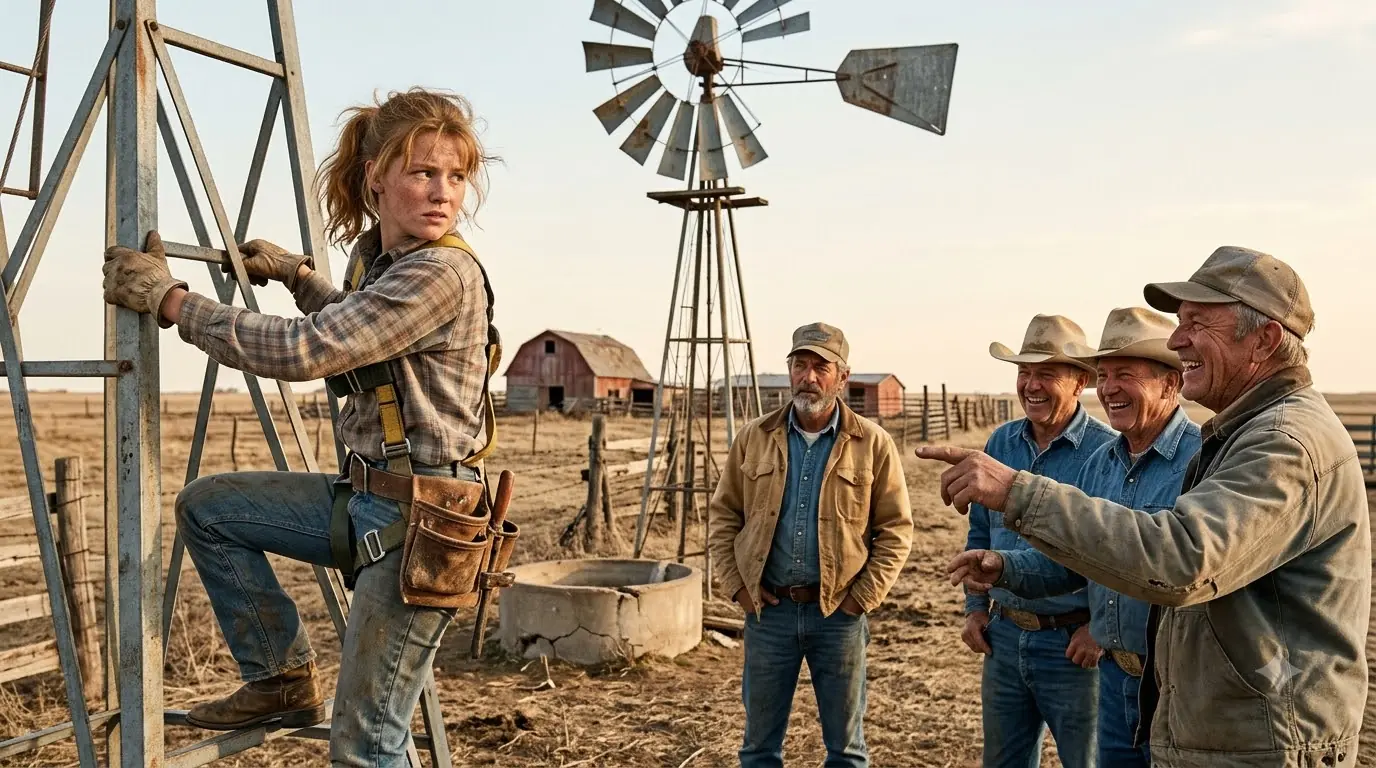
That was the part no one could explain with a joke. The wind was there. The tower shivered with it. Dry grass flattened in quick silver-brown waves across the slope, and the loose end of an old feed sack trapped against the fence snapped like a flag. Yet the wheel at the top remained perfectly still, its wide blades fixed against the sky. The long tail vane had been lashed to the tower with weathered fence wire, twisted tight enough to hold the windmill head at an unnatural angle.
Five hundred feet downhill, a concrete stock tank lay empty. Beyond the tank, thirty cow-calf pairs crowded along the creek fence, heads lowered through gaps in the rails toward a ribbon of water that had already been grazed and trampled hard. It was May of 1989, too early for the grass to look so exhausted. Dale Bell had begun hauling winter hay in spring. There was a repair estimate in the kitchen drawer for more than seven thousand dollars, and a school acceptance letter on Mara's dresser that made every hour on the ranch feel borrowed.
Mara tightened her grip and climbed another rung.
“Climb down, sweetheart,” one of the ranchers called. “That windmill was dead before you learned to drive.”
The others burst out laughing.
Mara tipped her head just enough to look at him. Her freckled face was flushed by heat and wind, but her green eyes held steady. “Then you won't mind watching me prove it.”
Her answer earned a fresh chorus of amusement. She did not give them anything else. The safety harness rode snug across her hips and shoulders. Her tools were secured in the leather belt at her waist, not swinging from her hands. She touched the next rung, tested it before transferring weight, and climbed toward the head of the old machine.
At the bottom, Dale Bell planted his muddy boots wide and looked up with a worry that had been growing since breakfast. He was forty-nine, with a brown-gray beard and the weathered face of a man who had spent his adult life making decisions against the clock of seasons. His tan ranch jacket hung open over a denim shirt. There was dust at the knees of his faded jeans and a crease across his forehead that had nothing to do with sunlight.
“Keep your hands clear of that wheel,” he called. “And don't hurry for anybody.”
“I know, Dad.”
He knew she knew. That was not the problem.