Gerald Stokes ripped the red clover out of the ground like he had caught it committing a crime.
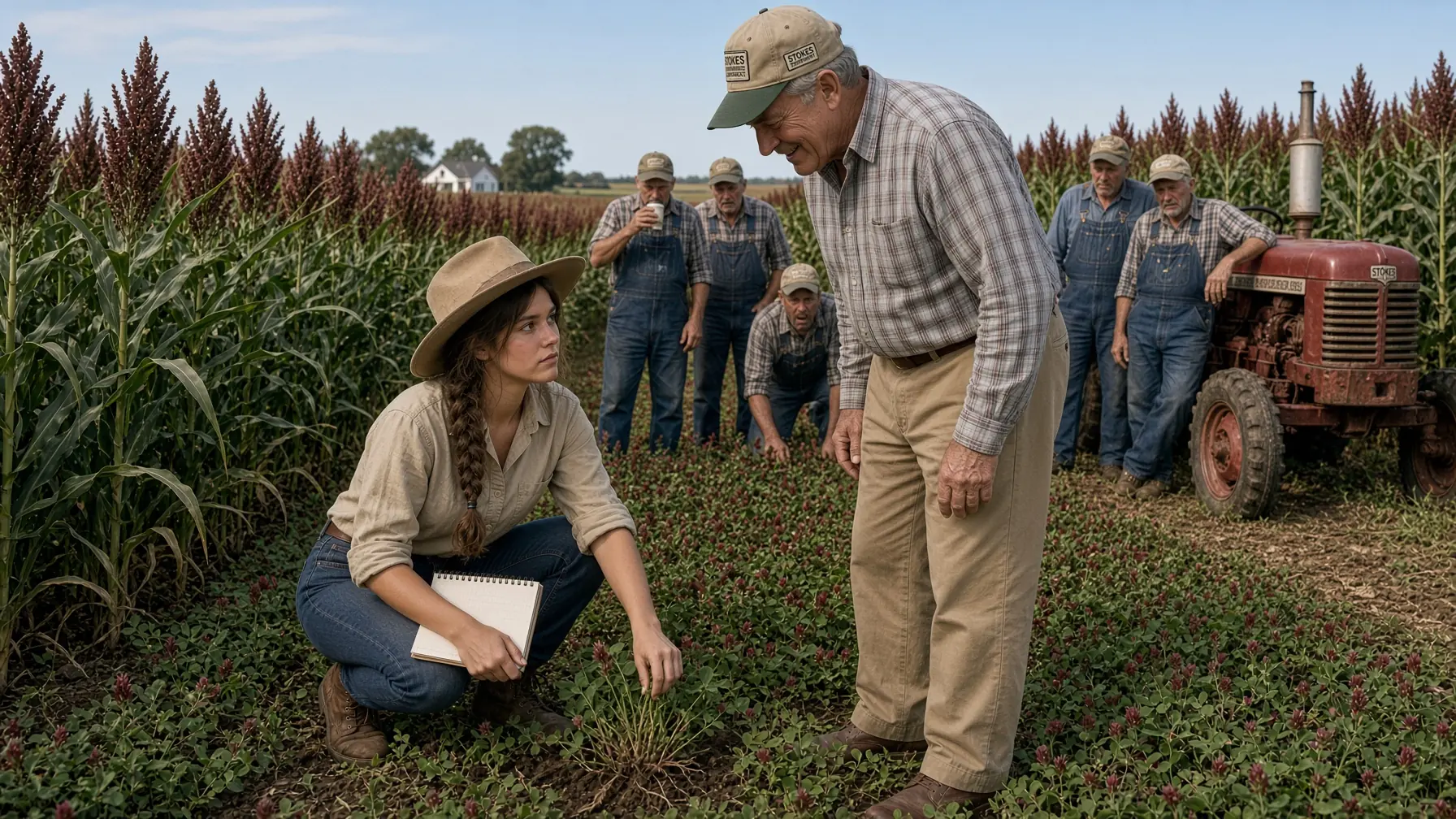
Roots tore free from the black Iowa soil.
Small crumbs of earth scattered across his polished brown boots.
Then he straightened, looked at eighteen-year-old Claire Halverson, and threw the plant at her feet.
“Pretty face, empty head.”
The farmers near the old red tractor laughed.
Gerald pointed toward the green carpet growing beneath the towering sorghum.
“You’re planting weeds in your father’s crop.”
Claire did not move.
Around her, the grain sorghum stood more than six feet tall, thick stalks crowded into long rows that disappeared toward the farmhouse. Broad leaves stretched into the late-summer sun. Heavy burgundy seed heads bent at the tops, already beginning to mature.
And below all of it—
red clover.
Thousands of small plants.
Dense enough to make the spaces between rows look green instead of black.
Claire held a spiral notebook against one hip.
Her brown hair was braided over one shoulder beneath a faded field hat. Dust covered the toes of her boots. Sweat darkened the collar of her beige work shirt.
Gerald stepped closer.
“When this crop fails,” he said, “the whole county will remember your mistake.”
Claire looked down at the clover he had torn out.
Then at Gerald.
She calmly took the plant from his hand.
Crouched.
Pressed its roots back into the soil.
The laughter began to fade.
One farmer lowered his coffee cup.
Another glanced toward the thick green cover beneath Claire’s sorghum.
Claire packed dark earth around the roots with both hands.
Then she stood.
Brushed the soil from her palms.
And met Gerald’s eyes.
“I’m planting something that will keep his soil alive.”
Gerald laughed again.
“You really believe that?”
Claire’s expression never changed.
“Come back after the drought.”
Gerald’s grin stiffened.
Claire looked toward the field behind him.
“Your fields can introduce me.”
No one laughed that time.
The Halverson farm had never been famous for experimenting.
Claire’s grandfather planted grain.
Her father planted grain.
The neighbors planted grain.
Everybody did essentially the same things because in farming, doing something familiar and surviving often seemed wiser than trying something clever and going broke.
The Halverson place sat outside a small Iowa town where roads ran ruler-straight between fields and almost every conversation eventually found its way back to weather.
Rainfall.
Heat.
Planting dates.
Input prices.
Equipment.
Yields.
People knew who had the cleanest rows.
Who had borrowed too much.
Who had bought a new combine.
Who had lost forty acres to hail.
And especially—
who had tried something strange.
Claire had become strange that spring.
It started with twelve acres.
Not forty.
Not the whole farm.
Twelve.
Her father, Walter Halverson, had nearly rejected even that.
He stood at the kitchen table in March with both hands wrapped around a coffee mug while Claire explained her plan.
“You want to plant what under the sorghum?”
“Red clover.”
Walter stared.
“You want another crop competing with the crop we're actually selling.”
“Not at establishment.”
Claire opened her notebook.
She had diagrams.
Dates.
Seeding rates.
Rainfall notes from previous seasons.
“I wait until the sorghum is established and tall enough to shade the ground. Then I overseed the clover between the rows.”
Walter looked at the pages.
“Why?”
“Because every summer we leave the soil bare between rows.”
“So?”
“So it bakes.”
“It’s dirt.”
“It’s living soil.”
Walter rubbed his forehead.
Claire continued before he could stop her.
“The surface gets hot. We lose moisture. Rain hits bare soil harder. We get crusting. We lose organic matter every time we disturb it.”
“You read that in school?”
“Yes.”
Walter gave her the look farmers reserved for information learned inside buildings.
Claire knew it well.
She had recently finished high school and planned to study agronomy at Iowa State in the fall.
That fact made certain older men in the county treat her ideas as temporary symptoms of education.
Walter was not that dismissive.
But he was cautious.
Caution had kept the farm alive through bad years.
“How much seed?”
Claire told him.
“How much does it cost?”
She told him.
“What happens if you're wrong?”
“Twelve acres look bad.”
“And if you're really wrong?”
“We lose twelve acres.”
Walter stared through the kitchen window.
Outside sat machinery that represented more borrowed money than Claire had earned in her entire life.