The steel beds of two dump trucks rose against the bright, overcast April sky, and a red avalanche came pouring down. Whole tomatoes struck the mound and burst. Split fruit, skins, seeds, and sour juice washed over the cracked gray clay, spreading toward a battered 1972 John Deere tractor parked near the edge of the field. Another truck waited along County Road 7, with still more behind it. By the time the drivers had finished, almost all five acres would be hidden under an enormous mass of discarded tomatoes.
"Look at him," Arthur Vance said, pointing from beside his spotless black pickup. "Praying to a pile of rot."
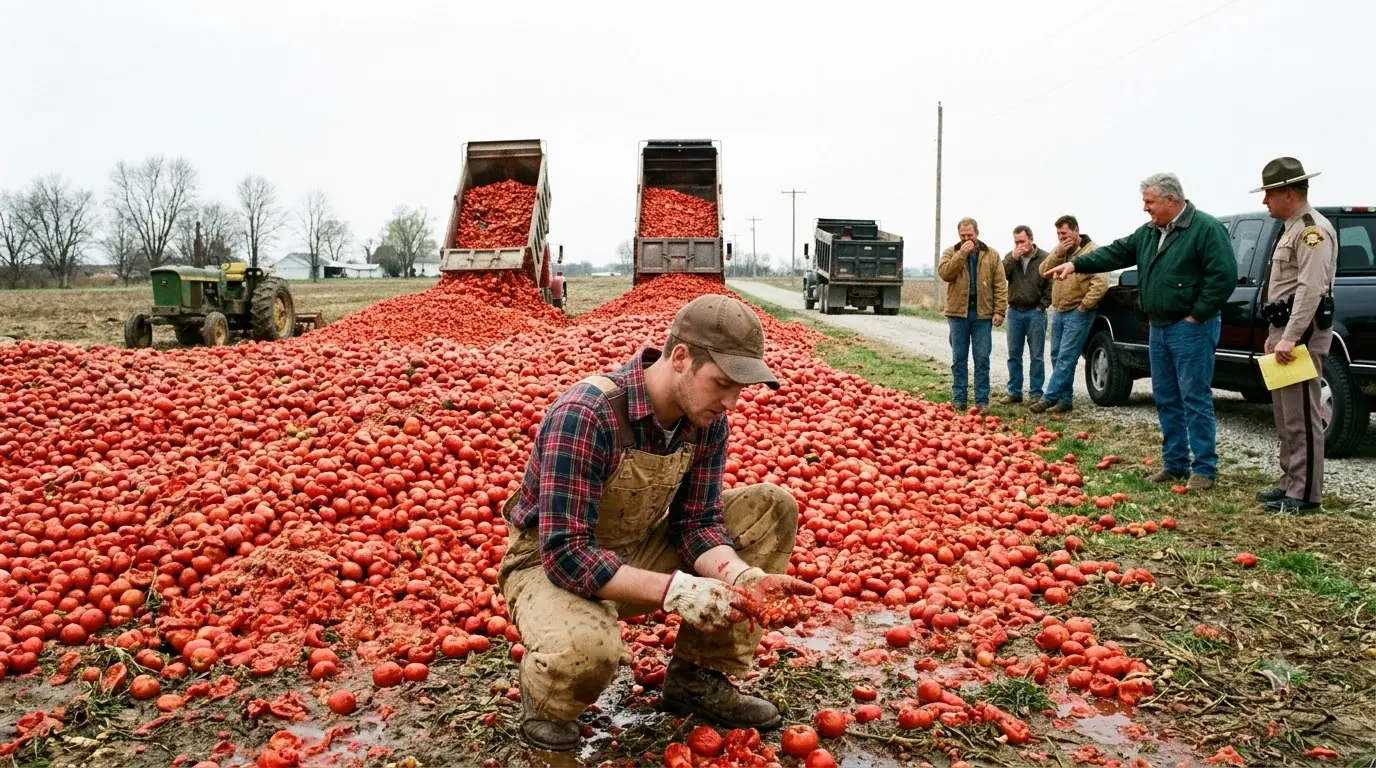
The farmers around him laughed and covered their noses. At fifty-eight, Arthur carried himself like a man who had never needed to question whether people would make room when he arrived. His dark green jacket was expensive, his boots polished. Behind him stood Deputy Sheriff Miller, a yellow county citation in his hand, looking from the trucks to the gathered neighbors with growing concern.
Cole Evans crouched in the foreground, close enough to the foul red heap that juice stained the fingers of his work gloves. He was twenty-two, with a faded brown cap over short brown hair, a red-and-navy plaid shirt beneath worn tan overalls, and mud on his boots. He squeezed a handful of pulp gently. As the liquid ran between his fingers, several pale, intact seeds remained against his palm.
"You buried five acres under rotten tomatoes," Arthur called. "What exactly are you farming?"
Another load crashed down. A truck's hydraulic system whined, and a spray of red pulp struck the lower side of its raised bed. Cole turned the seeds in his palm without answering.
"You really think something will grow from this?" Arthur demanded.
Cole stood slowly. His hazel eyes moved past Arthur to the line of trucks still waiting to unload. For the first time that afternoon, Arthur's grin weakened, as though he had seen something in the younger man's expression that did not fit the joke.
"You should ask what those trucks are carrying before they leave," Cole said.
Nobody laughed immediately. Deputy Miller lowered his eyes to the citation. Cole closed his hand around the seeds, knowing that the most difficult part of the work had not even begun.
"You understand what's been put on your property?" Miller asked when he finally reached him.
"Tomato processing residue," Cole replied.
"That's what the company calls it. These folks are calling it a landfill."
Cole looked at the crimson waste glistening in the shallow furrows. The material was more fluid than he had expected. He could see pockets where the liquid had collected instead of spreading, and he knew he would have to move quickly before those pockets became a different sort of problem. He also knew that telling Miller about the loose sheets of calculations in his workshop would change nothing on this particular afternoon.
"I'll keep it inside the boundary," he said. "And I'll manage the odor."
Miller held his gaze. "You'd better have a way to do both."