When Carol Whitfield turned off County Road 6 and eased her old pickup onto the rutted lane, the field looked even worse than it had in the tax photographs.
The county images had shown a rough rectangle of weeds, stone, and brown scars where rain had chewed through the topsoil. Standing there in person under the bright Kentucky spring sun, she could see just how thoroughly twenty years of neglect had erased whatever order the place once had. Gray stones lay scattered across the ground like old bones. Saplings had sprung up in clumps where the pasture should have been open. Thick weeds rolled in patches almost to the hood of her truck. Broken pieces of farm equipment rested half-swallowed by the ground—an old rake wheel here, the twisted tongue of a hay wagon there, a rusted disc blade standing crooked in the dirt as if the land itself had started spitting iron back out.
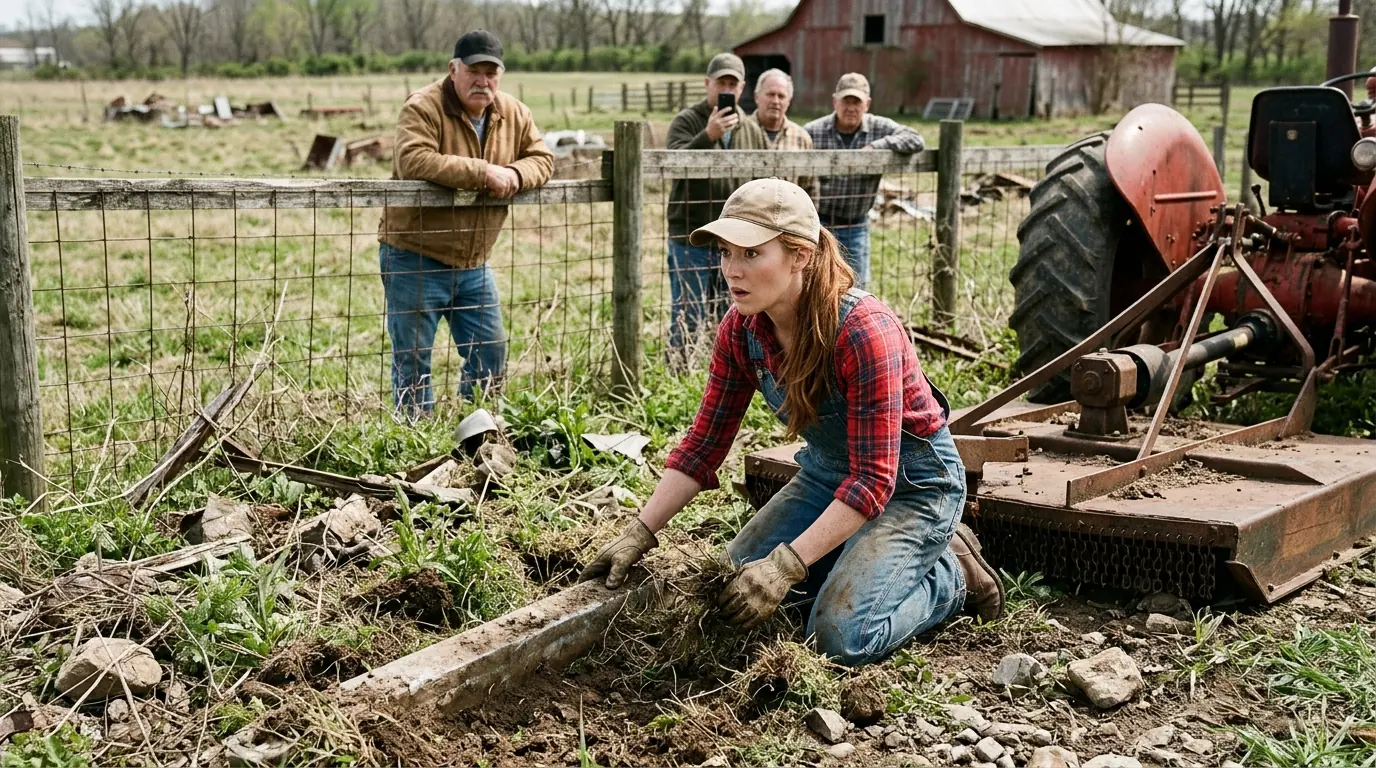
Beyond the field stood a weathered red barn with a bowed roof and one missing door. Past that lay the dark green edge of a tree line, the kind that looked peaceful from a distance and expensive up close. The whole place had the exhausted look of ground that had stopped expecting anyone to care for it.
To most people, that would have been enough reason to stay away.
To Carol Whitfield, it felt almost familiar.
She sat in the truck for a long moment with both hands on the wheel, studying the property in silence. Thirty-two years old, lightly freckled, lean from work rather than a gym, she had the face of someone who rarely wasted words before making a decision. Her long auburn hair was pulled through the back of a faded tan cap. Sweat had already dampened the collar of her red plaid work shirt from the morning she had spent finishing chores on the twelve-acre place she rented three miles away. She wore denim overalls, muddy brown boots, and leather gloves tucked under one thigh.
A person who did not know her might have thought she looked stubborn.
A person who knew her well would have said that was only one piece of it.
Carol had grown up on land owned by other people.
Her father, James Whitfield, had spent most of his life managing fields he did not control, fixing fences for neighbors who paid late, and coaxing one more season out of machinery that should have died under a richer man. Her mother had worked double shifts at a nursing home while growing more of the family’s food in a backyard garden than most people thought possible. Carol learned young that farming was often less about romance than arithmetic, and that the arithmetic favored anyone who started with enough acreage, enough credit, or enough luck not to sell in the wrong year.
When she was ten, her father took her to an auction where a tired man lost the family operation row by row, implement by implement. Carol remembered the way the adults whispered numbers as if the price of a disk harrow mattered less than the humiliation of watching somebody else claim it. On the drive home, her father had said, “If you ever farm, own what you can. Even if it’s small. Even if it’s ugly. Rent can feed you, but ownership lets you fight.”