When Emily Carter signed the paperwork for fifty acres of abandoned land, the woman across the county office desk actually looked sorry for her.
Not impressed.
Not curious.
Sorry.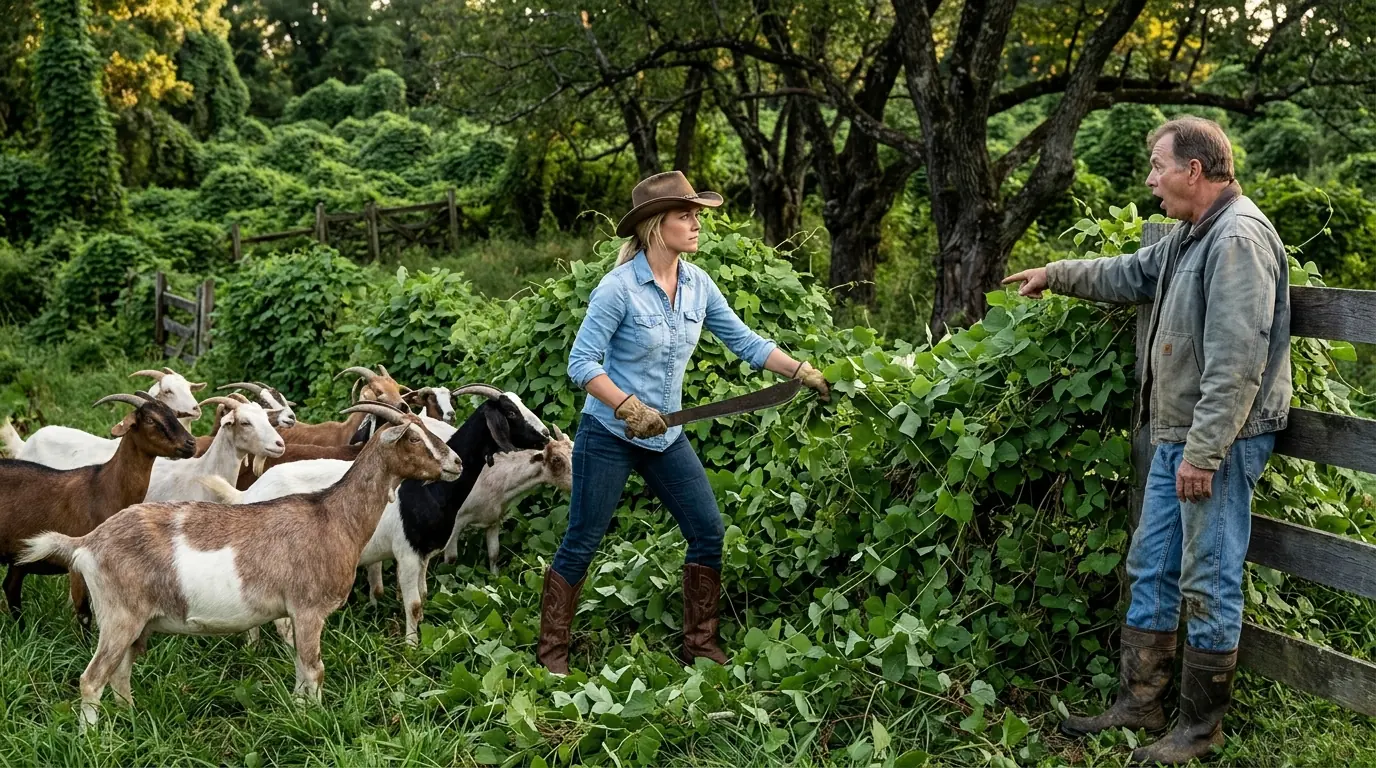
That was how everyone reacted when they heard the price.
One dollar.
A full fifty acres of land for the cost of a cup of coffee.
To most people, that sounded like the opportunity of a lifetime.
But the people who knew the property understood why nobody wanted it.
They did not see fifty acres.
They saw a problem.
They saw years of neglect.
They saw thick walls of kudzu swallowing trees, fences, and everything else in its path.
They saw land that had defeated every person who tried to reclaim it.
The county did not advertise it as an opportunity.
They advertised it as a burden.
And Emily Carter was the only person who looked at it differently.
Emily was thirty-four years old.
She was not a wealthy investor.
She was not a developer.
She was not someone with unlimited money and expensive equipment.
She was a farmer.
A person who understood that land had a memory.
She grew up on a small family farm in Tennessee where her grandfather taught her something she never forgot.
“Land tells you what it needs.”
At the time, she thought it was just something old farmers said.
But as she grew older, she understood.
The best farmers did not fight nature.
They learned from it.
They watched.
They listened.
They adapted.
That was exactly what she planned to do with the fifty acres everyone else had abandoned.
The property sat near the edge of a small Appalachian community.
Beautiful hills.
Rich soil.
Streams running through the valleys.
From a distance, it looked peaceful.
But walking onto the land told a different story.
Kudzu covered almost everything.
The invasive vine had grown so aggressively that entire sections of the property disappeared beneath green walls.
Old fence posts vanished.
Stone paths disappeared.
Small trees were bent under the weight of years of growth.
The land looked like nature had swallowed it completely.
Two previous owners had tried to restore it.
The first brought heavy machinery.
Bulldozers.
Excavators.
Workers.
He spent thousands clearing sections of the property.
Within months, the equipment was damaged by hidden rocks and unstable ground.
Eventually, he gave up.
The second owner tried again.
He hired a larger company.
More machines.
More money.
More workers.
But the result was the same.
The land fought back.
After years of failed attempts, people stopped calling it farmland.
They called it impossible.
When Emily announced she bought it, people laughed.
Not cruelly at first.
More like disbelief.
At the local diner, everyone had an opinion.
“You actually bought that place?”
Emily smiled.
“Yes.”
“Why?”
She shrugged.
“Because nobody else wanted it.”
The older farmers laughed.
“That’s because nobody else was crazy enough.”
Emily did not argue.
She understood.
From the outside, it looked ridiculous.
A young woman buying land covered in vines.
No buildings.
No working fields.
No easy path forward.
But Emily saw something different.
She saw potential.
Her first day on the property, she stood at the edge of the hillside and looked across the green wall.
The air smelled like damp earth and wild plants.
Birds moved through the trees.
The land was not dead.
It was simply hidden.
That mattered.
Dead things cannot recover.
Hidden things can.
Emily knew she could not attack the land the same way previous owners did.
Machines would only destroy what was beneath the surface.
She needed a different approach.
Something patient.
Something natural.
That was when she thought about goats.
People laughed even harder when they heard her plan.
“You’re clearing fifty acres with goats?”
Emily nodded.
“Yes.”
A neighbor shook his head.
“Those goats are going to get lost in there.”
Maybe.
But Emily knew goats were different from machines.
They could reach places equipment could not.
They could eat the vines.
They could move carefully.
They could reveal what was hidden instead of destroying it.
So she rented twelve goats.
A small herd.
A simple plan.
And a deadline.
She only had a limited amount of time before she had to return them.
If the goats did not make progress, she would have to rethink everything.
The first weeks were difficult.
The goats disappeared into the vines every morning.
Emily followed behind.
Moving fences.
Carrying water.
Clearing small paths.
The work was exhausting.
Her hands developed blisters.
Her clothes became covered in dirt.
Every evening, she returned home tired.
But slowly, something changed.
The land started revealing itself.
Small patches of soil appeared.
Sunlight reached areas that had been dark for years.
Old fence posts emerged.
Then something even more surprising appeared.
Stone.
Not random rocks.
A wall.
An old stone wall hidden beneath the vines.
Emily spent hours uncovering it.
The craftsmanship was obvious.
Someone had built it carefully.
Long ago.
The discovery changed how she looked at the property.
Because abandoned land does not always mean forgotten land.
Sometimes it means hidden history.
By the sixth week, Emily began noticing something strange.
One section of the property remained untouched.
The goats refused to enter.
Every morning, they walked toward the same area.
Then stopped.
At first, Emily ignored it.
Animals behaved strangely sometimes.
Maybe there was something underground.
Maybe there was a smell she could not detect.
Maybe they simply preferred another area.
But it happened again.
And again.
Three mornings in a row.
Twelve goats.
Same location.
Same reaction.
They stood together, staring into a thick wall of vines.
Not afraid.
Not confused.
Waiting.
Emily watched them carefully.
Something was there.
The goats knew.
She did not.
The next morning, Emily grabbed her tools.
She walked toward the vines.
The wall was thicker than anything she had cleared before.
The plants were tangled together like nature had built a barrier.
She lifted her machete.
The first cut opened a small gap.
The second revealed more vines.
The third strike hit something solid.
Emily stopped.
The sound was wrong.
It was not stone.
It was not a fallen branch.
It was wood.
Old wood.
She slowly pulled the vines aside.
And froze.