“Forty-six thousand seven hundred? For a dead engine?”
Grant Voss said it loudly enough for the three farmers behind him to hear. Then he laughed and pointed toward the combine, as though its size made the mistake even funnier.
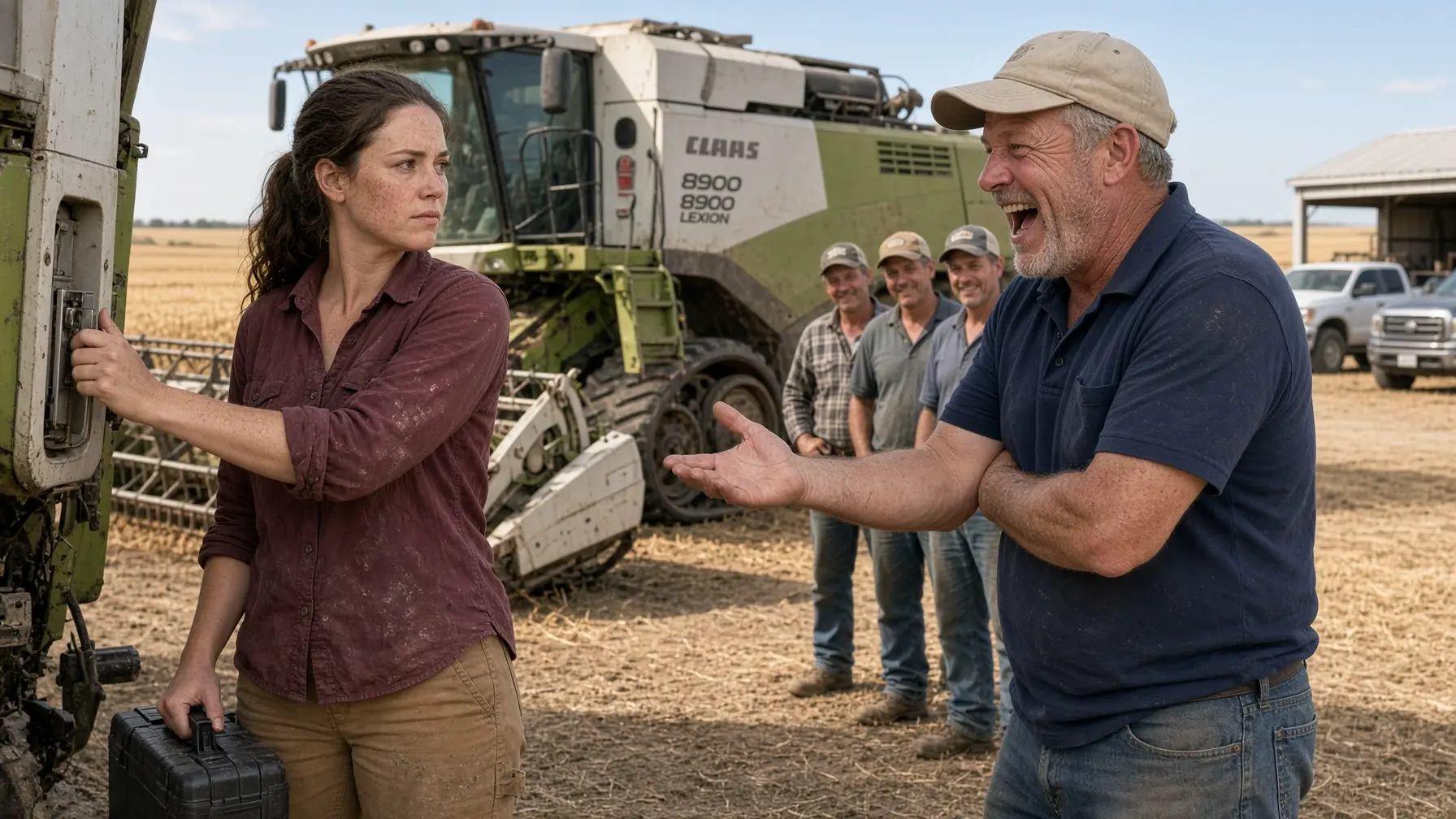
Banning stood beside the closed electrical access panel with a compact tool case in one hand.
She had just spent $46,700 on a machine that had not started in eleven months.
There was no useful way to make that sound sensible to someone determined to enjoy it.
“Give me twelve minutes,” she said.
Grant’s smile widened.
Banning set the case on the ground and released the panel latch. Dust moved beneath her fingers, leaving a clean streak across the metal.
Behind her, the auction yard continued sounding like an auction yard.
A pickup engine started. Someone called for a buyer to move his trailer. From beneath the open equipment shed came the clatter of a chain being dragged across concrete.
Nobody stopped working because a twenty-nine-year-old woman had made a purchase that might ruin her.
Only the men watching her seemed prepared to give it their full attention.
Earlier that morning, she had stood beside the same combine without owning any part of it.
The green-and-white machine towered above her, its panels dusty and its detached draper header resting nearby. Beyond the yard, golden wheat fields stretched toward the low horizon outside Haven Crest, North Dakota.
Late August had a particular way of making farmers impatient.
Every clear afternoon looked useful.
Every useful afternoon looked temporary.
Banning could feel that urgency even while standing beside equipment too silent to participate in it.
She had come to the auction with a limit written on a folded piece of paper.
Not a hopeful number.
A stopping point.
She wrote it down because she knew how quickly an auction could turn a decision into a contest. A person could begin by assessing a machine and end by refusing to lose it to the man standing ten feet away.
She did not intend to make that mistake.
There were enough other mistakes available.
Her faded burgundy work shirt was already marked with dust when she reached the combine. She rolled the sleeves higher, tucked a loose strand of brown hair back toward her ponytail, and looked at the detached header.
Then she looked up at the cab.
The machine was a 2024 CLAAS LEXION 8900.
Modern enough to make its condition troubling.
Large enough to make the price she expected equally troubling.
If everything were straightforward, it would not be sitting here under an auction listing that attracted people mainly interested in what was wrong with it.
Banning knew that.
She had not arrived believing she alone could recognize a bargain.
She arrived hoping there was a difference between what people knew and what they had repeated.
A man near the next row of equipment saw her studying it.
“That one?”
She looked toward him.
“What about it?”
He nodded at the combine.
“Hasn’t started in nearly a year.”
“Eleven months?”
“That’s what they’re saying.”
She waited.
He appeared to expect that information to send her somewhere else.
When it did not, he added, “Expensive thing to tow home.”
Banning looked back at the machine.
“It would be.”
The man shrugged and returned to examining a smaller piece of equipment.
She appreciated that he did not turn the exchange into a lecture.
He had offered a warning.
She had heard it.
Both could move on.
Banning walked around the combine slowly.
She was not pretending a walk could answer every question.
It could tell her what was visible.
Missing parts.
Damage.
Something obviously neglected beyond the dust.
She wanted to separate those observations from everything she could not know.
The distinction mattered.
A machine that did not start gave people too much room to describe it.
Dead.
Finished.
Scrap.
A disaster.
Those words were convenient because they required no further precision. They made uncertainty sound settled.
Banning preferred smaller statements.
It had not started.
That was supported.
The engine was dead.
That was a conclusion.
Perhaps a correct one.
Perhaps not.
She was not willing to let the second sentence borrow certainty from the first without asking what existed between them.
At the registration table, she had already asked for whatever information was available.
There was not much.
The machine’s identity was clear.
Its recent history was less so.
Nobody offered a guarantee, and Banning would have distrusted one delivered casually across a table.
She asked whether the description of the problem came from a documented examination or from the fact that the machine would not start.