“Take my advice, Carol. Sell the rocks by the truckload and apologize to the dirt.”
Walter Kemp said it loudly enough that the three men near the feed-store counter turned around. He was holding a receipt with Carol Whitfield’s name on it, and his broad grin announced that the morning had finally delivered something more entertaining than fertilizer prices. Outside Denny’s Feed & Supply, a hard May wind sent dust curling around the parking lot. Inside, Carol stood with one bag of mineral salt balanced against her hip and watched Walter enjoy himself.
“Probably the most useful advice you’ve given me all year,” she said.
Walter laughed harder. “So you admit you’ve lost your mind?”
“I’ve admitted no such thing.”
“You bought The Rock Field.”
“I did.”
“Twenty-eight acres of equipment damage. Thirty years of men pulling stones, and every spring the stones come back. What are you planning to grow, spare plow blades?”
Carol shifted the heavy sack. She was fifty-eight, compact and strong in the shoulders, with a weathered face that showed more years of sun than she felt like counting. Since her husband’s death, people in Whitfield County had developed a habit of watching her decisions as though a widow farming alone was a problem that had to be solved by committee. Walter was not malicious, exactly. But he enjoyed being certain, and certainty could sound remarkably like cruelty when spoken over someone else’s money.
“I haven’t decided what to grow,” she said.
Walter stared at her for a moment, then looked around for witnesses to the joke. “She buys twenty-eight acres and doesn’t know what she’ll do with them.”
The men laughed. Carol paid for the salt, folded the receipt into her pocket, and walked out before Walter could begin suggesting what her late husband would have thought. Ray Whitfield had wanted that parcel twenty years earlier. He had liked its position along the boundary of their existing land, the access from County Road 6, and the possibility that the right use might eventually turn a cheap nuisance into something useful. Carol had dismissed the idea at the kitchen table because they had more urgent bills and more dependable acres. Ray had smiled, called it cheap acreage, and let the argument rest.
Thirteen years later, his heart stopped before either of them had finished imagining old age.
Carol bought the parcel after the county took it for unpaid taxes. Nobody bid strongly at the first sale. The minimum fell, and when it fell again she watched the notice for three evenings before driving to the county office. The price was less than a used pickup that might or might not survive another planting season. Affordable, in the narrow sense of the word. Ownership itself would create taxes, fencing questions, maintenance, and responsibility. Carol understood every one of those. She signed anyway.
As she drove home with the salt in the truck bed, the road curved past the twenty-eight-acre field. Gray stones interrupted pale spring weeds. Some protruded like rotten teeth. Other clusters lay beneath thin soil where a mower or plow could find them the expensive way. On the western slope larger boulders formed broken lines. The parcel had become a local cautionary tale long before she married Ray. Three tractors had broken implements there. One neighbor bent a disc axle badly enough that the repair cost ruined the season’s expected margin. Another destroyed two mower blades in a single afternoon. Children had once been paid by the bucket to gather stones, teenagers by the hour, and grown men by whatever wage pride required. One owner had rented a loader for three weeks. Another paid a crew to clear nearly four acres, looked at the cost of the remaining twenty-four, and stopped the next morning.
The field had survived the campaign almost unchanged.
Carol turned her truck into the lane beside it and parked. Across the road, a pickup slowed; its driver raised two fingers in recognition and drove on. She walked fifty yards beyond the fence with the salt forgotten in the truck bed. Ray had stood in this same field with her once. She remembered him bending over a broad flat stone and tapping it with his boot.
“Odd shape for something frost pushed up,” he had said.
“Rocks don’t need permission to be odd,” she had answered.
He had laughed, and that had been the end of it.
Now she looked down at the scattered stones and wished she had asked what he meant. There were so many things she wished she had asked, and none could be repaired by grief. She returned to the truck and drove the mile home, where her nephew Ethan was replacing a damaged hydraulic hose on the skid steer. He was twenty-six, lean and dark-haired, and had been helping seasonally since before Ray died. Carol paid him for his hours and trusted him with machinery because he knew the difference between confidence and carelessness. He also knew when to tell her an idea was bad, though he did not always know when to stop telling her.
“Did you close on the land?” he asked as she climbed out.
“Yes.”
“How much?”
She told him. He whistled softly, then glanced toward the road. “Still cheaper than replacing a tractor transmission. Which you might have to do if you work it.”
“We’ll see.”
He straightened. “That’s exactly what worries me.”
For the first spring they did what everyone expected: they tried to make the rocky ground behave like a field. Ethan ran the skid steer, lifting the larger visible stones and carrying them to a growing pile near the road. Carol followed with a rake, a long bar, and orange survey flags, marking places where iron scraped stone beneath the surface. They worked twelve days. Early mornings remained cool, but afternoons turned hot enough that sweat made dust into grit on their faces. The skid steer consumed fuel. A tire caught a sharp edge. A hydraulic fitting began to weep. Every cleared strip revealed another slab just beneath the newly disturbed soil.
At the end of the twelfth day Ethan climbed down, removed his cap, and stared at their work. The rock pile beside the entrance looked impressive enough for a county fair exhibit. The cleared area was less than three acres.
“This is stupid,” he said.
Carol leaned against the rake. “Yes.”
He looked at her sharply. “You’re agreeing with me?”
“I’m fifty-eight, Ethan. Not blind.”
“Then what do we do?”
She looked over the field. Rock heads stood among weeds in irregular-looking clusters. Several flat stones seemed to sit at nearly the same elevation despite the slope. On the north side, where Ethan had dragged away two large blocks, the darker soil left behind suggested a straight shallow scar. She could not explain why she noticed it then. Perhaps because she had finally become exhausted enough to stop seeing only what she wanted removed.
“We stop,” she said.
“For today?”
“For the clearing.”
He stared toward the rock pile. “Then why did we spend twelve days doing this?”
“To find out what twelve days would teach us.”
“That we should have stayed home?”
“Among other things.”
When they drove away that evening, Ethan looked back three times at the equipment they were abandoning in the field. Carol knew he thought she was surrendering. He was not the only one. The neighbors saw the skid steer parked under cover again and concluded she had reached the same verdict as every owner before her. At the feed store, Walter said she had finally come to her senses. Carol did not correct him. For nearly two weeks, she entered the field early in the morning with a notebook, a tape measure, a hand compass, and flags tucked into her pocket. From the road she looked like a woman inventing extra chores because she could not admit defeat.
There were worse things to look like.
She began by recording what was present. Not every stone; that would have taken months. She marked broad flat pieces showing at the surface and clusters of narrow rocks that felt different under the rake. Her first sketch was nothing more than a rough rectangle with a crooked road at the bottom and one large boulder near the west fence as a landmark. She numbered the flag positions and measured the distances between them. In a notebook usually reserved for cattle weights and fertilizer quantities, she wrote: Flat stone A, north edge. To B, thirty-two feet. B to C, thirty-one. C to D, thirty-three.
She measured again from a different direction. Some stones were scattered, clearly unrelated. Others formed lines too consistent to dismiss. She distrusted her own excitement. Human beings loved patterns, and the brain could manufacture them from random things as easily as clouds became faces or knots in a board became animals. So she tested the lines from the opposite end. She marked a second sequence roughly perpendicular to the first. Then another. At sunset she climbed the roadside bank and stared down over dozens of orange flags.
A straight line crossed the northern section.
Another seemed to run parallel.
A narrow gap separated them.
Beyond, a broken rectangle lay under weeds and shallow soil. The stones had not merely surfaced anywhere they pleased. At least some of them occupied places someone might once have chosen.
Walter Kemp stopped his pickup while she stood there. He rested one arm out the window and looked at the flags with theatrical concern.
“You giving the rocks names now?”
“Only the friendly ones.”
He laughed. “You think too much, Carol.”
“Probably.”
He drove away. Dust drifted over the nearest flags, then settled. Carol waited until the truck disappeared and went back to her measuring tape. She could not yet explain what she had found, but the question had changed. For thirty years people had asked how to get the stones out. Now she was asking why some stones seemed to belong exactly where they were.
The next morning Ethan arrived before breakfast with a thermos and two sausage biscuits. He parked beside the gate, saw the flags, and stopped eating.
“Aunt Carol?”
“Yes?”
“Did you do all of this?”
“Unless somebody came in overnight with an unusual hobby.”
He climbed onto the truck tailgate for a better angle, then stood carefully on the bed. From there the pattern became visible even to someone who had spent twelve days fighting the field one rock at a time.
“Those are rows,” he said.
“I think so.”
“Old fence lines?”
“Maybe.”
He looked along the second set of flags. “Then why are they buried? And why would there be two long lines this close together?”
Carol smiled. “Now that’s a useful question.”
They ate the biscuits without deciding anything, because the shape of the problem had become more interesting than haste. Carol explained her measurements. Ethan proposed that decades of plowing might have pushed stones to repeated edges, an explanation neither of them could dismiss. He suggested an old building foundation near the north end. Carol said that might explain the rectangle, not the long rows. By the time they finished talking, they had a plan cautious enough to avoid destroying what they did not yet understand.
They would open one short section near the northern boundary.
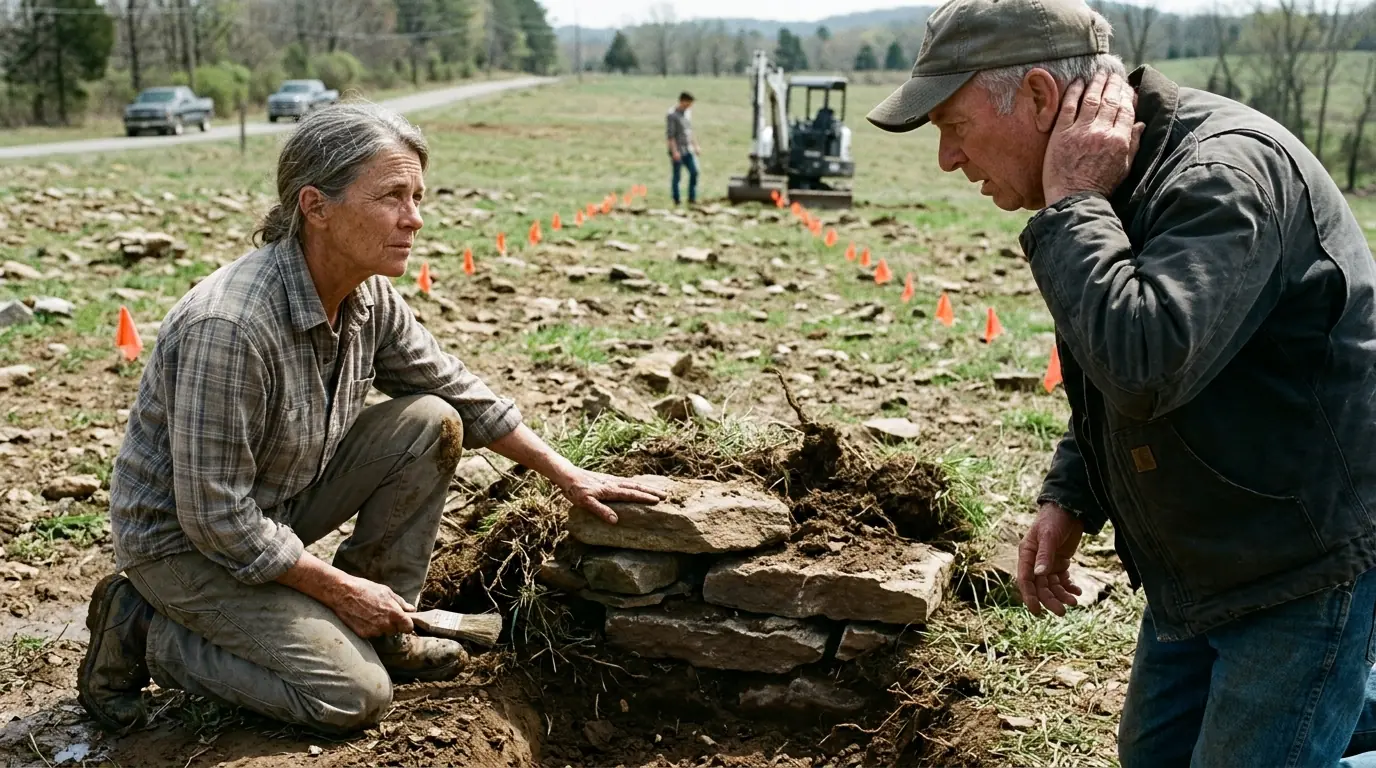
Ethan brought the small excavator the following day. Carol marked a shallow trench and insisted he remove only loose surface soil with the bucket while she watched. When the first flat stone appeared ten inches below grade, Ethan stopped the machine. Carol climbed into the shallow excavation with a shovel and a stiff brush. The stone was broader than she expected, its edge running under an adjacent patch of earth. She cleared along it. Another block appeared. Then another beneath the first.
The stones were stacked.
Ethan shut off the excavator, and without the engine the field seemed suddenly large and silent. Carol knelt by the exposed courses and pressed a palm against the face of the upper block. There was soil packed into the joints and fine roots threading between them. She followed the alignment for twelve feet, then twenty, then thirty, opening just enough ground to show continuity.
“A wall,” she said.
Ethan stood beside her. “A wall.”
He laughed once, not with amusement but because surprise sometimes came out sounding like it. Then he looked across the field at the flags. His expression changed.
“Oh.”
Carol followed his gaze. “Yes.”
“Oh.”
By lunchtime, three pickups had stopped on County Road 6. By late afternoon there were seven, with farmers standing along the roadside bank and pointing at the excavation. The first visitors expected a foundation; the second group arrived hoping for something more entertaining. Walter came down through the weeds, stood beside the exposed stones, and asked whether Carol had built it herself.
“Yes, Walter,” she said. “In forty-eight hours I secretly buried a thirty-foot stone wall just to improve the conversation at Denny’s.”
He scratched his neck. “I didn’t mean it that way.”
“I know.”
George Bennett, a neighboring farmer whose family had worked the county for generations, crouched beside the stones. His grandfather had once spoken of old walls in the area, he said, though George had imagined fence corners and cellar foundations, not anything extending across fields. Walter pointed out that every farm held abandoned structures somewhere. George surveyed the flags stretching across the twenty-eight acres and answered quietly that most farms did not hold quite so many.
That evening Carol went home with mud on her jeans and unease in her chest. The discovery was exciting; it was also a responsibility. She had bought farmland, not a puzzle box. Already people were arriving to look. Someone had suggested digging deeper for bottles or tools. Another man claimed a hidden cellar might contain valuables. She had no interest in turning the place into a rumor that attracted holes and strangers. She called the county historical society before supper.
Dr. Helen Morris answered on the fourth ring.
Helen was a retired history professor who volunteered as an archivist and spoke in a measured voice that grew sharper when questions became interesting. Carol explained the field, its reputation, the flags, and the stacked stone. Helen asked whether there was mortar, whether the stones appeared worked, how deeply they lay, and in which direction the alignment ran. Carol answered from her notebook. The longer she spoke, the less Helen interrupted.
Finally Helen said, “Please don’t dig any more tonight.”
Carol looked toward the back door, where Ethan was washing mud from his hands. “Why?”
“Because I’d like to see the feature before somebody with a backhoe gets excited.”
Ethan heard enough to grin. “She already knows farmers.”
The next morning Helen arrived in a small sedan carrying a canvas bag, a camera, and copies of county plats. Her hair was silver and kept short, her glasses hung on a cord around her neck, and she walked with the energy of someone who had finally been given a real problem to solve instead of another request to identify an unremarkable family portrait. She did not gasp when she saw the wall. She crouched, examined the courses, measured the exposed feature, and took photographs from several angles. Then she asked Carol not to disturb the surrounding soil without documenting it.
“It might be an agricultural structure,” Helen said. “It might be part of a building complex. It might also have been rearranged more than once. We can’t tell from one trench.”
Carol liked her immediately. “You said might three times.”
“That’s because I intend to remain accurate.”
They spent an hour walking the flag lines before returning to Carol’s kitchen. Helen spread out plats dated 1871 and later, photocopies of tax entries, hand-drawn surveys, and a few documents too fragile to remove from storage. On the earliest map, County Road 6 did not yet exist, and the present Whitfield farmhouse had not been built. Near the north side of the rocky parcel, however, sat a small rectangle. Beside it was written W. WHITCOMB.
“William Whitcomb,” Helen said. “At least the earliest owner I can establish from these records.”
Carol traced the faded road line. “You think this rectangle is what we opened?”
“I think it’s worth comparing positions before deciding.”
A later survey included more rectangles and a lane, then a larger complex of stone boundaries, a spring, and several structures. Ethan leaned over the table with coffee forgotten in his hand. He asked whether they were looking at barns and storage buildings. Helen said perhaps. The survey suggested a shared agricultural site, she explained, but it did not identify every use. Several families appeared to have occupied or worked adjoining parcels during the late nineteenth century. Ownership lines changed. Buildings came and went. Records were incomplete.
The next discovery would have to come from the ground without letting the ground be destroyed to produce it.
Carol agreed to selective exposure, careful photographs, and measuring before moving anything. She found herself unexpectedly relieved. For the first time since she purchased the parcel, the field had a history that extended beyond broken equipment and jokes. That was promising. It was also frightening. Once history entered a place, the owner could no longer pretend every decision was only hers.
At supper Ethan asked whether the stones might be valuable.
“Probably about as valuable as they were last Tuesday,” Carol said.
“But now we know they might be something.”
“Exactly. That changes what we should do, not necessarily what anyone would pay.”
He nodded slowly, unhappy with the distinction but willing to consider it. Across the room stood Ray’s old wooden chair, empty now for thirteen years. Carol sometimes still caught herself turning toward it when an argument reached the point where he would have made an irritatingly calm observation. She looked at it that evening and remembered again his boot tapping the flat stone.
Odd shape, he had said.
Perhaps he had been asking the first question long before she learned to hear it.
The following month was slower than the neighbors wanted. That alone became a problem. Once people heard a buried wall existed, they expected a dramatic unveiling, preferably by machinery and preferably before the weekend. Helen and Carol refused. They mapped the visible lines first. They opened only short windows through accumulated soil. They photographed each layer before lifting loose material. They avoided making claims about dates or functions until evidence supported them. A few visitors called the precautions excessive. Carol reminded them that the same county had spent thirty years hauling stones out of the field without asking what the stones belonged to.
She did not want the next generation to repeat that mistake in the opposite direction.
At the north edge, the exposed wall continued toward a large rectangular foundation. Nearby, two smaller stone-footed structures emerged in the survey. A narrow corridor separated part of the complex. Near the western slope, flags marked a broad circular arrangement thirty feet across. That feature generated the most confident guesses. Walter called it a livestock pen. Ethan wondered whether it had been a giant well. George thought perhaps the base of a silo, though the proportions bothered him. Helen recorded all the suggestions in a notebook and endorsed none.
The circular feature was built of stones laid around a shallow center. At first there was no obvious reason for it. Then a rainstorm moved through Whitfield County on a warm June night, sending runoff over the field and filling low hollows. Carol went out in boots the next morning to inspect the exposed sections before they could slump. Water stood inside the circle. She expected it to remain there for days as it did in other low spots.
Instead, the surface slowly lowered.
She crouched near the outer edge, where a narrow opening disappeared beneath a band of soil. Water slipped through, at first almost invisibly and then with enough movement to carry tiny suspended grains. Carol followed the route downhill. Between flag lines, the ground held a faint channel beneath weeds. Farther on, another stone-lined section appeared in the bank, conducting water toward the depression the old plats marked as a spring.
A system was waking into view.
She called Ethan without taking her eyes from the moving water. When he arrived, he tried the obvious explanation—that a natural crack simply drained the basin. Carol asked him to follow the alignment. The water passed through what looked like deliberately placed stone. Other shallow stone-lined features fed it. Terraces higher on the slope appeared to direct runoff toward protected routes instead of allowing it to strip soil away.
“This wasn’t just buildings,” Carol said.
Ethan looked over the western field. “They were moving water.”
“Yes.”
He crouched beside a gap in the basin and watched a thin current vanish under a flat stone. “We spent twelve days moving their drainage system into a pile beside the road.”
Carol did not soften the truth. “Maybe parts of it. We don’t know which stones were loose and which mattered.”
“That’s not comforting.”
“No. It’s useful.”
When Helen returned, the three of them spent almost a full day walking from the upper terraces to the circular feature, then downslope along the suspected drain line. They took levels, mapped runoff routes, and compared the present ground to the historical surveys. By evening Helen was willing to describe a likely nineteenth-century stone drainage and terracing system, though she insisted that the precise function of each feature still needed investigation. The rocks had served as more than obstacles. Some stabilized slopes. Others formed building foundations. Some carried or slowed water. Flat slabs that later plows struck had once been part of decisions made by farmers who understood the field’s limitations far better than the men who tried to turn it into uninterrupted row crop ground.
That conclusion brought no chest of coins and no secret fortune.
Carol found it more interesting anyway.
Because it meant the field was not stubborn by nature. It was damaged by forgetting.
The word spread without waiting for Helen’s report. At Denny’s Feed & Supply somebody said Carol had found an old settlement. By the time the story reached the breakfast tables on the other side of town, the settlement had become a lost village, complete with a church, a school, and buried valuables no one had seen. Someone else claimed her land contained a quarry. Another man recalled a grandfather mentioning stone terraces and announced that he had known all along. Carol listened to these inventions with the dry patience of a person who understood that gossip, unlike irrigation, required no maintenance to keep flowing.
Still, the attention caused trouble. One afternoon she discovered fresh tire tracks cutting across the southern edge of the field, ending near the shallow trench. Somebody had climbed the fence to inspect the foundations. The next morning two boys appeared with shovels and claimed they were looking for old bottles. They were not bad boys, merely fascinated by a rumor with no adult supervision attached. Carol sent them away and spent the rest of the morning repairing the latch on the gate.
She called Helen that evening. “If I have to spend all summer stopping people from digging holes, we’ll never find anything ourselves.”
“Then we need a written site plan and some boundaries people understand,” Helen replied. “And we should make it clear there is no evidence of treasure.”
“People rarely believe that when you say it.”
“Then perhaps they’ll believe the absence of a gold mine after getting mud on their shoes.”
Carol smiled despite her irritation. She liked Helen’s ability to be exact without being fragile. The following week they marked sensitive areas with modest stakes and posted a sign explaining that the property was private, historical features were under study, and access required permission. The sign did not end curiosity, but it did give Carol something to point to when visitors mistook interest for entitlement.
More difficult than strangers were the people who already knew her. Neighbors had seen The Rock Field fail in various hands. Some felt entitled to laugh at its new identity. Others felt accused. Walter, whose father had cleared stones there and who had helped as a teenager, found the whole subject uncomfortable. He had spent several evenings listening to Carol explain the wall and the channel. Each time he returned to the same defense: his family had been trying to make the land work.
“I know,” she told him one evening beside the feed-store counter.
“We didn’t have old maps. We didn’t have historians.”
“I know.”
“And nobody said anything about drains.”
“I believe you.”
He put down the can of fence staples he had been holding. “Then why does everyone talk as if we tore up a cathedral?”
Carol waited until he met her eyes. “Because the story is simpler that way. You found rocks. You moved them. You were doing what made sense with the information you had. And you left me enough pieces to ask another question. That’s all.”
He studied her as though the answer might contain an insult hidden between its sentences. “You’re being too nice.”
“What would you prefer? I could beat you with a remaining stone.”
His laugh burst out before he could stop it. “Don’t try. You’re smaller than I am.”
“Rocks are heavy, Walter. I would have an advantage.”
That exchange eased something between them. It did not make him an instant supporter. He still doubted the field could earn its taxes. But he began asking questions instead of supplying punch lines, and Carol counted that as an improvement.
George Bennett arrived the next Saturday with something more useful than an opinion. His grandfather’s papers included a rough hand-drawn map of the northwest part of the county, marked with old creek crossings, family boundaries, and a road that had been abandoned decades earlier. George had found it while looking for a warranty booklet in a drawer. He spread it over Carol’s kitchen table and held the corners flat with salt shakers.
Near the parcel, in a faded handwritten note, were the words Whitcomb spring works.
“Is that what they called it?” Ethan asked.
“Could be,” George said. “Or Grandpa’s own name for it. He was the type to name things nobody else named.”
Helen photographed the map and compared it with her copies. The alignment did not match exactly because the drawing was informal. But the mention of spring works supported what the stone channel had suggested. Some local memory of water infrastructure survived longer than the physical understanding of it.
The new clue led Helen to older agricultural reports in the county archive. She found tax references to William Whitcomb and neighboring farming families in the 1870s, later records showing consolidated ownership, and an early twentieth-century report noting that several farms on the slope cooperated in “stone works” for drainage and seasonal storage. The phrase was not a technical description, and no complete engineering plan survived. Yet it made the surviving walls and channels less mysterious.
Those farmers had faced stubborn land, too.
They had apparently dealt with the stones by giving them jobs.
Carol found that idea more satisfying than any rumor of buried wealth. The field had been cursed for having too many rocks; the older farmers had used the same excess to manage water, stabilize terraces, and create spaces suited to work. The rocks were not an obstacle someone magically transformed into treasure. They were material already present, arranged with knowledge and labor. In a landscape of shallow soil and tricky runoff, that might have been the most economical choice available.
But explaining the past was one problem. Maintaining the future was another.
By August Carol had paid for fuel, machine wear, flagging supplies, and more hours of Ethan’s help than she had planned. The field had produced nothing saleable. The county would still expect taxes. Fences needed attention. Rain had washed fine sediment into several exposed channels, and Carol feared that leaving them open too long without stabilization would damage features that had survived being buried. Meanwhile her regular 140 acres demanded the same work they always had, without regard to fascinating discoveries next door.
Ethan brought the problem to the kitchen table one hot evening.
“We have to decide what kind of farm this is,” he said.
Carol sat with her notebook and a cold cup of coffee. “I thought we knew. It’s the one that eats tractors.”
“That’s what I’m trying not to repeat.”
He laid out fuel receipts and a list of repairs for the skid steer. He had added costs with the care of someone who wanted a difficult conversation to remain about facts. “You bought the land cheap. But we can spend the purchase price again without planting a single acre. If it becomes a historical site, fine, but it needs a plan. We can’t maintain a puzzle forever.”
Carol looked at the figures. She had already done a version of them in her own notebook, but she let him finish. He had earned the right to be heard.
“You think I should sell?” she asked.
“I think you should stop saying the discovery is its own reward if the farm needs cash.”
That hurt because it was true enough to matter.
She stared through the kitchen window at the south yard. The barn doors stood partly open. Beyond them lay the hayfield she and Ray had fenced the first year they were married. When he died, she had learned a hard sequence of financial lessons: sentiment did not change payment dates, pride did not improve yields, and admitting a mistake early sometimes saved more than refusing to look foolish. She had kept the farm by learning to make decisions without him, not by pretending his absence had no cost.
“I bought the field because I thought there might be a use we hadn’t recognized,” she said.
“And now?” Ethan asked.
“Now I know there was a use once. I don’t yet know what use makes sense today.”
“Then we need to find out.”
She nodded. “Agreed.”
The conversation did not resolve the problem. It gave it a deadline. Carol decided she would spend the coming autumn and winter figuring out whether the old drainage and terracing system could contribute to an economically useful land plan. If it could not, she would reassess ownership honestly. She did not tell Walter that. He would have treated a conditional plan as surrender, and she had no patience for explaining the difference.
Her first call was to a soil consultant who had worked on uneven fields in the county. He arrived in a white pickup with an auger, a field case, and a habit of not looking surprised. The second visit came from a hydrologist associated with the state extension service, who took one glance at the restored stone channel and asked whether Carol was trying to reproduce nineteenth-century engineering without understanding modern runoff requirements.
“No,” Carol answered. “I’m trying to understand which parts of an old system still help and which parts don’t.”
That improved the conversation.
They walked the parcel over three different days. The soil consultant found thin topsoil over some rocky areas, heavy compaction in places equipment had repeatedly worked or crossed, and better soil accumulation on protected terraces. The hydrologist mapped the upper slopes, the depression around the spring, and the channel network. Water flowed too quickly from some high sections and accumulated below, especially where old drains had become blocked. Several surviving stone-lined routes still moved water. Others ended beneath silt or collapsed wall segments and required careful treatment if they were to carry runoff without causing new erosion.
The old system was not perfect. It had been built for a different era, different field practices, different traffic, and possibly different land uses. Restoring every feature to a guessed original configuration would have been as foolish as bulldozing the whole lot. But the surviving channels contained useful information about the ground’s natural movement, and certain components could remain part of a modern low-impact plan.
The question of what to grow complicated everything further. On the shallow upper slope, annual row crops would require input and equipment risk that Carol no longer wanted to bear. The flat lower section might support grazing if managed carefully and kept off when saturated. A few terrace pockets held soil deep enough for other plantings. The areas around the foundations were unsuitable for aggressive work and, more importantly, ought not be disturbed while their historical significance remained under study.
When the consultant asked what she wanted to plant, Carol nearly said corn because corn was what she and Ray had planted on land they knew. Then she stopped herself.
“What would you put here if nobody had told you this had to be a cornfield?” she asked.
He considered the slope. “That depends on your income goals, access, and how much management you want. Perennial cover. Forage. Rotational grazing on the firmer portions. Maybe specialty hay on the gentler ground. The rocky higher terraces could support carefully selected perennial crops if soils and drainage check out.”
“Not corn?”
“Not everywhere. Maybe nowhere. Is that a problem?”
Carol laughed. “Apparently only with my imagination.”
The hydrologist agreed that the planning should begin with water and soil conditions rather than nostalgia for a previous crop. He drew several alternatives on a map: maintain archaeological buffers around key structures; stabilize and reopen only those drainage routes proven useful; keep steep or shallow sections in perennial cover; move livestock through limited paddocks when ground conditions allowed; and avoid sending machinery over poorly documented buried stone. Nothing in the recommendations promised a fortune. That was one reason Carol trusted them.
By December she had three versions of the plan on the kitchen table. The expensive version required infrastructure she could not justify. The cheapest version left too much unmanaged. The middle version was less exciting and more workable: restore selected water paths, protect the most important historical features, establish perennial forage and pollinator strips, fence the firmer pasture sections for controlled grazing, and trial a small area of specialty hay. She would retain the option of planting a modest orchard on one better-drained terrace later, but only after evaluating the soil and the results of the first years.
Ethan read the plan twice. He tapped a line about moving cattle off wet ground.
“You know the problem with managed grazing,” he said. “The cattle have never read a plan.”
“That’s why we build fences.”
“And fences need maintenance.”
“That part of farming they understand perfectly.”
He smiled. “I think this might work.”
“I think it might be worth testing.”
“Why can’t you ever say something simple?”
“Because simple predictions are expensive.”
The first winter meeting with Helen was more difficult than Carol expected. Helen understood the economic need, but she was worried that restoring channels or installing fences could disturb buried foundations. Carol was worried that freezing the entire parcel as a historical landscape would make it economically unsustainable. Ethan worried about both women being too polite to acknowledge the real disagreement.
They spread two maps across the kitchen table and spent an hour moving pencils between different zones.
“I’m not proposing to plow a foundation,” Carol said.
“I know,” Helen replied. “But buried features extend beyond the obvious stones. A new post hole could hit something. The channel you want reopened might have been altered multiple times.”
“Then we survey before cutting or digging.”
“That helps. It won’t answer everything.”
“Nothing answers everything.”
Helen met her eyes. “Then we must decide what uncertainty is acceptable.”
The room quieted. It was the first time their priorities had collided directly. Helen cared about preserving information before disturbance. Carol cared about the survival of a working farm. Neither was wrong; neither could simply win by claiming virtue. Eventually they agreed on a staged approach. The most sensitive foundation and circular basin areas would be protected and monitored. The grazing fences would use existing boundary lines where possible and be adjusted to avoid key features. Any drainage work near historical structures would be reviewed before machines arrived. The field would not become a museum, but neither would it be stripped of its evidence to earn a few more bales of hay.
Helen left with a copy of the plan. At the door she turned back.
“You’ve been more careful than most owners would be,” she said.
“I’m trying.”
“Trying matters. But there will be arguments.”
Carol smiled. “I farmed with Ray for twenty-seven years. I know what an argument looks like.”
For the first time Helen laughed openly.
The work began in February when weather allowed. Ethan installed temporary fencing on the firmer ground and marked routes where equipment could pass without risking buried stone. Carol walked the historical buffers with Helen and documented the locations of features that needed protection. An experienced mason familiar with agricultural stonework advised on stabilizing a damaged section of wall without turning the old line into a modern decorative barrier. Nobody wanted a theme-park ruin. They wanted an old structure to remain legible, safe, and functional where appropriate.
Carol watched the mason inspect a leaning section. He ran his hand along the stones and pointed out how they had been placed to resist pressure from the uphill soil. He showed her a joint where stones once fitted together but had been displaced by roots and machinery. He did not propose rebuilding the entire wall. He proposed stabilizing the section that was at risk, keeping its old material, and documenting every stone moved.
“People think a wall is just a stack,” he said.
“Isn’t it?”
“Not if you want it to last.”
That sentence pleased Carol. It described both stonework and most of the hard things she had learned since Ray died.
As spring approached, they cleared only debris blocking suitable drainage paths, never guessing that every old opening should be forced back into service. The hydrologist checked the channel route and warned them about sending concentrated water where no safe outlet existed. In one section, the sensible choice was to leave the old stones visible and create a separate shallow grassed route nearby rather than try to reconstruct a buried drain from fragments. On another, a surviving stone-lined channel could safely carry limited runoff once sediment and brush were removed. Carol wrote down the difference in her notebook.
She no longer wanted the old farmers to be right about everything. She wanted their good reasoning to survive contact with present conditions.
Walter drove by during the first week of work and found Ethan measuring the angle of a new fence line rather than running a plow.
“Tell me you’re joking,” Walter called.
Ethan stood upright. “About what?”
“You finally figure out where the good dirt is, and you’re going to run cattle on it?”
“Some cattle. Some hay.”
“What about corn?”
Carol had come up behind the truck and heard enough. “Corn isn’t a religious obligation, Walter.”
He laughed, shaking his head. “You know what I mean.”
“Yes. You mean we should keep asking this field to act like every other field, even though that’s what broke equipment for thirty years.”
He surveyed the slope. In the newly opened section, stone ran in a line through grass. The rest remained green and uneven, but the change was visible: the work followed the land rather than trying to erase it.
“You’re really going to do this,” Walter said.
“I already am.”
“Could still fail.”
“Of course.”
He seemed genuinely startled. “You admit that?”
“I’ve been admitting it for a year. You were too busy explaining that I was wrong to hear me.”
Walter laughed again, softer this time. “Fair enough.”
The first grazing season brought a different category of difficulty. Carol had never managed cattle on ground with so many hidden constraints. It took days of observation to learn which areas stayed firm after rain and which softened dangerously. Temporary fencing had to be shifted. One section needed resting sooner than expected. A gate was badly located for moving animals when the lower track turned muddy. None of these problems invalidated the concept. They simply required changes. Carol and Ethan recorded each adjustment, comparing actual costs with the plan they had drawn over winter.
The first specialty hay cut was modest. The forage was patchy where soils remained thin, stronger where old terraces had collected deeper earth. Carol did not pretend otherwise. She tested soil and adjusted seeding in a small section rather than spending money blanket-applying inputs across twenty-eight complicated acres. The second cutting performed better in the favorable pockets and taught her that the parcel should be divided by capability, not by the neat rectangular geometry used in fertilizer sales brochures.
A hard storm in June gave the drainage plan its first real examination. Rain came in sheets, drumming on the Whitfield farmhouse roof and running fast across gravel lanes. Carol went to the field before breakfast with a raincoat and her notebook wrapped in a plastic bag. Where the old slope had once shed water in uncontrolled rushes, a restored and stabilized route now carried it toward a safe outlet. Grass on the upper terrace slowed surface flow. A line of stones protected a bank that had previously scoured badly. Lower ground still became wet, but the water no longer stayed trapped in the same broad stagnant pool after every storm.
Ethan joined her carrying a shovel they barely needed.
“Well?” he asked.
Carol watched water passing through the stone-lined section. “Better than last year.”
“That’s not much of a headline.”
“Neither is ‘nothing broke.’ But I like both.”
A week later, they inspected the same channel after the soil dried. There was less fresh erosion than Carol remembered from storms of comparable force, though she understood that one event was not proof of a permanent trend. She marked a small area of silt buildup for later maintenance and noted where flow had pushed against a grass bank harder than expected. The old system was helping. It was not taking care of itself.
That distinction became central to how Carol discussed the field. When people asked whether she had “fixed” the drainage, she answered that she had restored some useful pathways and adjusted the land use so the field was no longer forced to carry a burden it could not carry. It was a longer answer than they wanted. It was also closer to the truth.
By fall, she could calculate the first-year result. Modest grazing income. Specialty hay sales. Lower input costs than a failed row-crop attempt would have demanded. No broken plow or disc axle. No rented loader for endless rock removal. A small conservation grant helped offset selected erosion-control work. The cash result did not make Carol rich. It did, however, make the field look less like an expensive joke and more like a property with a plausible future.
Ethan brought the figures to her in a ledger the night before the first frost.
“So,” he said, “we did not buy a gold mine.”
“I never thought we did.”
“And we haven’t made back every dollar spent finding the walls.”
“No.”
“But the operating loss is not what it was when everyone tried to plant the whole thing.”
Carol nodded. “That’s progress.”
Ethan rested both hands on the kitchen chair. “You know what bothers me?”
“What?”
“We could have discovered the walls, got excited, and never changed the farm itself. We might have ended up with a story and no use.”
Carol looked at him. “That’s why I’m glad you argued.”
He seemed surprised. “You’re glad I called your idea stupid?”
“Only because you kept asking what it would cost.”
He smiled. “I’ll try not to become unbearable about that.”
“Too late.”
Carol slept better that night than she had in months. Not because the field had been transformed into guaranteed success. It remained rocky, uneven, and demanding. But she had stopped treating success as one giant hidden payoff she was waiting to discover. Instead she could see a working relationship between costs, returns, history, and land. A usable answer had emerged from the place everyone called useless.
The second winter brought a new problem in the form of a letter.
Carol found it in the mailbox on a bitter January afternoon, tucked between a seed catalog and a utility bill. The return address belonged to the county land office. She opened it in the truck, read the first paragraph, then read it again more slowly. A county road-drainage improvement project was being considered along the corridor south of The Rock Field. Engineers planned to review culvert capacity, ditch alignment, and runoff management along County Road 6. The letter invited landowners to comment before designs were finalized.
On an ordinary field, that might have been welcome news. Carol’s property depended on the outlet near the road, however, and the channel revealed by the archaeological survey terminated close to the proposed work. If a contractor widened the ditch carelessly or scraped the bank clean, they could damage both an old stone feature and the newer grassed stabilization installed around it. Equally troubling, a poorly matched outlet elevation could force runoff back toward the lower pasture.
Carol drove home with the letter on the passenger seat and the first familiar feeling of anger climbing beneath her ribs.
Ethan was mending a cattle panel behind the barn. She held out the notice.
He read it and frowned. “They’re going to straighten the ditch?”
“They’re considering it.”
“Can they?”
“They can do work on their right-of-way. What we need to know is how far their work goes and whether they understand the old drain.”
He looked toward the road. “They won’t, unless we tell them.”
Carol smiled without much humor. “Then we should prepare to be very annoying.”
The first county meeting took place in a plain room behind the courthouse. There were plastic chairs, a coffee urn, and a projector that required two attempts to display the drainage map. A road supervisor named Glenn Mercer explained that repeated shoulder washouts had prompted the project. Several culverts were undersized or deteriorated. The county needed to reduce maintenance costs and keep the road safe during heavy rain. Carol agreed with every one of those goals. She simply wanted the design to respect the land beneath it.
When the public comment period opened, she stood and introduced herself.
“I own the twenty-eight-acre parcel north of the road,” she said. “Part of the outlet drains a documented nineteenth-century agricultural water-management site. We’ve also restored modern erosion controls in coordination with advisers. Your proposed ditch line appears to cut through both.”
Glenn looked up from his notes. “We haven’t finalized that section.”
“Good. I brought maps.”
She carried three sheets to the front: a modern site plan, Helen’s preliminary feature map, and the hydrologist’s drainage diagram. The room grew quieter as people saw how the three layers overlapped. Glenn examined them and admitted that the county’s preliminary survey had not identified historical stonework beneath the roadside vegetation. He asked whether Carol expected the road department to preserve every rock in an old ditch.
“No,” she said. “I expect you to know which rocks are doing something before you remove them.”
Someone in the back chuckled. Glenn did not. He studied the maps for another moment and asked if she could arrange a field visit with her advisers.
She agreed immediately.
The visit took place ten days later in freezing wind. Glenn came with two engineers. Helen arrived in a scarf that refused to stay tied. The hydrologist stood beside the lower outlet and explained how the surface flow, surviving stone lining, and newer grassed waterway interacted. Carol walked the group along the proposed machine access route and pointed out places where heavy equipment could crush shallow buried features. The engineers asked questions about design elevations and safe discharge. Helen explained where historical documentation was strong and where uncertainty remained. Nothing was resolved in a dramatic argument. By the end, however, the county had agreed to adjust the plan and use more selective treatment near the historic outlet.
The final drawings retained the functioning connection and shifted the most disruptive work away from the sensitive area. County workers improved the damaged culvert while preserving the relevant stone-lined segment, with new stabilization where the old structure could not safely handle current runoff. Carol watched the first excavator arrive and felt dread despite having approved the design. No drawing, however careful, could entirely remove the risk of a machine doing something clumsy. She stood on the roadside bank for half a day until Glenn finally told her, with exhausted good humor, that he had not seen such close supervision since his own father taught him to back a tractor into a shed.
“Your father sounds sensible,” she replied.
“He was unbearable.”
“So am I, apparently.”
That made him laugh. The work finished without damaging the exposed historical section, and the road stopped washing as badly in the first storms of spring. It was a modest success, achieved with documents, phone calls, and field boots rather than an argument won in public. Carol liked that sort of success more the older she became.
The same spring, a different kind of visitor arrived.
A local property promoter had heard about the historical discovery and wanted to discuss “experience-based tourism.” He drove a polished black SUV and stepped out wearing boots whose soles were too clean for the land he proposed to transform. Carol met him beside the gate, where the old sign still asked visitors to seek permission before entering. He complimented her story, admired the slope, and began describing a destination with reconstructed stone buildings, a tasting room, weekend festivals, merchandise, and a branded “Rock Field Heritage Trail.”
Carol waited until he stopped for breath.
“How many people?” she asked.
“Eventually? Hundreds on a busy weekend, maybe. You’ve got an authentic narrative here.”
“How many cars?”
“We’d design parking.”
“Where?”
He gestured vaguely toward the southern pasture.
“That’s grazing ground. And some of it sits on buried features.”
“We can work around that.”
“Who pays for fencing, insurance, restrooms, staff, drainage, signs, and the road entrance?”
He smiled broadly. “That’s where our business model comes in.”
Carol had learned to be suspicious of proposals that arrived with beautiful words before numbers. She asked for written plans. He left without touring the sensitive areas, promising a package of projections. When it arrived, it assumed visitor numbers the county had never seen, infrastructure costs far below what contractors were likely to charge, and unrestricted use of areas Helen had marked for preservation. Carol sent a short note declining the project.
Ethan thought she might have been too quick.
“Could’ve brought in real money,” he said.
“Could’ve brought in real bills,” Carol answered.
“That’s true of farming too.”
“Exactly. That’s why we look at the numbers instead of the photographs.”
They argued through dinner, not because either was foolish but because opportunity meant different things when one was nearing sixty and the other still imagined decades ahead. Ethan saw a chance to expand. Carol saw a chance to lose control of land she had finally begun to understand. Their disagreement lasted three days, then changed shape. He returned with a smaller suggestion: limited educational visits by appointment, coordinated with the historical society and extension service, focused on conservation and agricultural history rather than entertainment.
Carol considered it. “How many visitors?”
“Small groups. Maybe a few a year at first.”
“And the livestock?”
“We separate the route.”
“And the historical features?”
“Designated paths. No digging.”
“And who manages it?”
He met her eyes. “I will help.”
She nodded. “Then write the plan.”
His expression changed from hopeful to mildly annoyed. “You learned that from the bank, didn’t you?”
“From being the person who has to pay for mistakes.”
He wrote it.
The first group arrived in late September, when the grass was dry enough to walk and the maples along the road had begun turning yellow. It included a dozen county agriculture students and two teachers. Helen introduced the historical context. Carol explained the soil and land-use decisions. Ethan demonstrated how the drainage routes related to slope, avoiding the temptation to make every old wall look like a heroic engineering feat. Students walked the designated lane, studied the exposed stonework, and asked why the circular feature had collected water without becoming permanently stagnant.
One girl, perhaps sixteen, listened carefully to the explanation and then asked, “So the most important thing you found wasn’t actually a building?”
Carol looked toward the circular basin and the channel beyond. “The important thing was a way of using the field that people had forgotten.”
“But you found walls.”
“Yes.”
“And that told you how to farm?”
“It told me I was looking at a place people had designed around before. Then we had to investigate what those designs meant and which parts still made sense.”
The girl wrote something down. Carol resisted the urge to ask what. She did not want to become the kind of adult who assumed every student’s interest had to produce an immediate compliment.
After the group left, Ethan counted the modest educational fee, deducted the hours and expenses, and showed Carol the result. It was not a business worth expanding rapidly. It was enough to support minor trail maintenance and help pay for site signs. She considered that an appropriate scale. The field did not need to become a spectacle to become useful.
That autumn Helen returned with the first serious request from a university research group. The researchers wanted to conduct non-invasive geophysical surveys in sections Carol had not disturbed. They hoped to identify additional foundations, buried channels, and possible lane alignments before any more ground was opened. The research would require access for a small team and a temporary restriction on some grazing areas, but it would not involve stripping the parcel bare.
Carol asked for the proposal in writing, read it carefully, and agreed after clarifying the access conditions and how findings would be shared. She wanted the research to belong to the record, not disappear into a private file. The archaeologists arrived in two trucks carrying equipment that looked less dramatic than the neighbors expected. They placed markers, ran survey lines, and spent long hours recording readings over grass and shallow soil. When Walter stopped by looking for excitement, Carol told him the machines could see patterns beneath the ground without digging everything up.
“Sounds like cheating,” he said.
“Only if your goal was to tear up more rocks.”
He smiled. “Used to be.”
The resulting maps identified several additional likely structural traces: an extension of the old lane, a possible cellar, more foundation lines, and discontinuous buried drainage features. The researchers cautioned that geophysical anomalies were not proof of every interpretation. Carol appreciated that they put uncertainty directly on the map instead of hiding it in footnotes. She had spent enough time with people who were certain too early.
One possible cellar stood near ground Ethan had considered for new fencing. They moved the fence line. A suspected drainage branch lay near a grazed strip; Carol marked it for monitoring rather than excavation. The new data made the site plan more complicated, but also better. More of the old system could remain undisturbed, while active farming continued where it was appropriate.
Then came a storm that exposed another kind of weakness.
It began in November with a heavy rain after two dry months. The soil took the first water greedily, then rejected the rest. Runoff gathered on the upper slope and raced toward a grassed route just above the old circular basin. Carol had inspected the channel the previous week and found it clear. During the storm, however, wind dropped a large dead branch across the upper inlet. Leaves and debris caught against it. Water backed up, then found a new route over the edge of a vulnerable bank.
Carol saw the damage the next morning and felt sick. A section of turf had slumped. Sediment lay against a protected stone wall. The basin itself had not failed, but one poorly monitored entry point had allowed water to concentrate exactly where she had hoped it would not.
Ethan climbed down beside her and studied the cut.
“Could’ve been worse,” he said.
“That’s a relief, but not a plan.”
They took photographs and called the hydrologist. The inspection revealed an obvious maintenance issue rather than a fundamental flaw in the broader design. They needed to prevent large debris from lodging at that point and create a safer overflow route for storms larger or messier than the normal channel could accommodate. Carol did not hide the failure. She wrote it down, included it in the site records, and discussed it openly with Helen and Ethan.
At the next county meeting, someone who had heard about the washout asked whether the field’s restored drains had failed.
“One part did poorly under debris blockage,” Carol answered. “We corrected it. The rest carried the storm better than the field used to.”
“So you’re saying it isn’t perfect?”
Carol laughed. “If you ever find perfect farm drainage, send me the address. I’d like to visit before the weather changes.”
That answer spread faster than the engineering details. It also strengthened her credibility. People could believe a woman who admitted limits more readily than one who claimed every stone had been exactly where it belonged since 1871.
The following spring was unusually favorable. Warmth arrived without the kind of violent rain that could ruin an early planting window. The grazed section greened well, the specialty forage thickened, and the repaired drain route handled moderate storms with little trouble. The soil on one terrace, tested and monitored over two seasons, appeared suitable for a small orchard. Carol chose a modest number of young apple trees, not because a historical photograph proved fruit had once grown there, but because the slope offered drainage and exposure that seemed appropriate if she managed pests and soil carefully.
Walter came to watch planting.
“You found old rocks,” he said, “and now you’re planting apples.”
“Yes.”
“Your husband would’ve planted corn.”
“Ray would’ve asked what paid and what survived.”
Walter adjusted his cap. “Fair.”
Carol placed a young tree in its prepared hole and checked its depth. “The past can inform a decision without making it for you.”
“Are you going to say that at one of your tours?”
“Only if you promise to complain from the back.”
He laughed and helped carry water to the next tree.
By the end of the third year, The Rock Field had earned a place in the Whitfield operation neither dominant nor embarrassing. It produced grazing value, some specialty hay, and modest educational income. The small conservation assistance reduced the burden of approved erosion work. The orchard remained too young for meaningful harvests. The rocks still complicated machinery access. Yet the parcel no longer required endless clearing expenses or accepted repeated equipment damage as inevitable. Carol knew exactly which pieces were worth protecting and which open areas could be managed productively.
More importantly, she could explain why.
That was when the county proposed an agricultural tour featuring the property. Thomas, the extension hydrologist, suggested it first; Helen supported it; Ethan handled the practical route and parking. Carol refused to stand beneath a banner calling herself the woman who saved the field. She had not saved it from its rocks. She had stopped demanding that it be something else.
Forty people arrived on a clear September afternoon. Young farmers, landowners, historians, extension agents, and a few older men who remembered the field’s worst seasons gathered beside the gate. Walter came too, wearing the same cap he had worn when Carol bought the parcel and carrying a folding chair he never unfolded.
Carol began at the old rock pile beside the road. Some of the stones from her first twelve days of clearing still lay there, a rough gray monument to her original mistake. She told the visitors what the work had cost and how little ground it opened. She showed them a photograph of Ethan with the skid steer and the cleared strip. Then she led them to the remaining orange survey flags, now faded and mostly kept as references rather than active markers, and explained how the measured spacing had changed her question.
One teenager raised his hand. “How did you know a wall was there?”
“I didn’t.”
He looked disappointed. “You didn’t?”
“No. I noticed that some stones were arranged in ways random rocks usually aren’t. I suspected there might be something to investigate. That’s different from knowing.”
Behind the group Helen smiled. The distinction had become one of Carol’s habits.
Walter raised his hand next, to general amusement from neighbors who had never seen him volunteer a question at any meeting.
“Tell them what you said at Denny’s when I told you we’d been removing rocks for thirty years.”
Carol sighed. “Walter, I’m trying to conduct an educational tour.”
“That’s why I’m helping.”
She shook her head and faced the group. “I said ‘Exactly.’”
People laughed, including Walter. Then Carol waited until they quieted.
“That was the whole problem,” she continued. “We had thirty years of evidence that removing rocks wasn’t turning the field into productive row-crop ground. And every new owner saw those failures and tried removing more rocks. At some point failure becomes data.”
The teenager wrote that down.
Carol noticed and hoped he would remember more than the line itself. It could easily become another catchy saying repeated without the cost, uncertainty, and careful work behind it. So she continued through the site. She showed the mapped foundations and explained why they had opened only selected sections. She described the surviving drainage paths and the modern modifications. She showed areas left in perennial cover, the firmer grazing paddocks, and the trial orchard. She gave figures on expenses rather than inventing a miraculous profit.
At the end someone asked whether she wished she had planted corn instead.
“I tried to make this field behave like a cornfield,” she said. “It answered with broken metal. I finally listened.”
Walter, standing behind the visitors, nodded slowly.
The county paper quoted the line about failure becoming data. Carol disliked the publicity but could not object to the substance. Ethan clipped the article and framed it beside the kitchen desk. When she complained, he said the field had earned at least one frame that was not a map of trouble spots.
She pretended to be annoyed. She looked at it more often than she admitted.
The university team returned the following spring, this time with a photographer and a graduate student who had been tracing families listed in nineteenth-century tax records. The young man was enthusiastic in the way students often are when they discover that a puzzle has survived longer than their teachers expected. He had found references to Whitcomb, two neighboring families, and a period between roughly 1870 and 1910 when several farms apparently shared resources near the spring. The records were incomplete, but they pointed toward a cooperative arrangement for moving water, storing goods, and maintaining agricultural structures on the slope.
Carol listened while he explained the documents around her kitchen table.
“Do we know they all worked together?” she asked.
“Not for every year. But the transfers and shared payments suggest some coordination.”
“And the stone walls?”
“Consistent with that use, though the exact sequence of construction still needs more investigation.”
Helen sat beside the window, pleased that someone younger was learning to separate plausible interpretation from proof. Carol appreciated the restraint. A story could be important without being ancient or extraordinary. Ordinary families, faced with shallow rocky soil and difficult runoff, had built practical improvements using the material at hand. They had made mistakes and repairs. Later they consolidated land, abandoned buildings, and lost the reasoning that once connected the stones.
The evidence did not imply a forgotten civilization. It implied people who had worked hard and left too little paper behind.
That seemed enough.
The researcher showed them a new photograph scanned from a regional family collection. It had been labeled around 1902, though the date remained approximate. Several people stood in front of a low stone wall, dressed formally enough that the occasion was probably not a normal workday. Behind them lay the slope Carol recognized immediately. The line of trees near the western edge matched the present terrain in broad outline. A wooden building stood where the field now opened toward the road. To the right of the people, a stone drainage channel was visible, its course angled toward the lower spring area.
Helen pointed to a man near the center. “William Whitcomb, according to the family identification.”
Carol leaned closer. He wore a dark vest and stood with one hand resting on the wall as if he had helped build it and wanted the photograph to remember. His face held the guarded seriousness of an age when photography required people to stand still and look important. Carol studied the stones behind him.
“Same alignment,” she said.
“The original structure appears to have survived in part,” the researcher replied.
Carol looked at the man again. “How many times do you think he cursed those rocks before he figured out what to do with them?”
Helen laughed. “Probably as many times as you did.”
“Then we have something in common.”
The photograph changed the atmosphere of the project without changing its practical terms. More people wanted to visit. Some expected the site to receive major landmark recognition. Others assumed the old buildings could be reconstructed from imagination. Helen rejected both assumptions. The evidence supported the existence of an agricultural complex and its relationship to land and water; it did not justify inventing an entire village, placing names on unknown structures, or pretending exact uses had been established. Carol supported that caution even when it made the story less dramatic for visitors.
In the following months she grew more careful about how she described the circular basin. Early visitors called it a pen, well, foundation, or cistern depending on which detail they noticed first. Now documentation suggested it had collected spring-fed and runoff water before releasing it through a lined route. There were still unanswered questions about its seasonal operation and whether it had served more than one purpose over time. Carol stopped anyone who tried to declare the matter fully settled.
“You sound like Helen now,” Ethan said one afternoon.
“That should worry you less than me sounding like Walter.”
“Depends which Walter.”
“What do you mean?”
“The old Walter who laughed at everything, or the new Walter who keeps asking whether an old wall needs maintenance before he moves a rock.”
Carol smiled. “The new one is more useful.”
Walter himself provided the best proof of change the following summer.
He arrived with his grandson, an eleven-year-old boy who had apparently been promised a look at the famous walls. The boy listened for approximately three minutes before attempting to climb the most accessible exposed section. Walter reacted with a shout that made several cattle lift their heads.
“Get off that!”
The boy froze and stepped back. Carol, standing near the fence, burst into laughter. Walter turned toward her.
“What?”
“You spent half your teenage years dismantling stone walls here, and now you’re their guardian.”
“That was before we knew what they were.”
Carol raised her eyebrows without speaking. Walter recognized the point and grumbled that he would regret this visit for the rest of the afternoon.
The boy asked why everybody had thought the field was bad.
Walter answered before Carol could. “Because we wanted it to work like every other field.”
“Why didn’t it?”
“Because it wasn’t every other field.”
Carol looked at him, surprised by the clean simplicity of the answer. Walter glanced away, embarrassed by being right in public for a reason other than winning an argument. She let him have the moment.
Afterward they walked the stone-lined route, with Walter explaining how his father had removed rocks in the old days. He did not hide the work or excuse it. He told the boy about the buckets, the trucks, and the ambition to create a clean surface a tractor could cross. He described the bent axle and the mower blades, the endless frustration of stones returning to the surface, and the relief when a section finally looked clear. Then he pointed to the restored water channel and admitted they had not known what lay beneath. The boy listened closely, and Carol realized the land was finally being remembered in a way that could prevent the same mistake rather than merely condemn it.
That autumn brought the first small apple harvest from the trial terrace.
It was nothing worth boasting about. A few trees had set fruit, some apples were damaged by insects or weather, and the total usable crop barely covered a workbench. Ethan carried the first basket to the kitchen and set it in front of Carol as if presenting a grand prize.
“There,” he said. “The Rock Field grows apples.”
Carol examined a small red-and-yellow fruit with a surface scar. “It grows some apples.”
“Must you ruin every celebration with arithmetic?”
“Only the expensive ones.”
She washed one, cut it into slices, and tasted. It was crisp, mildly tart, and better than she expected. They ate the rest at the table while looking through next year’s plans. The orchard’s significance did not lie in immediate income. It showed that at least one terrace had conditions suited to a different use from the annual row crops that had failed there. Whether the planting would remain worthwhile depended on maintenance, yields, disease pressure, and the small local market Carol hoped to serve. She refused to let one good apple answer all those questions.
The following winter was harder.
Carol developed persistent pain in one knee. At first she treated it as ordinary fatigue, the cost of many years climbing machinery and walking uneven ground. Eventually a doctor explained that there were limits to how much stubbornness could repair. She reduced some fieldwork, arranged for Ethan to handle heavier tasks, and learned to carry a walking stick on long visits to the rocky parcel. The change offended her. For decades she had defined competence partly by being able to do the work herself. Depending on another person felt, at first, like a private failure.
Ethan noticed her frustration most when she insisted on walking steep sections after rain.
“You don’t need to prove you can,” he told her one morning as she reached for the gate latch.
“Prove what?”
“That you can still walk every acre.”
Carol looked at him. “I own the acreage.”
“You do. That doesn’t mean every step needs your knee attached to it.”
She scowled because he was right and because he sounded like a younger version of Ray, which made the correction both comforting and painful. They worked out a different routine. Ethan handled daily checks and sent photographs of problem areas. Carol continued to walk the property, but chose routes that let her inspect what mattered without demanding that her body repeat every mile she had once covered easily. She learned to trust records and conversations rather than direct observation alone.
That was harder than she expected. Her whole discovery had begun because she looked where others did not. Now she had to teach Ethan how to look, then trust him to notice things she might miss.
The process revealed differences between them. Carol tended to begin with the land and ask what it could support. Ethan often began with operational efficiency and asked how to simplify tasks. Sometimes his preference was better. He suggested moving one temporary fence to reduce repeated labor without disturbing the protected features. He reorganized a water line so cattle could be rotated with less vehicle traffic. He proposed a digital record system for field maps, costs, and maintenance notes, then spent a week entering Carol’s notebooks because she refused to let any old data disappear.
“You don’t trust computers,” he teased.
“I trust them to lose exactly what I forgot to back up.”
“That’s why we keep copies.”
“So you’re admitting paper has uses.”
He laughed. “I’m admitting you’ll win this argument even after the computer proves something.”
By the time Carol turned sixty-seven, Ethan managed more of the daily operation. She still made major decisions, but she asked his opinion before offering her own more often than she once had. One evening they sat on the stabilized stone wall overlooking the gentler slope, the sun low behind a stand of trees. The grass was thick, the orchard leaves flickered in the breeze, and cattle grazed farther below. From that position the field no longer resembled the gray wasteland of its reputation. It still held rocks everywhere. They simply had different meanings now.
Ethan asked whether she ever regretted buying it.
“Frequently,” she said.
He laughed. “Seriously.”
“No.”
“Even when you didn’t know there was a wall?”
Carol thought of the twelve days clearing stone, the pile by the road, the receipt from the tax sale, and the evenings when Ray’s empty chair seemed to make decisions more difficult by reminding her who should have shared them. She did not want to pretend she had possessed secret confidence all along.
“Some days, yes,” she admitted. “But I never regretted wanting to understand it.”
Ethan turned toward her. “That’s different from what you said.”
“Most useful answers become more complicated if you stay long enough.”
He watched the pasture. “So what was wrong with this field?”
“Nothing that made it worthless in itself. It had shallow soil, difficult water, and more stone than the way we wanted to farm could tolerate. Those are real limits. We were the ones insisting it behave as though the limits weren’t there.”
“That sounds inspirational.”
“I hate inspirational.”
“I know.”
She tapped the wall beneath them with her walking stick. “The older farmers understood something about this slope. Later farmers understood other things—how to run larger equipment, how to produce more acres with fewer people. Neither group understood everything. The mistake was losing the connection between what the land was and what we asked it to do.”
Ethan nodded. For a while they listened to cattle tearing grass and the faint rattle of a pickup on County Road 6.
At last he said, “Ray would’ve liked this.”
Carol smiled toward the western tree line. “He would’ve told me I took the scenic route to agreeing with him.”
“That sounds like Uncle Ray.”
“He’d have been unbearable for months.”
They laughed together, and the sound carried across the stones without asking anything from the field in return.
The first serious disagreement over who should manage the historical features arrived the year after the newspaper article. It began with a proposal from a local conservation foundation offering to help protect portions of the site through a voluntary easement. Helen regarded the idea as worth examining. Carol regarded the first draft as a bundle of restrictions written by people who did not feed animals for a living. Ethan, looking at the proposed financial assistance, thought they might all be too suspicious.
They met in the farmhouse on a windy February afternoon while the windows rattled and the coffee cooled before anyone drank it. A representative from the foundation explained that preservation agreements could protect the most significant archaeological areas from future disturbance while providing the farm with some support and long-term clarity. Carol asked whether ordinary fence maintenance would require approval. The answer began with “depending on the activity.” She asked whether selective repairs to the modern drainage route would be permitted. Again, depending. She asked what would happen if an outlet failed in a storm and crews needed access quickly. The representative consulted a printed page.
“That’s why we’d specify maintenance provisions,” he said.
Carol leaned back in her chair. “Then let’s specify them before anyone signs.”
The discussion lasted two hours and ended without agreement. It was not a failure. It was the beginning of knowing what the document would actually mean. Over the next month Carol reviewed the proposal with a lawyer familiar with agricultural property and conservation agreements. She insisted on defining the protected archaeological zones separately from working pasture and established access routes. She wanted provisions for emergency drainage repairs, routine maintenance, reasonable agricultural use, and consultation if future research revealed features outside the mapped areas. She refused to treat ownership as a sentimental obstacle or preservation as an excuse to stop thinking economically.
Helen sometimes thought Carol was too protective of her operational freedom. Carol sometimes thought Helen underestimated how a careless restriction could burden the next generation. Their friendship survived because each was willing to say the disagreement plainly.
“I don’t want a bulldozer here in twenty years because nobody remembered why the stones matter,” Helen said during a walk on the upper terrace.
“Neither do I,” Carol answered. “But I also don’t want Ethan asking permission from a committee every time a storm dumps silt across a necessary outlet.”
“Then write the protections properly.”
“Exactly.”
In the end they accepted a narrower arrangement covering the best-documented historical complex and its immediate setting, while retaining defined management rights and reviewing the costs carefully. The assistance helped support maintenance and interpretation, not a dream of turning the farm into a museum. Ethan watched Carol sign and said later that it was strange to spend so many weeks negotiating over rocks nobody had wanted ten years earlier.
“Value can create responsibilities,” she told him.
“Did the rocks sign their part?”
“Not that I saw.”
He laughed. “Then at least someone here understands paperwork.”
The agreement also forced them to improve their records. Carol’s hand sketches, Helen’s archival maps, university survey plots, and the hydrologist’s diagrams occupied separate folders, each with notes made at different times. Ethan wanted one accessible system. For six weekends they sorted, scanned, indexed, and cross-referenced the material. He built a simple map showing active grazing areas, historical buffers, drainage maintenance points, and places where buried features might require caution. Carol wrote short field notes beside each point, preferring plain language to technical jargon where both would serve.
At the circular basin she wrote: Watch after hard rain. Water should exit toward the stone channel. Do not assume standing water is blockage until checked.
At the north wall: Stable after repair. Avoid vehicle traffic on uphill edge. Document any movement.
At the first excavation: This is where we learned we were asking the wrong question.
Ethan read that entry and smiled. “That last one isn’t maintenance.”
“It is maintenance for the person doing the maintenance.”
He left it.
By late spring the new records proved their worth. An employee hired to help with haymaking noticed a few displaced stones near a fenced buffer and reported them before moving anything. The map showed that the spot was part of a documented wall line. Ethan visited, photographed the change, and found that a fallen branch had struck the upper stones during a recent windstorm. A small stabilization repair prevented further movement. Before the records existed, the employee might have treated the stones as obstacles and pushed them aside with the loader.
Carol was proud of the employee for asking and proud of Ethan for building a system that made asking useful. She did not announce this pride dramatically. She paid for lunch for the small crew and told them the best repair was sometimes the one that began with somebody choosing not to move something.
The following drought tested the economic side in a different way. Rainfall dropped sharply after early summer, and the grass on the shallow slopes lost color. Forage growth slowed. The lower grazing area, which often stayed too wet in spring, now dried rapidly enough that livestock pressure threatened its cover. Carol and Ethan walked the pastures every few days, adjusting rotation and reducing time on weaker sections. They bought hay sooner than they had hoped and sold a few animals rather than stripping the land bare to avoid an immediate cash expense.
Walter considered the decision overly cautious.
“I’ve seen pasture recover from worse,” he said.
“So have I,” Carol replied. “I’ve also seen it take years when someone refuses to leave enough cover.”
“It might rain next week.”
“It might. Until then the cows eat what’s actually growing.”
She disliked reducing the herd, but she remembered what the land looked like before grass held the terraces. The cost of letting cattle damage a fragile slope would fall on next season as surely as this season’s hay bill fell on the present one. She chose the smaller visible loss over a larger hidden one.
Ethan, who had argued for holding the animals another month, changed his mind after taking measurements of the remaining forage. He returned from the lower paddock one evening with dust on his shirt and a quiet admission.
“You’re right about the cover. I thought there was more usable grass than there is.”
Carol closed her notebook. “I would have liked you to be right.”
“So would I.”
They adjusted their plan again. The field endured the dry summer without losing its protective grass in the most vulnerable places. Some forage failed. The orchard suffered stress and produced little marketable fruit. Carol did not call the season a success simply because no disaster occurred. It had been an expensive year. What mattered was that the farm entered the next season with its soil and drainage protections intact.
That autumn, Helen brought a class of adult history students to see the site. Carol agreed on condition that the visit include the failed forage and drought adjustments, not only the old stonework. The students seemed confused when she spent ten minutes discussing grazing pressure before showing them the 1871 map. Then one woman asked why modern land management mattered to a historical tour.
“Because the walls were not made to stand in photographs,” Carol answered. “They were made by people trying to live here. If we discuss only the stones and not the decisions that kept farms going, we’ve misunderstood the thing we came to see.”
Helen nodded. “Historical landscapes are records of work.”
Carol looked at her. “There. That’s the sentence you can write on the fancy sign.”
They never made the fancy sign. Instead, Ethan added a small panel near the designated entrance explaining that the old systems were agricultural infrastructure and that present management decisions followed the same larger question: how should this land be used without destroying what makes it function?
The panel disappointed one tourist who wanted to know where the treasure was. It delighted a soil-science student who spent nearly an hour tracing the drainage alignment. Carol considered those reactions an accurate measure of whether the sign was doing its job.
The historic photograph of William Whitcomb generated its own unexpected connection. A woman from another county wrote to Helen after seeing it in a small article and said her family possessed letters from a relative who had worked with the Whitcombs. She sent copies, none sensational, all useful. One letter described carrying stone from the upper field to strengthen a drainage line after a wet season. Another mentioned sharing labor between neighboring farms to repair a spring channel. A third complained that young men wanted wider lanes for new equipment and disliked the inconvenience of existing walls.
Carol laughed at that one.
“Sounds familiar,” she told Helen. “Every generation thinks its equipment needs the world rearranged.”
The letters strengthened the picture of coordinated nineteenth-century farming, though they did not produce a complete plan. They also gave Carol a greater sense of the people behind the stone. William Whitcomb was no longer only a name on a plat and a figure in a photograph. He belonged to a network of neighbors who borrowed labor, argued over improvements, and made compromises because no single household could manage every problem alone.
That understanding changed Carol’s feelings toward Walter and George as well. Their families had inherited not only land but a long tradition of solving problems with whatever tools were available. Sometimes those solutions worked. Sometimes they erased earlier wisdom. Her own plan might someday need correction in ways she could not see. She wrote that thought down because it was important not to confuse being the first person to notice a forgotten pattern with being the last person who would ever need to revise its use.
When Walter came by with his grandson again the next summer, Carol showed them one of the letters. Walter read the complaint about equipment and laughed so hard he had to take off his cap.
“That fellow would’ve hated my father’s tractor,” he said.
“Probably,” Carol replied. “And your father would’ve hated the original lane width.”
The boy asked whether the old farmers were smarter than the newer ones.
Walter took a moment before answering. “They knew things we forgot. We knew things they couldn’t have known. The problem was we stopped listening to the ground while we argued about machinery.”
Carol looked at him with approval. He noticed and glared playfully.
“Don’t start,” he said.
“I didn’t say anything.”
“You didn’t need to.”
The boy laughed, and Carol realized that knowledge was finally moving in both directions: back through records and forward through living people who could explain what had changed. That seemed more valuable than a plaque fixed permanently to a wall.
Another decision tested Carol’s judgment in a quieter manner. A seed company approached her about using a flatter terrace for trial plots of a new forage variety. The arrangement would pay a modest fee, but it involved repeated machinery passes near a mapped area of buried drainage. Ethan initially liked the idea. Carol asked for a detailed traffic plan. When the company representative said they could simply run the trial where it was easiest, she showed him the site map and asked whether the machinery could remain within the approved route.
He studied the boundaries and said the layout would be less convenient.
“That’s true,” Carol replied.
“The fee might not justify moving the plots.”
“That might also be true.”
They declined the trial. Ethan was disappointed, but after calculating the potential damage and the uncertain payment, he agreed it was not worth the risk. The experience helped him recognize a distinction Carol had learned after twelve days with the skid steer: not every activity that produces revenue creates value if it carries hidden costs into the future.
The same lesson applied to historical use. When a film crew asked to stage a period scene beside the exposed wall, Carol read the equipment and access requirements. Horses, generators, temporary sets, and several trucks would need to cross the grassed buffer. The fee was attractive. The risk to the site was not. She proposed a different location in a firm section by the road and permission to film the wall from a distance. The producers declined. Carol felt a brief sting of lost income and then returned to cattle records without regret.
Ethan teased her that she was turning down more money than she had earned in the field's first year.
“Maybe,” she said. “But I’m also turning down more ways to lose what we’ve built.”
They began keeping a separate ledger for rejected opportunities, not because they regretted all of them, but because recording why they said no made future decisions easier. Carol wrote that it was a ledger of avoided complications. Ethan called it the book of money they never made. Both descriptions were true in their own ways.
The orchard gave them another reason to practice patience. Several trees suffered from poor growth in one wet year despite standing on what appeared to be the better-drained terrace. A consultant found that the planting holes had been backfilled too differently from the surrounding shallow soil, creating localized water problems after heavy rain. Carol had made the planting decision carefully, but she had not anticipated that interaction. They corrected the practice on new plantings and adjusted drainage around the young trees where appropriate without disturbing the historical terrace features.
The trees did not suddenly become a profitable orchard. They improved gradually. Carol learned to stop describing the planting as a future business until it produced consistent fruit over more than one favorable year. Ethan appreciated the honesty because he was the one maintaining guards, mowing around the rows, and replacing damaged posts. An aspiration, he reminded her, was only useful if it survived a labor budget.
She told him that sounded like something Ray would say.
He smiled. “I’ll take that as a compliment.”
One bright fall morning they harvested enough good apples to fill several small crates. Carol brought the fruit to Denny’s Feed & Supply, not to sell it but to share a sample with the people who had spent years talking about the parcel. Walter took an apple, turned it in his hand, and said he never expected to eat anything grown on The Rock Field that had not first passed through a cow.
Carol laughed. “Neither did I.”
He bit into it and chewed thoughtfully. “Good.”
“Not remarkable?”
“Good,” he repeated. “Sometimes good is enough.”
She agreed. The field had taught them all to appreciate outcomes that did not need to become legends.
During the years when Ethan assumed more responsibility, he made a mistake that nearly destroyed their new understanding of the parcel. It was not dramatic enough to become a county story. That made it more important.
He had hired a contractor to grade a short access route near the western grazing area while Carol was recovering from a knee procedure. The route existed already, but wet seasons had left ruts deep enough to catch the axle on a small utility trailer. Ethan wanted a modest improvement before winter feeding began. He consulted the farm map and believed the planned route lay outside the protected historical zones. The contractor arrived with a compact grader and promised the work would take half a day.
At noon Ethan returned from the lower pasture and found the operator had shifted the grading line several yards uphill to avoid a wet pocket. The blade had scraped soil across a faint stone alignment nobody had included on the active feature map because its status remained uncertain. A few flat stones lay exposed along the new grade. Nothing seemed deeply damaged, but Ethan felt his stomach tighten. He had approved the job, and his instructions had not anticipated a field adjustment made for practical reasons.
He stopped the machine immediately.
The contractor climbed down irritated. “That’s the route that’ll hold,” he said. “If I stay where you marked, it’ll rut again.”
“Then we stop and redesign. You can’t move into unreviewed ground without asking.”
The operator looked at the stones and shrugged. “They’re rocks.”
Ethan thought of the original rock pile beside the road, and for the first time fully understood how easily a reasonable sentence could become the beginning of an expensive error.
“Not necessarily just rocks,” he said.
When Carol arrived in the truck, she found him standing beside the exposed alignment with the contractor waiting in his cab. Ethan explained everything without shifting blame. He had not given clear enough constraints. He had failed to mark the no-go boundary physically. He had assumed that showing a map would be sufficient when the contractor faced real ground conditions.
Carol listened with her walking stick planted in the gravel. She could see he expected anger. She felt anger, but not only at him. She remembered the twelve days she had spent pulling stones out of a field before she knew what she was moving. She had made a much larger mistake with far less awareness.
“Did you stop as soon as you saw it?” she asked.
“Yes.”
“Did you document what moved?”
“Photos, before anything else.”
“Then we know how to begin fixing this.”
He looked almost disappointed that she did not shout. “I should’ve known better.”
“You knew enough to stop. Next time we need to know enough not to start there.”
They called Helen and the adviser who had helped with the site plan. After inspection, the exposed alignment appeared to be a previously uncertain line of stone with some disturbance already present from older work. The new grading had dislodged several loose pieces but had not clearly destroyed a major intact feature. Nevertheless they documented the change, left the stones in place for assessment, and redesigned the route on firmer ground with a clearly marked construction corridor. Ethan added a requirement to future contractor instructions: no route adjustments without explicit approval, even when the alternative looked practical in the moment.
The incident cost money and a day's delay. It also deepened Ethan's management skills in a way a flawless project might not have. He realized that preservation depended not only on knowing what was important but on communicating constraints to people whose job was to accomplish another task efficiently.
He told Carol this while they repaired fence together the next weekend.
“You always talk about seeing the land,” he said. “But the contractor wasn’t looking for the same thing. He was looking for a road that wouldn’t rut.”
“Which was what you paid him to build.”
“Exactly. We gave him a goal without enough boundaries.”
Carol nodded. “There’s a lesson worth keeping.”
Ethan wrote it on the first page of the updated field manual:
A good plan fails when the person doing the work does not know which changes are unacceptable.
Carol read it and smiled. “That one is yours.”
He looked up. “Not yours?”
“Mine would’ve included an unnecessary lecture about stones.”
He laughed. “It still might.”
The access route was eventually completed without further disturbance. It held through winter and made feeding easier. The improvement mattered because conservation was never supposed to freeze the property in a difficult state. Carol had no interest in preserving inefficiency as a tribute to history. She wanted safe, functional farming that respected what had been learned.
That philosophy influenced their transition plan. Ethan would assume greater responsibility over the next few years, first for daily decisions and then for the larger budget. Carol wanted the historical zones and water-management records to be treated as operating assets, not sentimental restrictions. She asked him to develop his own annual review of the parcel rather than simply repeat her notebook entries. What worked? What cost more than predicted? Where did maintenance demand grow? Which areas still needed specialist advice? If a decision no longer made sense, he should explain why and change it.
At first Ethan treated the assignment like a school exercise he had not volunteered for. By the second year, his reviews became sharper than Carol's in some places. He was better at tracking machinery hours and labor costs through digital records. She was better at recognizing subtle field changes by memory. Together they made a more complete picture than either could alone.
The differences led to one of their longest disagreements, over whether to expand grazing into a patch of shallower ground near the northern boundary. Ethan believed a revised rotation could extract modest additional value without damaging the archaeological features. Carol worried that cattle pressure would expose stone and accelerate erosion on a slope that had stabilized only gradually. They walked the section three times before deciding to run a limited supervised trial with conservative stocking and clear stopping conditions.
The trial succeeded in one part and failed in another. The upper edge tolerated short grazing well. The steeper strip showed pressure too quickly. They revised the fence and left the weaker ground in protective cover. Ethan admitted the failure of his original full-area idea. Carol admitted the successful upper section had been worth testing. Neither made a victory speech.
At supper, Ethan said, “I think that might be the first time we both changed our minds on the same day.”
Carol cut a slice of bread. “Don’t get used to it.”
He laughed. “Wouldn’t dare.”
The next summer, a strong storm tested the new access and grazing arrangements at once. Water rushed along the higher drainage route, but the protected grass held. The access track remained passable. The steeper ungrazed section showed little new disturbance. Carol and Ethan stood under the shelter of the old field gate after the rain and examined what had worked. It was a quieter payoff than finding a buried wall, but perhaps the more important one. They had learned to make a field function through multiple decisions, not merely recognize one historical secret.
That evening Ethan brought out Ray's old field ledger, a book Carol had not opened in years because she knew nearly every page by heart. He placed it beside her current notebook and the new digital printout.
“I wanted to see whether Uncle Ray wrote anything about the Rock Field,” he said.
Carol's chest tightened slightly. “Did he?”
“A few notes. Not much.”
He opened to a page from twenty years earlier, near the season when Ray first suggested purchasing the parcel. The notes listed ordinary seed costs, machinery repairs, and a comment about pasture fencing. In the margin, Ray had written:
North rock parcel cheap again. Worth a look for grazing and slope protection if water can be understood. Carol says the rocks will eat us alive. Probably right if we plow it.
Carol read the line twice.
Ray had not known about the buried wall or the old drainage works. But he had been asking whether a different land use might suit the parcel. She could almost hear the gentleness in his voice when he teased her about paying for cheap acreage. The memory hurt in a warm, complicated way. He had never wanted to prove her foolish. He had wanted to think beyond what the field's reputation allowed.
Ethan watched quietly as she rested her fingertips on the handwriting.
“He understood more than he said,” she murmured.
“Seems like it.”
She closed the ledger and looked toward the field. “I wish I’d heard him better.”
Ethan did not tell her there was no reason for regret. There was reason. She had dismissed the idea, and he had died before they could revisit it. But he also did not let her turn a single old disagreement into a judgment on an entire marriage.
“You heard him plenty of times,” he said. “And he listened to you. That’s why you kept the farm going together.”
Carol swallowed, then nodded. “You’re getting good at difficult conversations.”
“Had a difficult teacher.”
She laughed softly. They sat beside the open ledgers for a long time, the pages from different years lying next to one another as though the people who had written them were still discussing the same land.
The discovery of Ray's note became a private piece of the story. Carol did not add it to the historical tour or frame it for visitors. It belonged to her and Ethan, and to the quiet understanding that she had not entirely invented her curiosity. It had been offered to her years earlier by someone she loved, then returned later in a shape she finally had the experience to recognize.
In the next annual plan she wrote a sentence beneath the section on the northern parcel:
Don't mistake an old disagreement for a permanent answer.
She showed it to Ethan. He smiled and asked if she was going to put that on a county sign. She told him absolutely not.
As the years passed, the field's historical value remained local rather than spectacular. The research identified a working agricultural complex, not a lost civilization. The buildings belonged to a period when farmers adapted land with stone, gravity, and shared labor. Some features could be mapped and interpreted. Others were best left uncertain. There was no hidden fortune to justify every effort retrospectively. Carol found satisfaction in that restraint. It meant the lesson could not be reduced to lucky treasure hunting.
A young researcher once asked whether the most remarkable part of the site was the fact that nineteenth-century farmers had constructed such extensive stonework. Carol answered that the structure itself was impressive, but the more important fact was that generations later had forgotten its purpose while continuing to fight the same land. The researcher asked whether she considered that a failure of historical memory. Carol said yes, partly, but also a failure of observation. The stones were still visible. The water still moved downhill. Farmers had changed their tools and practices without preserving enough of the reasoning embedded in the earlier landscape.
The researcher wrote that down. Carol hoped he also heard the caution: her own era would leave mistakes for someone else to untangle. She did not want future farmers treating her decisions as sacred simply because she had discovered a wall. She wanted them to ask whether the field still behaved the way her maps described.
At a later tour, Ethan began the discussion not at the excavated foundation but at the original pile of stones near the road. He told the students how he and Carol spent twelve days clearing and how proud he had been of the rock pile before they calculated what they had actually accomplished. He described the moment she said to stop and admitted he had thought she was simply defeated. Then he took them to the measured line and explained why the flags changed everything.
Carol watched from a bench near the gate, her walking stick across her knees. It pleased her that Ethan did not tell the story exactly as she did. He had his own perspective, his own failures, and his own lessons. When he described their contractor mistake and the improved instructions that followed, she nodded. He had become more than the nephew who helped lift stones. He was becoming the person who would know why some stones should never be lifted casually.
After the tour, a teacher thanked Carol for letting students see a place where history, conservation, and farming intersected. Carol pointed toward Ethan, who was folding the temporary signs.
“Thank him too. He's the reason the system will still make sense when I'm not walking every morning.”
Ethan looked up, surprised by the public praise. He did not answer immediately. Then he said, “Aunt Carol still checks my maps.”
“She should,” Walter called from the fence. “Somebody has to.”
Everyone laughed.
That evening Carol walked the field slowly while Ethan put away tools. She stopped beside the exposed wall and thought of the many meanings that had accumulated there. To the first farmers, it had been practical stonework. To later owners, an obstruction. To her, at first, a puzzle. Then evidence, then a management asset, then a responsibility to communicate. None of those meanings erased the others. They layered like soil around stones, each generation leaving something for the next.
She wondered whether she would ever truly understand everything beneath the twenty-eight acres. Probably not. Some foundations remained buried. Some drainage lines had been damaged beyond recognition. Some family records would never be found. That no longer troubled her as it once might have. A complete explanation was not a prerequisite for making better decisions. It was enough to recognize the difference between what she knew, what she suspected, and what remained unknown.
The field had taught her that distinction more thoroughly than any book.
The last important test came during a winter thaw when the field had become familiar enough that everyone was tempted to stop worrying about it. Several days of frozen ground gave way to warm rain, and the upper slope released water faster than it could absorb it. The ditch along County Road 6 filled. Carol was home nursing a cold and had not planned to leave the house, but Ethan called just after dawn to say he was going to inspect the outlet.
She asked him to send photographs and waited by the kitchen window. Half an hour later the phone rang again. A fallen fence section had caught debris at the lower route. Water was beginning to turn toward a protected stone feature instead of following the designated outlet. Ethan had not moved the debris yet because the flow was strong and he did not want anyone standing where the water could knock them off their feet.
Carol felt the old impulse to pull on boots and solve it herself. Then she heard Ray's voice in her memory, not an actual sentence but the tone he used when she insisted that wanting something done was the same as being the right person to do it. She sat back down and asked Ethan whether he could reach the obstruction safely from higher ground using equipment and help.
“Not safely from where we are,” he replied. “I'm calling the road crew. They have the right equipment and a clear approach.”
She looked toward the gray sky. “Good.”
“Good?” He sounded surprised. “You’re not going to tell me to be careful?”
“I assumed you knew that. Let me know what Glenn says.”
The crew arrived within the hour. They removed the blockage from a controlled position and checked the culvert inlet before water could undermine the bank. Ethan documented the damaged fence and restored the boundary only after the flow subsided. The old stones remained intact. The grassed overflow route showed some scouring, enough to require reseeding in spring but not enough to threaten the larger system.
When he came home, wet and tired, Carol made coffee and listened to his account without interrupting.
“You made the right call,” she said.
“Even though it cost more than grabbing a chain and doing it ourselves?”
“Especially because we couldn't do it safely ourselves.”
He looked down at the coffee. “I was afraid you'd think I wasn't handling it.”
“I hired help for the first twelve days and still failed to understand the field. You hired help for an hour and prevented a bigger problem. There's a difference.”
Ethan nodded slowly. The relief in his expression struck Carol more deeply than she expected. For years he had measured himself against her competence and against Ray's memory, always trying to prove that he could carry the work without needing to ask. Now she understood that her most important remaining job was not to demonstrate how strong she still was. It was to show him that good judgment included knowing when to call someone else.
They spent the afternoon updating the site manual. Ethan added the storm photographs, the road crew contact, and a note about keeping the fence line clear of the high-flow route. Carol pointed out that the old map should show the newer overflow route more prominently. Together they corrected it. Neither made a speech about stewardship. The work itself was the speech.
Later that winter, Walter stopped by with a packet of photographs his grandson had printed from the agricultural tour. In one picture Carol stood on the stone wall with her walking stick and Ethan beside her, both looking down toward the circular basin while students gathered on the lower path. In another Walter himself was explaining the old rock-clearing days with his hands spread wide in the exaggerated pose he used when describing a story he considered worth the audience's time.
Carol studied that photograph and laughed. “You were probably making yourself the hero.”
“Of course,” Walter said. “I carried six dump trailers of rocks. Somebody ought to remember that.”
“You helped erase the evidence.”
“And now I help explain why erasing it was a mistake. That's called personal growth.”
She laughed again. His willingness to admit the contradiction had become one of the field's most unexpected outcomes. A younger Walter might have defended old choices because pride required it. The older man could tell the whole story, including the part where he had been wrong, and find a kind of dignity in the correction.
His grandson entered the kitchen carrying a small field notebook and asked if Carol would look at a sketch. The boy had mapped a wet place behind his grandfather's cattle lot and marked where the water gathered after rain. He was not proposing to build a stone drain or dig a cellar. He simply wanted to know whether his observations made sense.
Carol studied the drawing carefully. She asked where the ground fell, how often the puddle remained after rain, and whether a buried pipe might cross the area. He answered as best he could and admitted the last question was uncertain.
“That’s good,” she said.
“Not knowing?”
“Knowing what you don't know. That's how you decide what to check next.”
Walter looked pleased enough to burst, but he pretended to inspect the window curtain instead.
When the boy left, Carol found herself thinking about the first spring after the purchase, when she stood amid orange flags with no one willing to take the pattern seriously. Then she imagined all the other small overlooked places on neighboring farms: a wet line mistaken for bad luck, a stone arrangement mistaken for trash, an old ditch nobody remembered cutting, a family ledger whose owner had not thought it worth keeping. She did not imagine hidden wonders in every one. She simply recognized the cost of deciding too early.
That evening she opened Ray's field ledger again and placed it beside her own maps. On the page where he had written about the cheap north parcel, she added a separate note on archival paper so the original handwriting would remain untouched. It read:
We finally asked what the field could be, instead of what we wanted it to be.
She slipped the note into the book and closed it. The act felt private and complete. She had no need to show it to anyone. A good answer did not always require an audience.
In spring, after the thaw damage had been repaired, she visited the old northern wall with Ethan and watched water move through the slope in the gentler way their maintained system allowed. The stones were rough, ordinary, and still partly buried. Grass moved between the exposed courses. The field was neither young nor perfect. It was simply being used with more care than it had received for many years.
Ethan asked what she wanted the next generation to remember about the place.
“Don't ask them to remember me,” she said. “Ask them to keep the maps current.”
He smiled. “That's a very Carol answer.”
“Is it wrong?”
“No.” He looked out across the field. “It's probably the best one.”
The next difficulty came from success itself. As the property became known for its history and unusual management, people began treating Carol as an expert on every kind of difficult land. A farmer with a wet clay parcel asked which forage mix to plant. Another with steep eroding ground wanted advice on terraces. A small conservation group invited her to speak at a regional gathering. Carol was happy to discuss what she had learned, but she distrusted the idea that one successful field made her an authority on conditions she had never studied.
At the gathering, she opened her remarks by describing the twelve wasted days with the skid steer rather than the discovery of the wall. She wanted the audience to understand that her insight had grown out of failed work and a decision to stop repeating it.
“If I tell this as though I knew the answer from the first day,” she said, “you’d learn nothing useful. I didn’t. I bought cheap land, tried to clear it, lost time and money, and finally admitted I didn’t understand the problem.”
Several people laughed sympathetically. She continued.
“What came next was measuring, asking questions, calling people who knew more, and being willing to change the goal. I didn’t discover a magical field. I found an old drainage and terracing system, then worked with people who understood soil, water, archaeology, and farm costs. The field became useful because we changed how we managed it.”
An audience member asked whether the historical structures should all be restored. Carol said no. Some remained buried and were best protected by leaving them in place. Others needed stabilization rather than reconstruction. A surviving water channel could be useful, but only if its capacity, condition, and outlet made sense under current runoff. A picturesque wall was not automatically safe or functional. The past deserved investigation, not obedience.
Another farmer asked whether Carol believed all marginal land should become pasture. She said no again. Some parcels might be better for perennial crops, conservation cover, timber, or carefully designed row-crop systems. Others should remain largely undisturbed. The question was what the specific site could support at acceptable cost and risk.
By the end, she had disappointed at least three people who wanted simple slogans. Helen, sitting in the second row, congratulated her afterward.
“You made uncertainty sound like work,” she said.
“It is work.”
“That’s why people avoid it.”
Carol smiled. “Then they’ll be very disappointed if they come to my field expecting answers without walking.”
The local newspaper eventually published a feature comparing The Rock Field before and after the new management. The first photograph had been taken years before Carol bought it. Gray soil, weeds, scattered stones, and a pile of damaged equipment near the fence showed a place that looked defeated. Someone had written beneath it in black ink: ROCK FIELD — NOT WORTH WORKING.
The newer photograph showed the same slope from a similar angle. Stone lines were visible through grass. A drainage channel carried water beneath a low bridge installed on the designated walking route. Cattle grazed in the distance, and the small orchard stood on the terrace behind them. Ethan had prepared a draft caption calling the transformation a rescue. Carol crossed it out.
“Why?” he asked.
“Because we didn’t rescue the land from its stones. We learned what the stones were doing.”
“What do you want it to say?”
Carol considered the two images side by side. The first did not lie: the rocks had been a genuine problem for the operations people attempted. The second did not erase that history. It showed another way of living with the same ground.
“The rocks were part of the story,” she said.
The paper used the line. She approved.
The headline made Walter groan when he saw it at Denny’s, not because he disagreed but because he knew he would be asked to explain his role in the original clearing for the next month. He eventually taped the two photographs behind the counter, where farmers waiting for feed orders could study them. Under the old image he wrote: BEFORE WE ASKED WHY. Under the new one: AFTER WE STARTED LISTENING.
Carol found the captions on her next visit and stared at them.
“You’re becoming a poet,” she told him.
He scowled. “I’m becoming old. People mistake the symptoms.”
She laughed and bought mineral salt, just as she had on the morning he first mocked her purchase.
The next day the young boy returned with Walter to photograph the old and new field maps laid beside one another. Carol set the original survey sketch on a table outside the farmhouse so the light would be good, and the boy studied the orange dots she had made years before. Each dot represented a stone she had chosen not to move until she understood its place. He asked why some dots were crossed out and others were surrounded by a circle. She explained that the crossed-out marks came from measurements she later corrected, and that the circles marked places where further investigation had changed her first interpretation.
“Why didn’t you erase the mistakes?” he asked.
“Because then somebody might think I knew the answer from the beginning.”
Walter looked at her over the boy's shoulder. “You didn't?”
Carol raised one eyebrow. “I've been trying to tell you that for years.”
The old man laughed, and the boy photographed the pages with the corrections visible. That image never appeared in a newspaper, but it found a place in Ethan's working manual. Beneath it he typed a note: Keep earlier measurements and revisions. They show how conclusions were reached.
Carol approved the note. She had learned that a clean final drawing could be useful for work while still concealing the very uncertainty that made the work honest. Keeping the earlier sketches would give whoever managed the field next a way to judge not only what was decided, but why.
Years passed without turning the place into anything grander than a well-managed small parcel. Carol considered that success. The historical society held occasional visits by appointment. A handful of students came each year to see how practical agricultural engineering could be forgotten when land changed owners and technology changed methods. The grazing returned modest value. Specialty hay helped in favorable seasons. The orchard produced enough small harvests for Carol to experiment with selling fruit locally when conditions allowed. Conservation work reduced avoidable soil loss. Expenses remained real, but they were now tied to a purpose rather than a campaign to make the rocks disappear.
Some seasons were worse. A dry summer reduced forage growth and forced changes in grazing. A wet spring delayed access to the lower paddock. One winter freeze damaged an exposed section of stone lining, requiring careful repair. The orchard struggled with pests one year and an early bloom freeze the next. Nothing about the plan promised immunity from weather. Its benefit was flexibility. When one use failed to perform, the parcel did not instantly become worthless again.
Carol kept measuring.
She measured costs against returns. She measured soil conditions, forage growth, and maintenance hours. She recorded where water stood after storms, where cattle pressure needed reducing, and where an old feature showed signs of movement. She measured with more respect now because the first useful discovery had begun with thirty-two feet, thirty-one feet, and thirty-three feet between flat stones nobody else considered worth noting.
The original orange flags mostly disappeared with time. Some tore loose in wind, others faded until they resembled pale ribbons. Ethan replaced the important markers with durable survey references linked to maps. He preserved several flags in a small wooden box beside Carol’s notebooks, a gesture she called excessive sentimentality even while she checked the box once a year to make sure they remained dry.
At seventy, Carol still walked the field most mornings, though the route grew shorter. She carried her stick and took time to rest on the wall where she and Ethan had talked about regret. The stones felt cool beneath her even on hot days. From there she watched the sun move over a slope that had taught her more than she expected to learn in later life.
One afternoon a young farmer named Lucas visited after inheriting eighty acres of wet heavy clay nearby. His father had spent years trying to drain it sufficiently for row crops, and Lucas had heard Carol was the woman who understood bad land. He arrived with a map and three urgent questions about what to plant.
Carol listened, then laughed gently. “I have no idea.”
He stared. “You’re supposed to be the expert.”
“No. I’m the woman who wasted twelve days clearing rocks before admitting I didn’t understand mine.”
“So what do I do?”
She pointed to his map. “First, stop asking strangers what to plant before anyone has walked the ground. Show me where the water comes from. Show me where it stays. Show me what your father tried. Then get the right soil and drainage advice for that field.”
Lucas looked disappointed at first, then thoughtful. “That sounds like a lot more work.”
“It usually is.”
“And then I decide?”
“Then you’ll have a better question to decide.”
He looked over The Rock Field and sighed. “I wanted a simple answer.”
“So did I,” Carol replied. “I wanted all the stones gone. Look how that worked out.”
He smiled reluctantly. When he left, he took no cut-and-paste prescription, only the names of advisers, several suggested measurements, and the uncomfortable possibility that his inherited problem deserved a more careful examination than his first impulse allowed.
Carol considered that a worthwhile visit.
After Lucas drove away, Carol returned to the north wall where she had first knelt beside Ethan and brushed soil from stacked stone. Years of sun and rain had darkened the exposed courses. Grass grew along the edges, and the protective fence stood far enough away that cattle could not disturb them. Nothing about the wall looked especially dramatic to a stranger passing along County Road 6. It was an ordinary piece of old farm engineering, built by ordinary people who had paid attention to a difficult slope.
She settled on the bench Ethan had placed near the viewing path and watched water from the previous night's rain travel through the lower channel. The current was too quiet to hear from that distance, but she could see a leaf slip past one stone and continue downhill. That small movement was the same clue that had changed her understanding years earlier. The land had never been hiding a fortune. It had been preserving a working question beneath all the answers people rushed to give it.
Carol took out her notebook. On the first page, faded from years of handling, were the original measurements: thirty-two feet, thirty-one, thirty-three. Below them stood the words she had written before she knew whether the alignment was a fence, a building, or nothing at all: Check again before moving.
She read them once, then closed the book.
Across the field the rock pile from those first twelve days still rose beside the road, smaller now because some loose stones had been used appropriately elsewhere and others remained as a reminder. Carol could remember herself standing there with the rake, tired and humiliated, ready to admit that Walter and the whole county had been right about the field. She had not become wiser in a single flash. She had merely stopped doing the one thing that kept failing and allowed a better question to enter.
Ray would have understood the humor in that. So would Ethan. Perhaps even William Whitcomb, if he could see how many generations had quarreled with the same ground before remembering its old solutions.
The wind moved through the grass. A pickup passed on the road without slowing. Somewhere beyond the terrace, cattle grazed with the patient indifference of animals that did not care whether their pasture had once been famous for breaking machinery.
Carol smiled.
The Rock Field still had rocks. It always would. But they were no longer only the reason people said the land was worthless. They were evidence of work, of water, of forgotten decisions, and of the cost of refusing to look beyond a familiar problem.
For thirty years everyone had asked how to get the rocks out.
Carol Whitfield had finally asked why they were there.
And that question gave the field back its future.