The flatbed truck groaned as its steel bed lifted higher and higher, and then the first wave of peanut hulls came sliding down.
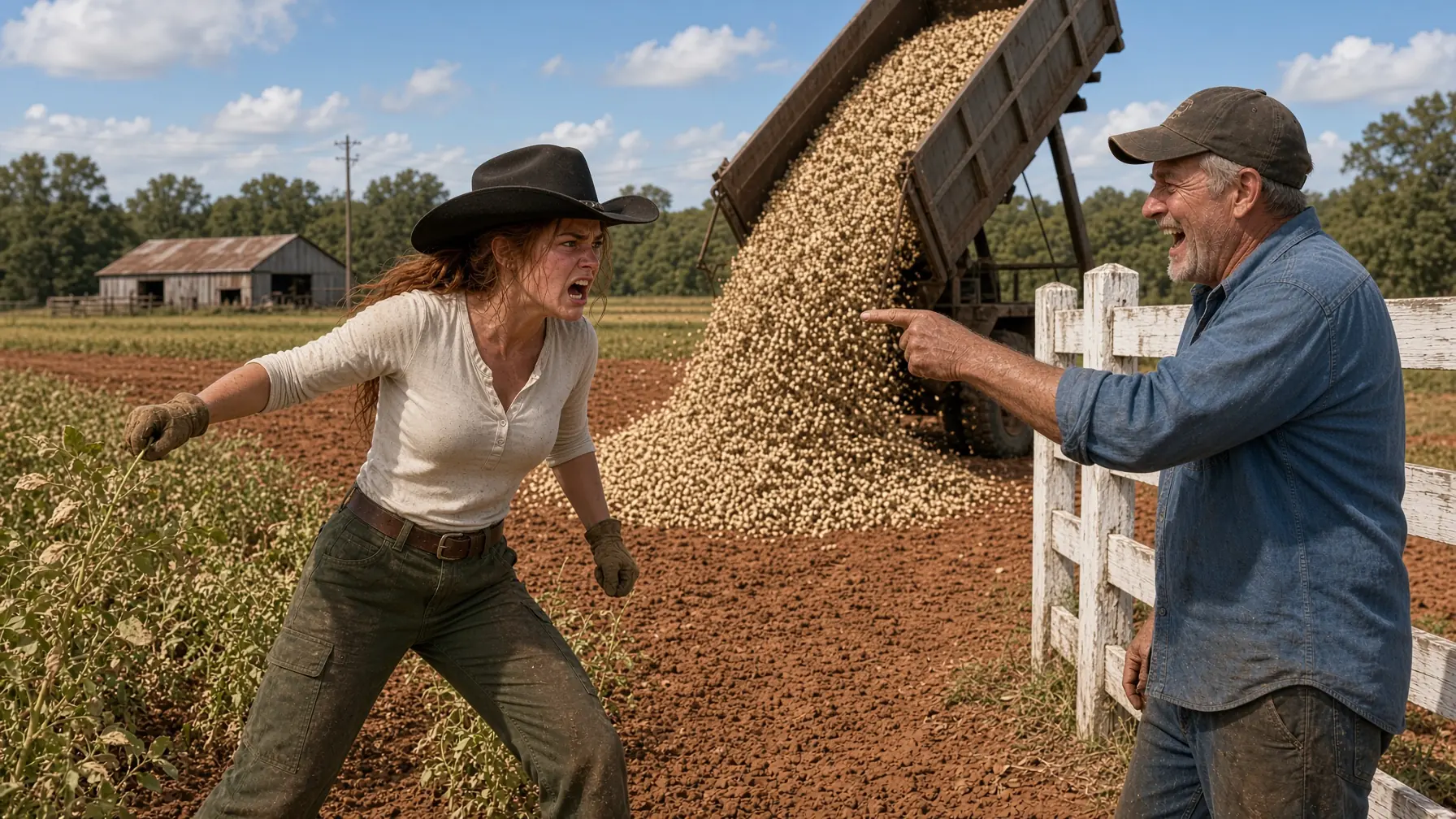
Dry, pale, papery hulls poured out like a grain avalanche, rushing onto the cracked Alabama field in a dusty cascade. They hit the exhausted red clay with a whispering roar and spread across the ground in a mound so huge it looked, from the road, like somebody was dumping trash on a dying farm.
A few struggling rows of peanut plants stood nearby, their leaves thin and faded, their stems weak, their roots trying to survive in soil that looked more like brick than earth.
And standing in front of it all was Nora Bennett.
Twenty-seven years old. Auburn hair pulled into a loose high ponytail beneath a faded ranch cap. Cream henley darkened slightly with sweat across the shoulders. Gloves on. Boots dusty with red clay. Her green-gray eyes were shining, not with fear, but with the kind of humiliation that burns so hot it begins turning into anger.
Facing her was Reggie Sloan.
Reggie had the broad, weathered look of a man who had spent forty years in fields and believed that gave him ownership over every opinion he had ever formed. Gray stubble. Muddy boots. Faded blue work shirt. A cap pulled low over narrow eyes already bright with mean amusement.
He scooped up a double handful of peanut hulls and threw them dramatically across Nora’s struggling plants.
The two farmers behind him burst out laughing.
“Look at those peanut plants,” Reggie barked. “You buried your whole farm in garbage.”
One of the other men slapped his thigh.
“She’s growing peanuts in a trash heap!”
Nora’s face tightened. For a second she looked down at the weak plants, the cracked soil, the pale hulls spreading wider by the second. Anyone watching closely could have seen the sting land. This was not abstract criticism. This was her land. Her crop. Her chance.
Reggie leaned closer, smelling blood.
“Inspector comes tomorrow,” he said with a cruel grin. “Then this circus is finished.”
For one long moment Nora said nothing.
The truck idled. More hulls trembled in the raised bed, waiting.
Then Nora slowly lifted her head.
Something in her expression changed.
The hurt did not disappear.
It hardened.
She raised one gloved hand toward the truck driver.
The driver hesitated only half a second, then nodded and worked the lever.
The truck bed rose higher.
A second, even heavier wave of peanut hulls thundered down behind her and spread across the starving field.
Dust billowed.
The laughter behind Reggie faltered.
Nora stared straight at him.
“Good,” she said. “Let him see what this starving soil looks like now.”
Reggie’s grin wavered.
Nora pointed toward the field.
“Then come back when those peanut plants prove you wrong.”
Three months earlier, Nora Bennett had stood in the exact same field holding a shovel and wondering whether she had already lost.
The Bennett farm sat on a modest patch of rural Alabama land that looked better from the road than it did up close. The farmhouse was still standing. The well still worked. The fencing mostly held. But the soil was tired—so tired that every year it seemed to give a little less and demand a little more.
Nora’s father had grown peanuts on that land the way his father had before him.
Peanuts, cotton, rotation when they could afford it, fertilizer when they had to, hope every spring, worry every summer.
Then came bad prices, two rough seasons, a medical bill, and finally the stroke that left Earl Bennett unable to work full days in the heat. By the time Nora came back home for good, the farm had become a balancing act held together by debt, stubbornness, and memory.
She had every reason to walk away.
Instead, she stayed.
Not because she was naïve. Not because she thought farming was romantic. She stayed because she knew what the place meant to her father, and because she could see the real problem more clearly than he wanted to admit.
The farm was not dying because they didn’t work hard enough.
It was dying because the soil had been drained of life.
Nora first realized just how bad it was when she dug test holes after a spring rain. Six inches down, the earth should have smelled alive—dark, crumbly, rich with organic matter.
Instead, it broke apart in hard red chunks.
Too little cover.
Too much heat.
Not enough organic matter.
Water ran off too fast when it rained and disappeared too fast when it didn’t.
The soil wasn’t holding.
It was surrendering.
That was when Nora started asking around about peanut hulls.
At a shelling plant twenty miles away, mountains of them sat behind the building like useless leftovers. The peanuts went to processors. The hulls, for the most part, became a disposal problem.
But Nora had spent enough nights reading agricultural bulletins and old extension reports to know that hulls were not garbage.
Not if they were clean.
Not if they were used right.
Not if the goal wasn’t appearance—but recovery.
Peanut hulls could shade the soil. Slow evaporation. Reduce temperature swings. Add organic matter over time. Protect the surface from crusting. Help the ground hold moisture long enough for roots to matter again.
Not overnight.
Not magically.
But possibly enough to change the direction of a field that had been starving for years.