Dale Turner stopped laughing long enough to count the rows.
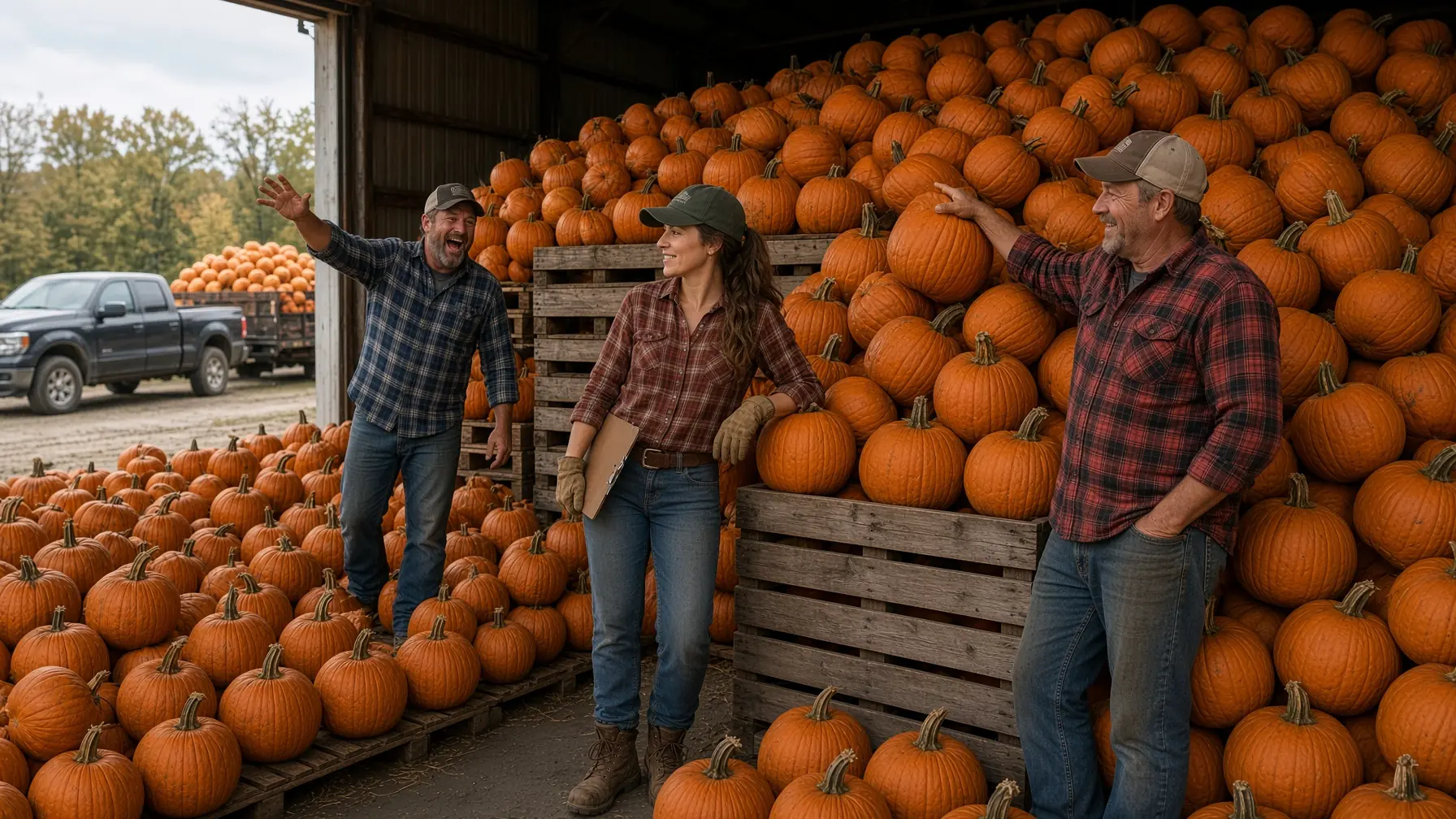
He made it to six.
Then gave up.
“Emma.”
His voice echoed through the storage barn.
“Have you lost your mind?”
Emma Carter did not look up.
She stood beside a wooden bin with a clipboard pressed against one hip, checking quantities.
One hundred twenty-six carving pumpkins.
Forty-three pie varieties.
Seventy-one white pumpkins.
Thirty-six oversized.
Another two hundred still curing beneath the open-sided shed.
And that did not include the trailer parked outside.
The barn looked less like storage and more like somebody had tried to hide autumn itself indoors.
Pumpkins filled nearly every usable section.
Tall wooden bins.
Low crates.
Pallets.
Rows across the concrete floor.
Bright orange globes stacked waist-high in places.
A pickup truck sat beyond the open doors with another trailer waiting behind it.
Dale walked farther inside.
Looked left.
Then right.
Then started laughing again.
Hank Miller, another neighboring farmer, lifted one pumpkin from a crate.
He turned it over.
Perfect stem.
Good color.
Maybe fourteen pounds.
Then looked at the hundreds more behind it.
Hank shook his head.
“What are you planning to do with all this?”
Emma marked another line on her clipboard.
Hank grinned.
“Feed every critter in the county?”
“Maybe.”
Dale pointed toward the enormous stockpile.
“Emma, seriously.”
“You’ll never sell all these.”
She finally looked up.
Twenty-nine years old.
Brown hair beneath a faded green cap.
Rust-red flannel sleeves rolled to her elbows.
Mud dried across her boots.
Her face showed no embarrassment.
No panic.
Only that small expression Dale had learned to dislike whenever Emma knew something she was not ready to explain.
He spread both arms.
“Then why fill the whole barn?”
Emma closed the clipboard.
“Because October hasn’t started yet.”
Hank laughed.
Dale laughed harder.
Emma placed one gloved hand on the nearest crate.
Outside, another trailer rattled into the farm lane carrying more pumpkins.
Dale stared at it.
“Oh, Lord.”
Emma smiled.
And said nothing else.
Five months earlier, the Carter farm had not contained a single pumpkin.
Only plans.
Emma had inherited seventy-six acres from her grandfather.
Not glamorous land.
Sandy loam in parts.
Heavy clay in others.
A pond that shrank too much in August.
One storage barn.
One equipment shed.
A farmhouse built before air-conditioning and apparently designed to prove it.
Her grandfather had grown soybeans, sweet corn, squash, and occasional pumpkins.
Emma had grown up helping him.
After college, she returned permanently.
Not because farming was romantic.
Mostly because she discovered that office work made her more tired than twelve hours on a tractor.
She rented twenty additional acres nearby.
Sold vegetables through two farm stands.
Supplied sweet corn to a grocery cooperative.
Did enough custom mowing to smooth out bad months.
The farm survived.
That was not the same as thriving.
Every year contained one bill large enough to threaten everything.
A tractor transmission.
Irrigation pump.
Property taxes.
Seed.
Fuel.
Something always arrived at the wrong time.
The previous October, Emma noticed something while delivering squash to a grocery store.
The produce manager had a problem.
No pumpkins.
Not enough, anyway.
His contracted supplier had delivered the first two loads.
Then rain hit.
A field turned too wet to harvest.
Pumpkins remained stranded.
The store bought replacements from farther away.
Higher freight.
Lower quality.
Emma listened while unloading but said little.
Two days later, a church called asking whether she had pumpkins for a fall festival.
“No.”
A school called.
Same answer.
A brewery hosting an October event asked for fifty.
No.
A photographer wanted small pumpkins for family sessions.
No.
Then a wedding venue wanted white pumpkins.
Also no.
Emma wrote the requests down.
By Halloween, the page held fourteen names.
She had sold exactly zero pumpkins.
Because she had planted almost none.
That bothered her.
Not because every missed sale represented guaranteed money.
Many inquiries disappeared when people heard a price.
But fourteen separate calls meant something.
Demand existed.
And people were looking late.
In January, Emma began calling.
Not customers.