The first cutting went into the drowned field with a wet sucking sound that made Warren Pike laugh hard enough to bend forward and slap his leg.
Cold gray light lay across Jennings Farm like a sheet of tin. Brown floodwater covered what had once been one of the better pieces of ground on the place, and only the broken tips of last year's corn stubble still rose above the muddy surface. Farther back, the weathered red barn looked darker than usual, its reflection trembling in the water that should never have reached that part of the field. A line of fence posts leaned under the pressure of drifting debris. Pickup trucks stood on the rise near the lane. Beyond them, other farms faded into the wet haze of a Missouri spring that refused to dry out.
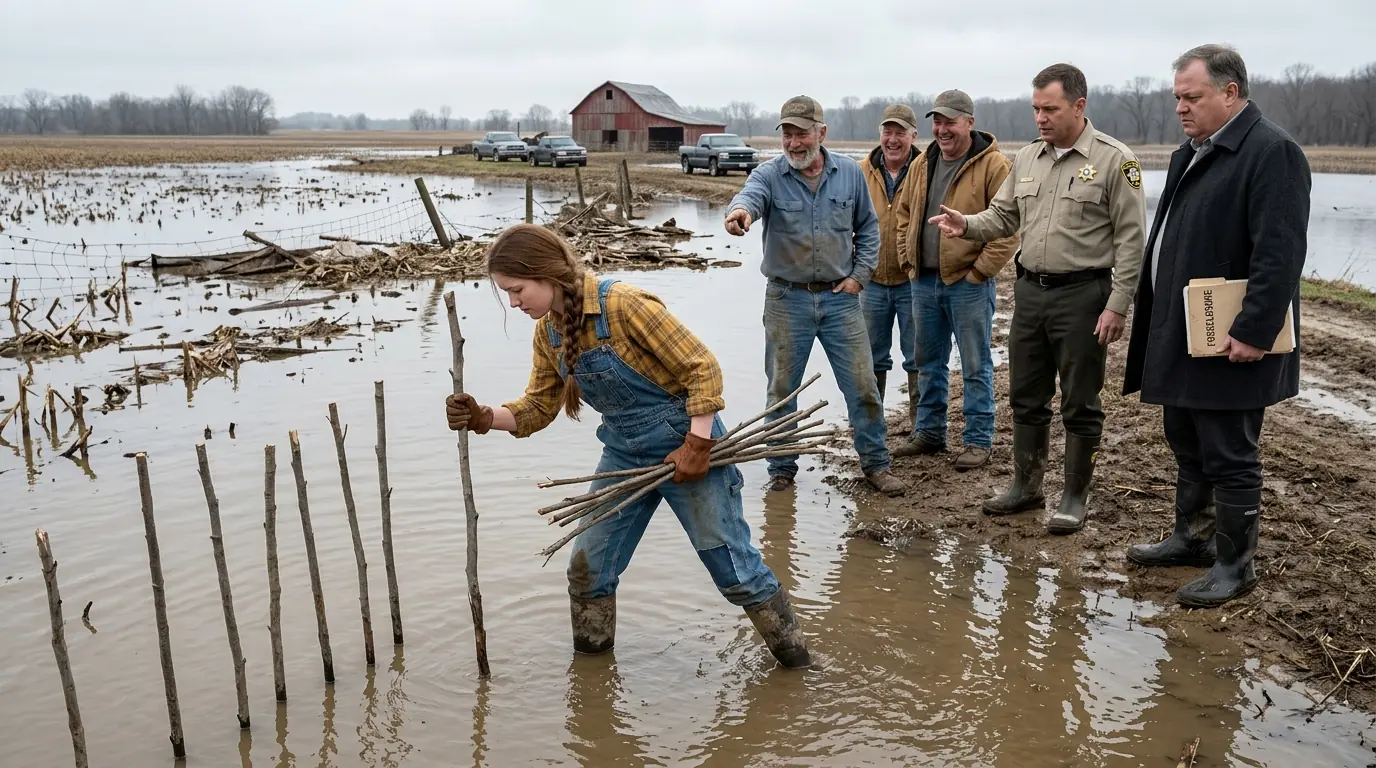
Clara Jennings stood knee-deep in the flood, boots sunk deep in heavy clay, and drove the willow cutting down with both hands and the weight of her whole body. She was eighteen, freckled, narrow-shouldered but stronger than most people guessed, and she had stopped caring a month ago what her posture looked like when she worked. The faded mustard plaid shirt clung damply to her arms. Her patched denim bib overalls were stained with mud above the knees. Her braid hung over one shoulder, darkened by mist. She reached for another cutting from the bundle held under one arm and planted it beside the first without looking toward the men laughing on the bank.
Warren Pike picked up a fallen branch from the edge of the lane, held it upright, and made a theatrical show of jamming it into the grass by his boot.
"There," he announced to the two middle-aged farmers beside him. "I just planted myself a fortune."
They laughed because he laughed, but not as loudly. People were often bolder when a girl was the target and a flooded farm lay behind her.
County agricultural agent Thomas Reed stood a little apart from them, his county badge clipped to a khaki field shirt already splashed with mud. He was fifty, stiff-backed, and habitually careful with words, though not always careful enough. Beside him stood Leonard Baines, broad in the shoulders and heavy through the middle, wearing a charcoal overcoat and polished shoes protected by rubber overshoes. Beneath one arm he carried a thick foreclosure folder with the red bank label exposed. He had brought it deliberately. Leonard believed in visible realities.
Clara planted a third cutting, tamped the mud hard around it, and only then lifted her head.
Warren spread his hands toward the field. "Your farm is drowning, and you're planting firewood."
"I'm giving the water somewhere to go," Clara said.
Her voice was calm enough to irritate him.
Thomas Reed pointed toward the rows of gray-brown cuttings already standing upright across the flooded field, evenly spaced and leafless. There were nearly two hundred of them by then, and to anyone who had not seen willow take root from little more than a switch, they did look like dead sticks. "Those cuttings will rot before summer," he said. "Especially in saturated clay."
Clara pushed the next one deeper. "Come back when the rain stops."