Hollis watched the red crawfish tumble from Nora’s bucket and laughed as though she had just thrown money into the water. The other farmers joined him, certain the shallow drainage creek would swallow her investment before the birds finished feeding. Nora set down the empty bucket and reached for another. She gave them one year to come back—but before that year ended, she would have to find out whether her promise was courage, stubbornness, or a mistake she could not afford.
“You bought all that just to dump it?”
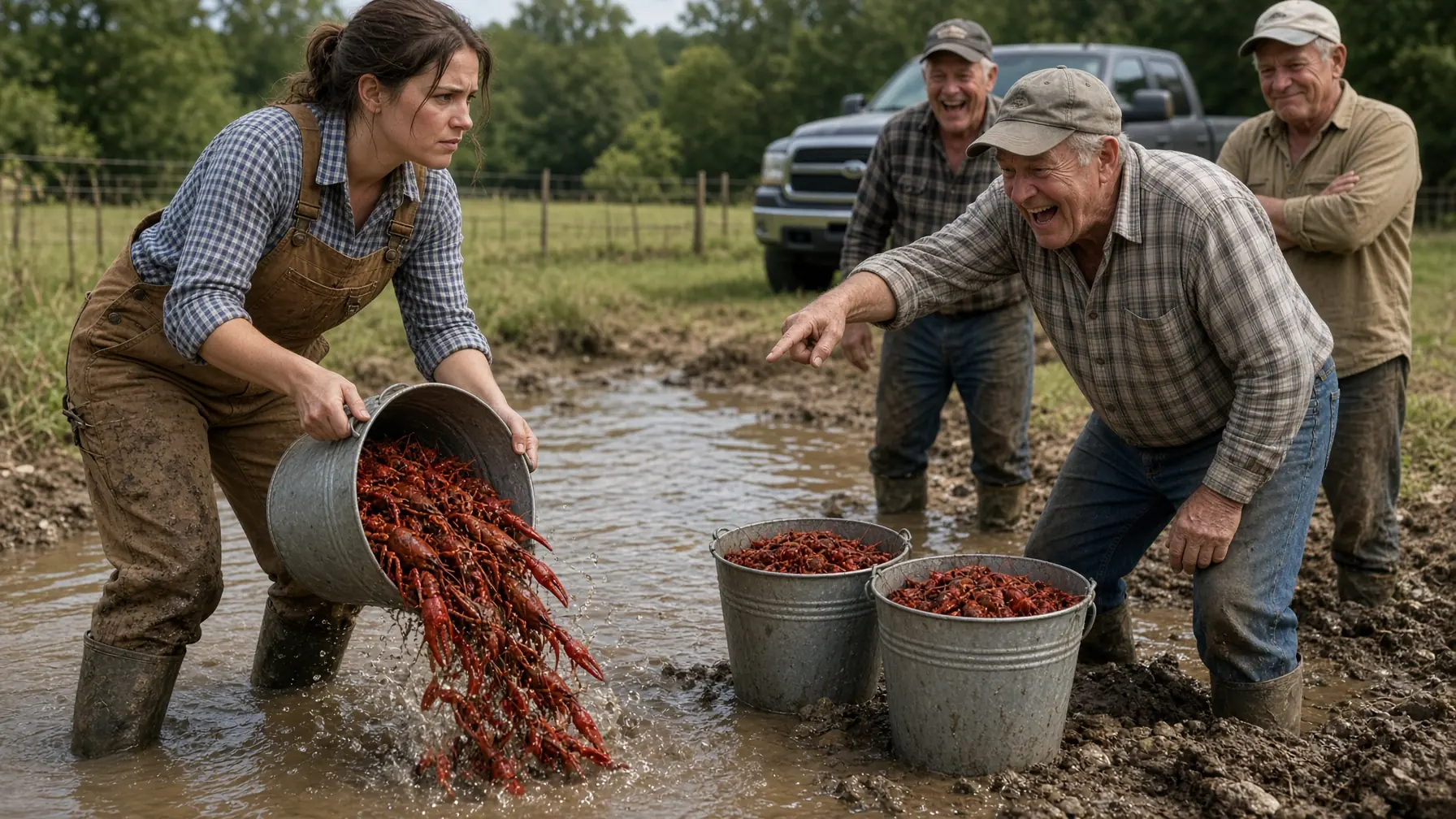
Hollis stood near the parked pickup with his thumbs hooked in his jeans. He had farmed the adjoining land since before Nora learned to drive, and he wore the expression he reserved for young people discovering expensive ways to ignore advice.
Beside him, Wayne looked toward the leafy branches overhanging the creek.
“Hell, the birds’ll love her!”
The third farmer laughed.
Nora tipped the bucket farther, guiding the remaining crawfish into the shallow water. Their red shells flashed against the brown creek bed before the animals slipped beneath roots and submerged grass.
She had a smear of mud on one cheek and water inside her left boot.
Neither problem seemed worth addressing.
“It’s free feeding for everything with wings,” Hollis said.
Nora set down the bucket and lifted the next.
“Laugh now. Come back next summer.”
“To see you broke?”
She poured without answering.
The laughter continued behind her while she watched the crawfish settle into the shaded bank. A few moved against the current. Others vanished beneath the grass so quickly that it seemed impossible they had been there at all.
Nora reached for the final bucket.
Her hands hurt.
She had loaded the crawfish before sunrise, driven back to the farm, and carried every container down the slope herself.
The three men had arrived when most of the work was finished.
That gave them the easiest part.
An audience.
An opinion.
A chance to leave.
Nora turned toward them.
“Are you staying long enough to help carry these back?”
Wayne glanced at Hollis.
The older man smiled.
“Helping you pour money away?”
“Helping carry buckets.”
The third farmer shrugged and picked up two empties.
Hollis watched him.
Then he looked at Nora again.
“Your daddy tried enough things down here.”
Nora’s grip tightened.
“My father didn’t try this.”
“He knew water wouldn’t stay where you wanted it.”
She looked beyond the creek toward the low field.
“Yes,” she said. “That’s why I’m trying to work with it.”
Hollis shook his head.
He did not ask what she meant.
The three men left after carrying the buckets to the truck, still discussing her crawfish as though she were not standing nearby.
Nora waited until their pickup disappeared beyond the trees.
Then she crouched by the bank.
One crawfish remained visible beneath a submerged root.
It raised a claw when her shadow crossed the water.
She smiled despite the knot in her stomach.
“All right,” she whispered. “Let’s not embarrass each other.”
The farm was not large.
There was an old house, a barn with a patched roof, pasture on higher ground, and a lower field that turned troublesome whenever rain settled into the valley.
For years, the drainage creek had carried water through the property.
Her father called it the back ditch.
Her mother called it the reason their boots never dried.
Nora called it a resource only after spending months looking at the farm’s accounts and realizing she could no longer afford to treat every difficult acre as a place to avoid.
She was thirty-two.
She had worked in a commercial plant nursery before returning home.
She could manage propagation schedules, repair irrigation lines, and keep a row of seedlings alive through weather that seemed determined to kill them.
Running the whole farm was different.
Her father died two years earlier.
The land came with equipment, repairs, and debt.
None of those waited politely while she learned.
The higher ground supported vegetables and a small pasture lease.
The low field absorbed money.
Drainage work helped one season and failed the next.
A crop planted there after a hopeful spring could disappear under standing water before the first payment for seed came due.
Hollis had offered to rent it.
Then offered to buy that portion.
He said she could simplify her life.
Nora knew he might be right.
She also knew selling the easiest piece to dismiss would make the remaining farm harder to use as a whole.
The creek crossed the field’s edge.
The old drainage controls were repairable.
The soil held water.
What had been a problem for dry-land crops might be useful for something that did not need the ground to stay dry.
That thought led her to crawfish.
It did not lead directly to buckets.
First came questions.
The species.
The water.
The soil.
The market.
The difference between placing animals in water and managing a crop.
She visited an established producer.
She spoke with an extension specialist.
She tested the water and studied the land.
The creek section she intended to use was part of the farm’s controllable drainage system, linked to a shallow basin she could manage separately.
It was not an invitation to scatter animals into every stream she saw.
She had repaired screens and controls before buying the stock.
She had walked the boundaries with someone who understood drainage.