The first chicken hit the orchard floor at 7:12 on a cold October morning.
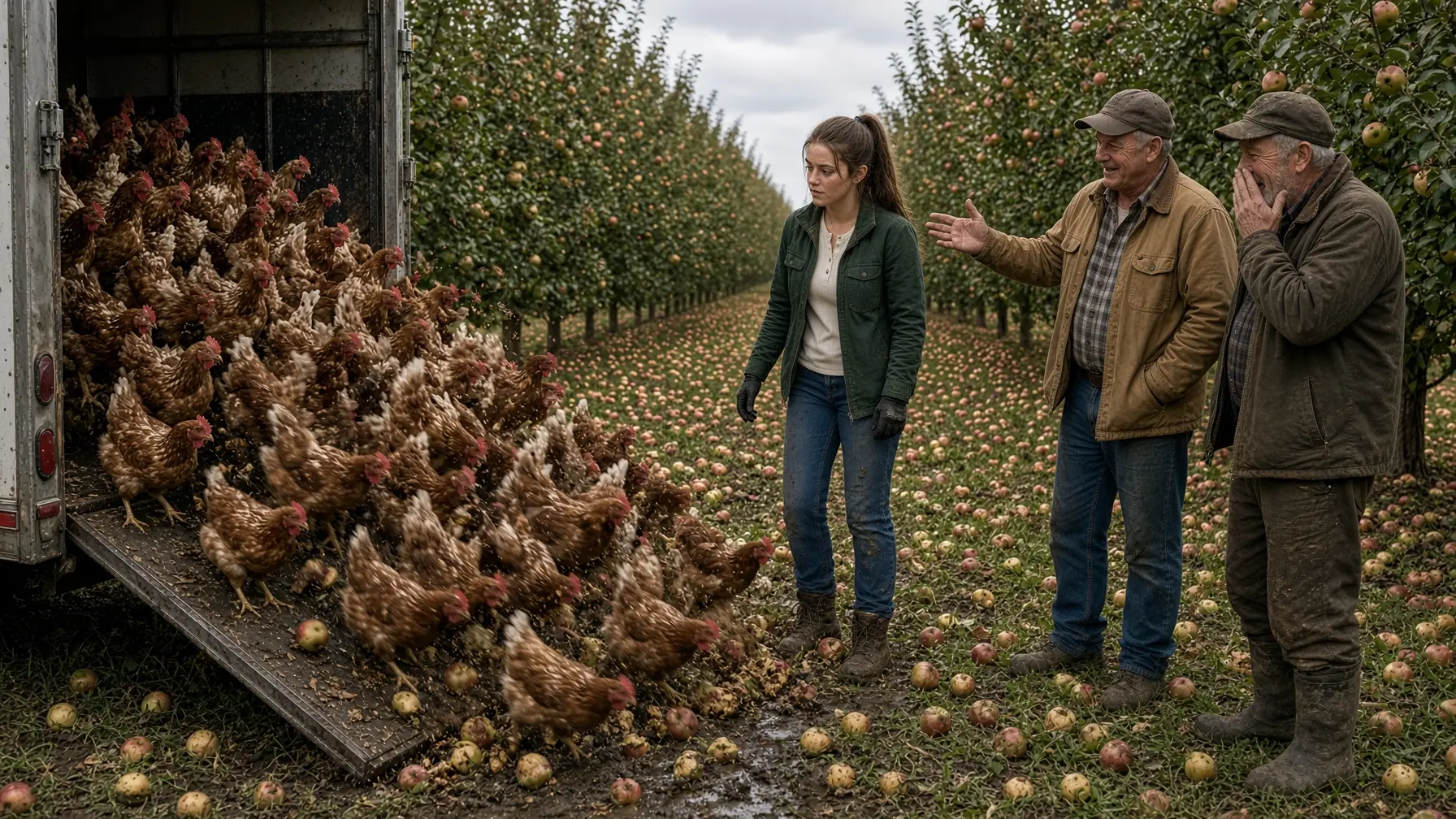
Then came another.
And another.
Within less than a minute, five hundred hens were pouring down the livestock trailer ramp beneath rows of apple trees.
Brown.
White.
Black.
Red.
Some flapped.
Some stumbled.
Some immediately began scratching through the wet grass.
Others ran straight toward piles of damaged apples lying beneath the trees.
Emily Carter stood beside the trailer wearing muddy boots, faded jeans, a canvas jacket, and the expression of someone who had spent too much money on an idea to admit she was nervous.
Her father, Mark, stood twenty feet away with his arms crossed.
He said nothing.
Neither did Ray Donnelly.
At first.
Ray had advised orchard growers in western Michigan for almost thirty years.
He knew apple scab.
Codling moth.
Fire blight.
Fruit rots.
Spray intervals.
Pruning schedules.
Soil amendments.
Harvest timing.
He had helped dozens of farms survive seasons that should have ruined them.
And now he was staring at five hundred chickens running beneath mature apple trees.
Finally, he laughed.
“You actually did it.”
Emily looked at him.
“Yes.”
Ray pointed.
“Five hundred chickens.”
“Yes.”
“In an apple orchard.”
“That is generally where we are standing.”
Mark turned away so Ray would not see him smile.
Ray shook his head.
“What is this supposed to be?”
Emily opened the temporary electric fence.
A group of hens immediately rushed toward a pile of split Gala apples.
“A trial.”
Ray laughed again.
“A trial of what?”
Emily watched one hen peck through a bruised apple.
Two others joined it.
Then four.
Insects hiding beneath the fruit scattered into the grass.
The hens chased them instantly.
Emily smiled.
“That.”
Ray stared.
One chicken stood on an apple.
Another pulled a worm from beneath wet leaves.
A third scratched so aggressively that dirt flew backward onto another bird.
Ray looked at Mark.
“You're allowing this?”
Mark shrugged.
“Twelve acres.”
Ray turned back to Emily.
“You know chickens don't know which insects you want them to eat.”
“Yes.”
“They'll scratch your orchard floor.”
“Yes.”
“They'll manure everywhere.”
Emily nodded.
“That is also the idea.”
Ray stared at her.
Then burst out laughing.
Several neighboring growers standing near the lane joined him.
One called:
“You starting a petting zoo, Emily?”
Another shouted:
“Charge admission!”
Emily said nothing.
She had heard all of it before.
For eight months.
At meetings.
At the feed store.
At the kitchen table.
Even from her own father.
She closed the trailer gate.
Then looked at Ray.
“You asked for numbers.”
Ray smiled.
“I did.”
Emily pointed toward the orchard.
“Come back after the season.”
Six weeks later, nobody was laughing.
Because the rain had not stopped.
And the tractor had.
The Carter family had been growing apples for more than fifty years.
Emily's grandfather planted the first twenty acres in 1968.
Her father expanded the orchard to one hundred forty acres.
By the time Emily was ten, she could distinguish a Gala from a Fuji before either had fully colored.
At fourteen, she could drive a tractor.
At sixteen, she announced that she would never become a farmer.
Mark took the news calmly.
“Good.”
Emily stared at him.
“Good?”
“Every farmer needs at least one child smart enough to leave.”
She went to college two years later.
Environmental systems.
Her father described it to neighbors as:
“Something involving dirt and spreadsheets.”