The first person to laugh was Dale Mercer.
The second was the auctioneer.
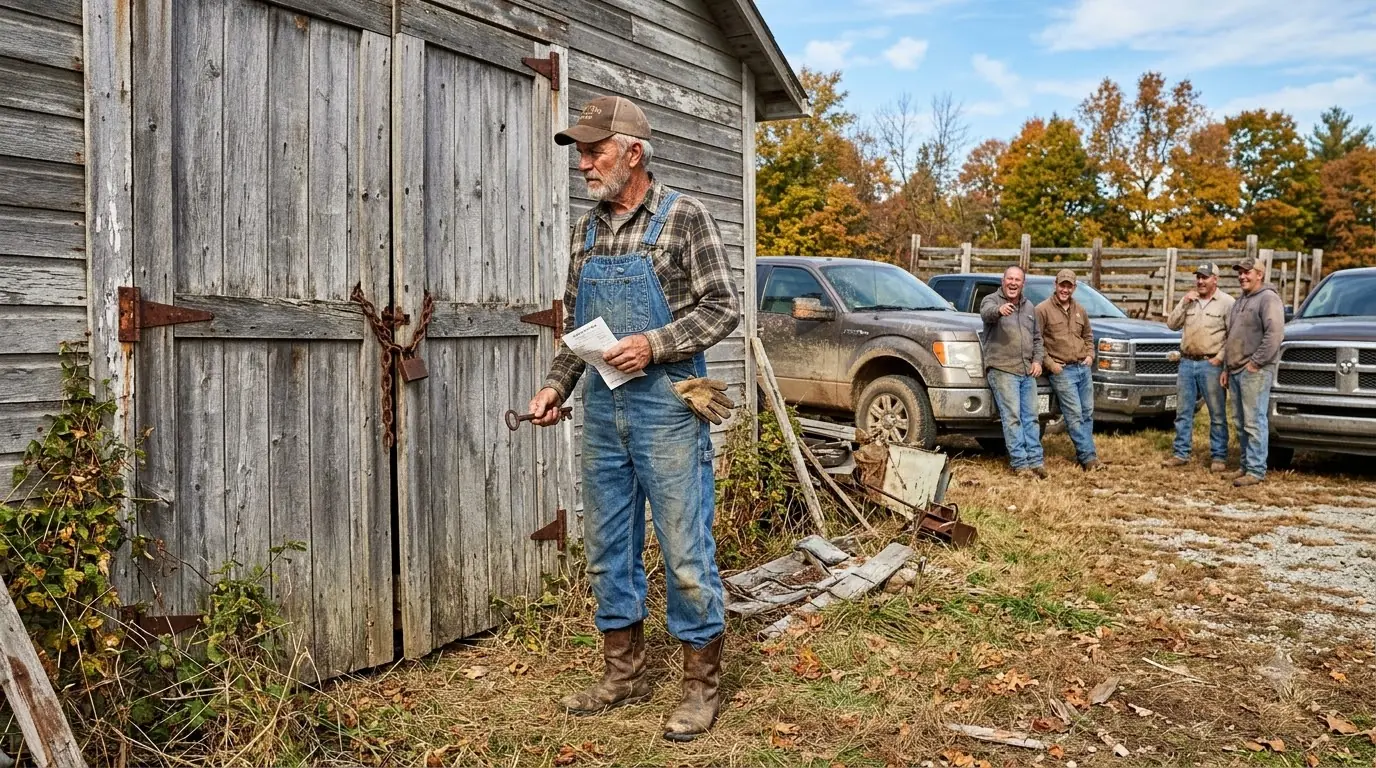
By the time Ethan Cole raised his hand and offered twelve thousand dollars for the abandoned Whitmore barn, half the men standing beside the county road were smiling.
Not because the price was high.
Because they thought any price was too high.
The barn had been empty for more than thirty years.
Its roof sagged toward the middle.
Vines covered one wall.
Two windows were gone.
Part of the north siding had turned gray and soft with rot.
A maple tree had grown so close to the foundation that one root had pushed a stone nearly six inches out of line.
And on the eastern side of the building stood a pair of enormous wooden doors nobody in town remembered seeing open.
They were nearly fourteen feet high.
Oak.
Iron-banded.
Blackened by age.
A rusted chain crossed them twice.
The metal lock hanging in the center was bigger than Ethan’s fist.
The auctioneer looked at him.
“Twelve thousand?”
Ethan nodded.
Dale Mercer laughed from behind him.
“Cole, you buying firewood now?”
A few men chuckled.
Ethan ignored them.
The auctioneer looked around.
“Do I hear twelve-five?”
Nothing.
“Twelve-five?”
Silence.
Dale folded his arms.
“I wouldn't give him twelve hundred.”
The auctioneer waited.
Then lifted his hand.
“Going once.”
Ethan stared at the barn.
“Going twice.”
Wind moved through the high grass.
“Sold.”
The hammer came down.
“Twelve thousand dollars to Ethan Cole.”
Dale whistled.
“Congratulations.”
Ethan turned.
Dale grinned.
“You just bought the most expensive raccoon house in Carter County.”
More laughter.
Ethan put his hands into the pockets of his faded work jacket.
“Maybe.”
Then he walked toward the barn.
That answer irritated Dale more than an argument would have.
Ethan Cole was fifty-nine years old and had farmed land outside Mill Creek, Kentucky, almost his entire life.
He was not wealthy.
He owned forty-seven acres outright.
Leased another thirty.
Raised hay.
Kept twenty-three beef cattle.
Grew sweet corn and pumpkins on several lower fields.
He repaired his own equipment whenever possible because new equipment prices offended him personally.
His tractor was older than his youngest daughter.
His pickup was older than several men working at the feed store.
Ethan did not spend money casually.
That was exactly why people could not understand the barn.
Twelve thousand dollars represented nearly all the cash Ethan had set aside for replacing his hay baler.
His current baler had missed knots twice the previous summer.
Everybody knew it.
Even Dale.
Especially Dale.
When word spread that Ethan bought the Whitmore property instead, people treated the decision like a late-life breakdown.
At Miller’s Feed & Supply, Carl Jensen asked:
“You feeling all right?”
Ethan looked up from a mineral block.
“Fine.”
“You spend twelve grand on that barn?”
“Yes.”
Carl waited.
Ethan continued loading.
“That’s it?”
“What?”
“You’re not gonna explain?”
“No.”
Carl stared.
“People say that thing’s ready to fall.”
“People say a lot.”
“What are you going to do with it?”
Ethan lifted another block.
“Open it.”
Carl laughed.
“The door?”
“Yes.”
“That’s your plan?”
“Part of it.”
“What’s behind it?”
Ethan stopped.
Looked toward him.
“I don't know.”
Carl blinked.
“You spent twelve thousand dollars and you don't know?”
“No.”
“That makes it worse.”
Ethan smiled.
“Maybe.”
The Whitmore barn sat on nine acres nobody wanted badly enough to maintain.
It belonged to the Whitmore family for almost a century.
Silas Whitmore built the original structure in 1911.
His son expanded it after World War II.
For decades, Whitmore Farm had been known for draft horses, seed corn and machinery repair.
Then everything changed.
Silas’s grandson Harold moved away in the late 1970s.
Cattle were sold.
Fields rented.
The house burned in 1987 after an electrical fire.
Nobody rebuilt it.
The barn remained.
For a few years, people used part of it for hay.
Then the doors were chained.
Taxes were paid irregularly by distant descendants.
Eventually the county forced a sale.
That was the public history.
Ethan became interested because of something much smaller.
A photograph.
He found it six weeks before the auction.
Not online.
Not in a county archive.
Inside an old coffee can.
Ethan had been helping his neighbor Walter Briggs clean out a shed after Walter broke his hip.
Walter was eighty-one and had accumulated six decades of things he considered “too useful to throw away.”
Most were not useful.
Rusty bolts.
Broken hinges.
Bent license plates.
Old catalogs.
But inside one coffee can were photographs.
County fairs.
Farm machinery.
Barn raisings.
One image stopped Ethan.
Black and white.
Dated in pencil:
Whitmore Farm — August 1956
The photograph showed five men standing beside the barn.
Ethan recognized the building immediately.
Same roofline.
Same eastern wall.
Same massive doors.
But there was something strange about the image.
The doors were open.