The miners began laughing before the ceremony was finished.
It was not polite laughter.
It rolled through the muddy street outside the Bitter Creek mining camp saloon, loud enough that men inside came to the doorway just to see what had happened.
At the center of it stood the plus-size camp cook, twenty-eight years old, fair-skinned, with a soft round face, long dark-brown hair, and a body that had been discussed by strangers for so many years that she sometimes wondered whether it belonged more to public conversation than to herself.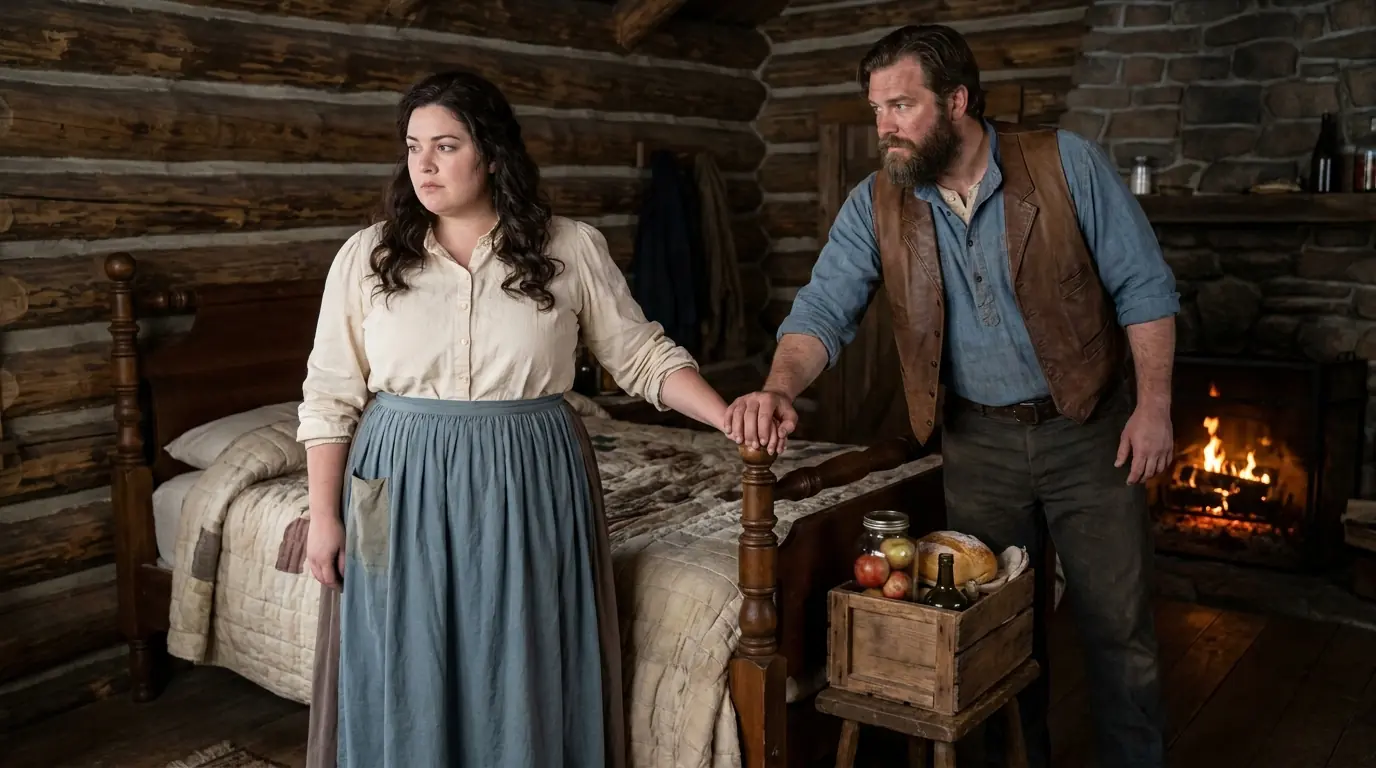
She weighed close to three hundred pounds.
Everyone in camp knew it.
Not because she told them.
Because men had spent two years estimating it out loud.
The cook stood beside a half-sober local magistrate wearing the cleanest dress she owned, a modest cream blouse with gathered sleeves, a long dusty-blue skirt, and an apron she had forgotten to remove until one of the kitchen women quietly untied it for her.
Beside her stood the mountain man.
He was nearly forty, more than six feet tall, broad through the shoulders, with dark wavy hair, a thick beard, a weathered face, and an old scar cutting across one cheek.
He wore a faded blue work shirt beneath a brown leather vest, dark trousers, heavy boots, and a coat that had been repaired so many times that three different shades of thread crossed one sleeve.
Nobody laughed at him.
They laughed because he was marrying her.
A miner cupped both hands around his mouth.
“Careful taking her up the pass! That mule sees her coming, it might quit!”
The street erupted.
The cook stared straight ahead.
Another man shouted, “Mountain man, you planning to reinforce the bed?”
More laughter.
The magistrate cleared his throat.
The mountain man did not turn toward the crowd.
He looked only at the cook.
“Want to leave?”
She blinked.
The magistrate was still standing between them.
The vows were not technically complete.
“Now?”
“Yes.”
The cook stared at him.
“What about the ceremony?”
The mountain man looked toward the magistrate.
“You finished?”
The magistrate glanced at the paper.
“Near enough.”
“Then we’re leaving.”
Someone shouted another joke.
The mountain man finally turned.
The laughter weakened.
He did not threaten anyone.
He did not reach for the hunting knife at his belt.
He simply looked across the gathered miners with an expression so calm that one by one, men discovered other things to study.
Boots.
Mud.
Clouds.
Anything except him.
Then the mountain man lifted the cook’s two heavy trunks into the wagon.
One in each hand.
That caused a different kind of silence.
The cook watched him.
“You could have asked me to help.”
“I could.”
“You didn’t.”
“No.”
“Why?”
He placed the second trunk securely against the first.
“Because I was already standing here.”
The cook frowned.
That answer was irritatingly reasonable.
The mountain man walked toward the large draft mule hitched to the wagon.
Someone near the saloon muttered another comment.
This one was too low for the cook to hear.
The mountain man heard it.
He stopped.
The cook felt heat rise into her face.
Here it comes.
He would defend her.
Make a spectacle.
Turn her into the helpless woman whose husband had to silence mean men.
Instead, the mountain man looked at the miner and said:
“You ate three bowls of her stew last night.”
The miner froze.
The mountain man continued.
“Seems strange to insult the woman keeping you alive.”
A few men laughed.
Not at the cook this time.
The miner looked away.
The mountain man climbed onto the wagon.
The cook remained beside it.
He looked down.
“You coming?”
She glanced at the miners.
Two years.
She had fed them during cave-ins.
Fever outbreaks.
Snowstorms.
Pay disputes.
She had cooked beans until her hands cramped.
Baked bread before sunrise.
Dragged flour sacks through mud.
Made soup from vegetables so old the camp manager wanted to throw them away.
The same men who joked about her weight appeared every evening holding empty bowls.
One of them had once called her “too much woman for any sensible man.”
Then asked for another biscuit.
The cook looked toward the mountain road.
Three days upward.
One isolated cabin.
One husband she barely knew.
No guarantee of anything.
She put one foot on the wagon step.
The mountain man offered his hand.
She looked at it.
He waited.
The cook took it.
He pulled only enough to steady her.
She climbed onto the broad padded seat he had attached beside his own.
The cook immediately noticed.
“This seat new?”
“Yes.”
“For me?”
“Yes.”
Her stomach tightened.
He had anticipated her body.
The old shame returned.
The mountain man noticed her expression.
“Problem?”
“You thought I’d break the other bench?”
“No.”
She looked sharply at him.
“Then why?”
“The regular seat is narrow.”
“So?”
“So it looked uncomfortable.”
The cook stared.
He flicked the reins.
The wagon began moving.
That was all.
No apology.
No embarrassment.
No speech about her size.
Simply uncomfortable.
So he had made something more comfortable.
The miners disappeared behind them.
The cook looked forward.
For the first mile, neither spoke.
Then she asked:
“You really want a wife?”
“Yes.”
“You’ve lived alone how long?”
“Fourteen years.”
“And suddenly you need one.”
“No.”
She frowned.
“You said you did.”
“I said I wanted one.”
“That’s different.”
“Yes.”
The cook looked at him more carefully.
“You told me you needed a wife.”
The mountain man thought.
“I said it badly.”
“That seems important during a proposal.”
“Yes.”
She almost smiled.
Almost.
Three weeks earlier, he had walked into the cook tent after supper.
The last miner had left.
Rain beat against the canvas.
The cook stood beside a wooden table scraping flour from the surface.
The mountain man had spent the previous two days in camp trading hides, buying salt, lamp oil, coffee, and grain.
She had seen him before.
Everyone had.
He came down from the mountains twice a year.
People stepped aside when he entered rooms.
Some because he was frightening.
Others because stories had turned him into something larger than a man.
The cook never believed most stories.
Men who survived one difficult winter could become legends by spring if enough whiskey was available.
That evening, he watched her lift a fifty-pound flour sack onto a shelf.
She caught him looking.
“What?”
He glanced toward the empty tables.
“They talk to you badly.”
The cook continued wiping.
“They pay for food.”
“That doesn’t answer.”
“The talk comes free.”
The mountain man leaned against a support post.
“You mind?”
She shrugged.
“Some days.”
“What do you do?”
“Keep cooking.”
“Why?”
“Because hunger makes men worse.”
That answer made him smile.
Small.
Almost invisible.
Then he said:
“Winter’s coming.”
The cook stared.
“It generally does.”
“I have a cabin three days above the pass.”
“I’ve heard.”
“Good roof.”
“Congratulations.”
“Firewood.”
“Impressive.”
“Food enough for two.”
She stopped wiping.
The mountain man looked directly at her.
“I want a wife.”
The cook stared.
No one had ever proposed to her.
Men had teased.
Flirted as jokes.
Once, when she was nineteen, a cousin’s friend kissed her during a party because someone had dared him.
He laughed afterward.
She had never forgotten.
Now this scarred mountain man stood inside a flour-smelling cook tent proposing marriage like he was discussing a weatherproof roof.
The cook looked around.
“If someone put you up to this, tell them they won.”
“No one did.”
“You expect me to believe you walked in here and decided you need a wife?”
“Want.”
She rolled her eyes.
“Fine. Want.”
“Yes.”
“Why me?”
The mountain man looked at her.
“You work.”
Her face hardened.
Of course.
Strong back.
Cheap labor.
“I can hire someone.”
He continued.
“You don’t panic.”
“Usually.”
“You can cook.”
“That’s my job.”
“You know how to preserve food.”
“Yes.”
“Use an axe.”
“Yes.”
“Repair clothes.”
“Badly.”
“Better than me.”
The cook folded her arms.
“Are you marrying a woman or hiring a camp worker?”
The mountain man paused.
Then said:
“You’re right.”
That stopped her.
He continued.
“I’m explaining badly.”
“You seem gifted at that.”
“Yes.”