Three days before the biggest signing ceremony of the year, a company refused to pay a quiet single man $40 for 8 hours of honest work and told him to take it to court if he wanted it so badly.
Nobody in that glass tower bothered to ask what he had spent the day doing or why his hands were still faintly dusted with concrete residue when he stood at the payment counter waiting patiently for a form that never seemed to arrive.
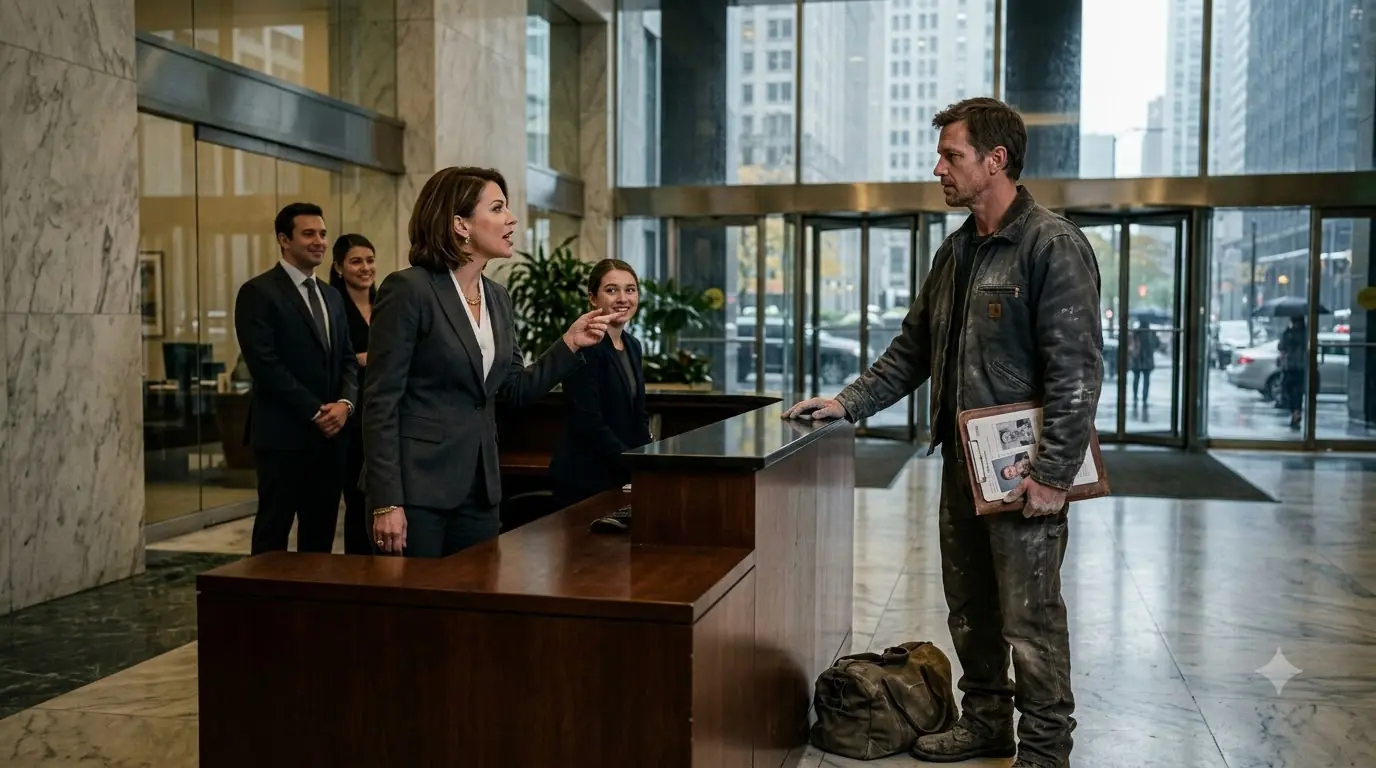
Elias Mercer did not raise his voice. He did not slam his palm on the counter or demand to see a manager the way another man might have after being humiliated in front of an entire lobby of strangers.
He simply closed his laptop bag, slid the folder of photographs and readings back inside it, and walked out into the cold autumn rain that had been falling over Chicago since morning. His coat collar turned up against the wind as he crossed the parking lot without once looking back at the building behind him.
What none of them understood, not the receptionist who laughed under her breath, not the accountant who shrugged and moved on to the next task, not even the woman who gave the order to make him wait as though his time carried no weight at all, was that the man leaving their building was the only structural risk consultant who had actually found the flaw buried inside their newest tower.
A flaw that could unravel a deal worth more than a billion dollars. 72 hours later, in front of bankers, partners, and reporters, in the middle of the most important contract signing of the entire year, the room would go silent as investors stared down at the very report the company had mocked, and the number written at the bottom of the settlement would read 12 million dollars, a figure that would follow the company's name through headlines for months to come.
Elias Mercer was 41 years old, and he had built a quiet, steady life out of precision. He worked as an independent structural inspector and risk assessor, the kind of professional companies called when they needed a second set of eyes they could trust completely, someone with no stake in the outcome except the truth. He had been divorced for several years, and though he lived alone now in a modest apartment on the north side of the city, his days were shaped by discipline rather than sentiment. He measured twice, documented everything, and never signed his name to anything he had not personally verified.
Colleagues who had worked alongside him over the years described him the same way, almost without exception, calling him unhurried, unshakeable, and impossible to rattle. The sort of man who could deliver bad news about a failing beam with the same even tone he used to discuss the weather. He had learned that steadiness early in his career, back when a louder, more excitable inspector might have been dismissed as alarmist and ignored entirely. Quiet certainty, he had come to believe, carried further than noise ever could.
That morning, Ashcroft Urban Holdings had called him in on short notice, needing an emergency inspection completed within a single day before their flagship tower could be cleared for a major investment closing. The call had come from a mid-level project coordinator who sounded frazzled, explaining that their usual inspection firm had a scheduling conflict and that the timeline could not slip even by a day. Elias had cleared his calendar, packed his laser equipment, his cameras, and his notebooks, and arrived before sunrise to begin walking every floor of the structure. He worked alone, as he always did, moving from the underground levels upward with methodical patience, pausing at every junction, every seam, every place where one material met another, carrying with him the quiet certainty that thoroughness now would prevent far greater trouble later.
By the time the sun had fully risen over the skyline, he had already logged more measurements than most inspectors would take in a full week, filling page after page of his notebook with careful, legible handwriting that left no room for later confusion. By early afternoon, he had completed the full survey, moving methodically through mechanical rooms, load-bearing corridors, and the underground parking structure that supported the entire weight of the building above it. He worked with the same unhurried thoroughness in every section, crouching beside support columns, running his gloved hand along seams in the concrete, and cross-checking each area against the blueprints loaded onto his tablet.
Something in the third sub-level caught his attention immediately. A section of reinforcement that did not match the original specifications on file. The kind of detail that would have been invisible to anyone not specifically trained to look for it. He photographed it from several angles, took laser measurements to confirm the deviation, and noted the anomaly carefully in his preliminary report before continuing his walk-through, unwilling to let the discovery rush the remainder of his work.
When the inspection was finished, he submitted his findings to the front desk exactly as instructed, handing over a printed summary along with a note that a more detailed report would follow within the day, and asked, politely, about payment for the day's work. A modest sum of $40 that had been agreed upon as a processing fee, separate from his full consulting invoice, which would be billed later through standard channels. The woman behind the counter looked at her screen, frowned, and told him there was a delay, something about a missing signature from finance that she could not resolve on her own. Elias nodded and said he would wait, setting his equipment case down beside the bench without any hint of impatience in his expression.
He waited for nearly 2 hours in the lobby, seated on a leather bench beneath a wall of framed awards the company had won for architectural excellence. Employees passed him without a glance, phones pressed to their ears, coffee cups in hand, the ordinary rhythm of a company convinced that nothing could touch it. Twice he approached the front desk to ask politely whether there had been any update. And twice the young receptionist offered the same apologetic shrug, explaining that finance handled disbursements on its own schedule, and that there was little she could do to speed things along.
Elias thanked her both times and returned to the bench without complaint, setting his equipment case carefully beside his feet and continuing to review his photographs on his tablet while he waited. Eventually, the CEO herself crossed through the lobby on her way to a meeting. Vivian Ashcroft was 39 years old, sharp-featured, dressed in a tailored charcoal suit that made her look like she had stepped directly out of a business magazine cover. She noticed him only because an assistant murmured something about a vendor complaint, glancing briefly toward the man seated near the awards wall.
When she learned the entire hold-up concerned a sum as small as $40, she let out a short, dismissive laugh that echoed across the marble floor. "$40," she repeated, loud enough for the small cluster of employees nearby to hear, and asked if he was really planning to stand there over an amount that small when there were people in this building closing deals worth more than his entire yearly income before lunch. A few of the younger staff members laughed along with her, the kind of laughter that comes not from real amusement, but from the instinct to align with power.