Ernestine Freeman was standing beside her birthday cake when an officer shoved her off the patio and onto the grass. While her family tried to reach her, his partner crushed the cake and announced that the celebration was over. Then the side gate opened, and the man carrying a birthday gift stopped so suddenly that everyone turned to see what he was looking at.
The shove caught Ernestine before she could finish her question.
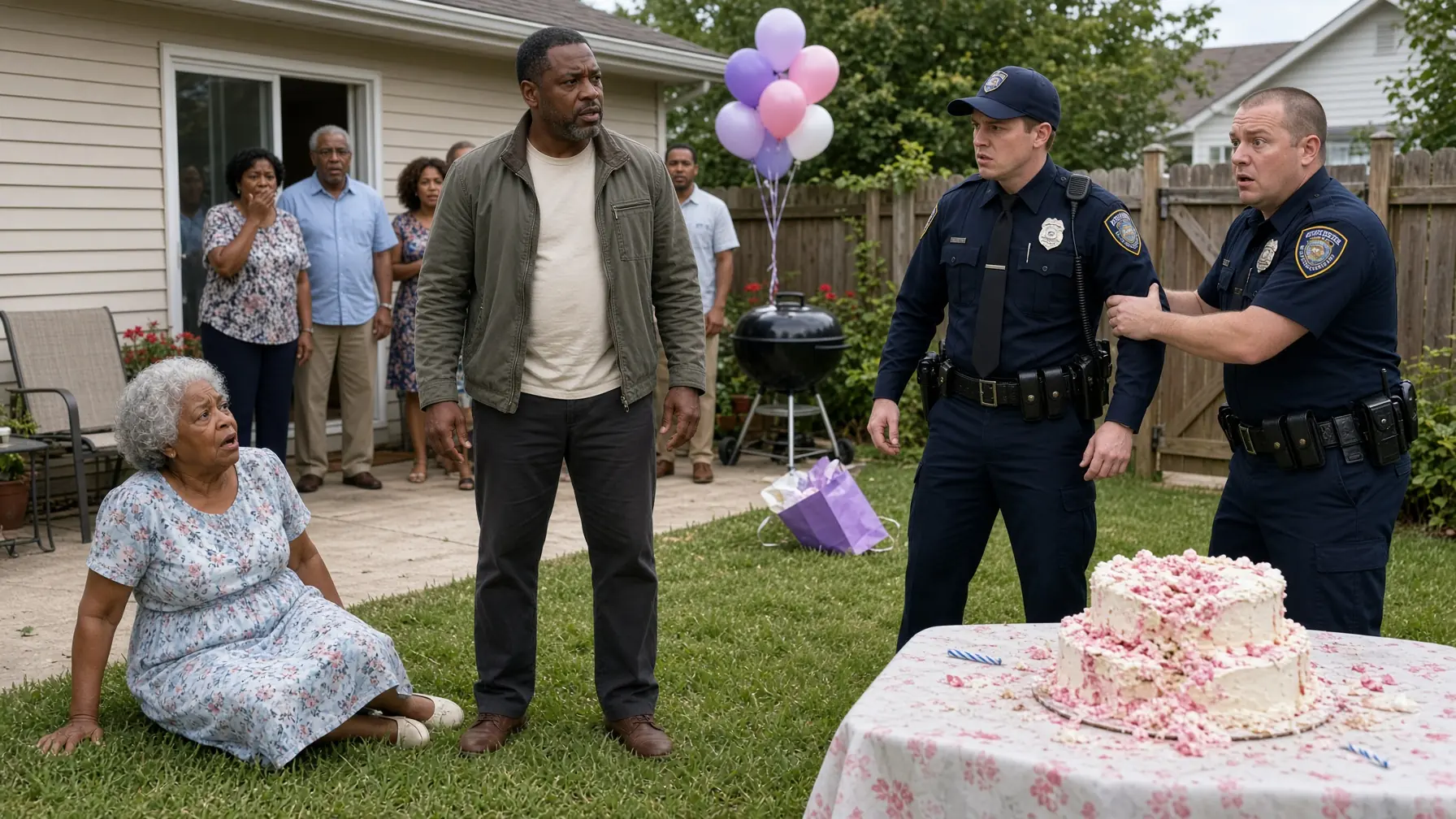
Officer Tyler Grady’s palm struck her shoulder. She stepped backward to keep her balance, but the heel of her cream flat slipped beyond the patio edge.
For a moment, she seemed suspended between standing and falling.
Then she landed on the grass.
The sound that came from her daughter was sharp enough to stop a conversation near the grill. A paper plate slipped from somebody’s hand, and the birthday candles leaned in the afternoon breeze while Ernestine tried to understand why she was looking up at the sky.
“Get back!” Grady shouted. “I said move!”
He was still on the patio.
Ernestine was already on the ground.
Her daughter started toward her, but Officer Nathan Bole stepped into the space between them and held out his arm.
“Stay there.”
“She’s my mother.”
“Stay there.”
Ernestine propped herself up on one hand.
Her pale blue floral dress had caught beneath her knee. She could feel grass against her palm and the sudden sting in her shoulder.
She looked at Grady.
“This is my home,” she said, her voice shaking. “What the hell are you doing?”
Nobody answered the question.
That morning, Ernestine had awakened before anybody else.
She lay in bed for several minutes listening to the familiar noises of the house. The refrigerator downstairs, a branch moving against the outside gutter, the soft creak near the bedroom doorway when the temperature changed.
Seventy.
She had tried the word in her mind before getting up.
It did not feel wrong.
It did not feel like her, either.
There were days when she felt every year in her knees. There were other days when she heard a song from her twenties and wondered why the woman in the mirror had become so much older than the person listening.
Her daughter had told her not to come downstairs before nine.
Ernestine looked at the clock.
Seven twelve.
She smiled.
Then she got out of bed.
A birthday did not change her ability to decide when she wanted tea.
She put on a robe, moved carefully down the stairs, and found her daughter standing in the kitchen beside two bowls, a roll of ribbon, and a list written on the back of an envelope.
The younger woman turned.
“Mom.”
“Good morning to you too.”
“You were supposed to stay upstairs.”
“In my own house?”
“Yes. For once.”
Ernestine looked at the counter.
“What’s all this?”
“Nothing you need to worry about.”
“That sounds expensive.”
Her daughter laughed despite herself.
“It isn’t.”
Ernestine lifted the kettle.
“Then you won’t mind if I see it.”
Her daughter took the kettle gently from her hand.
“I will make your tea.”
“I’m seventy, not furniture.”
“I know.”
“People keep saying they know while trying to move me around.”
Her daughter looked at her, then softened.
“I want you to have one day where you don’t do everything.”
Ernestine did not answer immediately.
It was a reasonable request.
That made it harder to resist gracefully.
She sat at the kitchen table.
Her daughter put the kettle on.
For a few minutes, they worked around each other in the way people did when they had shared a house long enough to know where the other person would reach.
Ernestine wanted to help.
Her daughter wanted her to rest.
Neither desire was entirely about the tea.
The house had belonged to Ernestine for years.
She knew the repairs that were visible and the ones hidden beneath fresh paint. She knew which window needed lifting from the left side and which cupboard door would not stay closed if the handle was touched too lightly.
The backyard had changed more slowly.
A new fence.
A repaired patio.
Trees that had been small enough for her children to jump over when they were planted and now reached well above the roofline.
Her family sometimes spoke of the house as though it were a permanent thing that had always waited for them.
Ernestine remembered making it permanent.
Payments.
Repairs.
Choosing between a new appliance and keeping enough money aside for an unexpected bill.
She did not resent those years.
She simply did not want them erased by the ease with which her children now said, “We’ll do it at Mom’s.”
She liked having them there.
She also liked being asked.
This party had been negotiated over three separate conversations.
First, she said she did not want one.
Then she said she did not want a large one.
Finally, she agreed to a family gathering, provided nobody hired anything, built anything, or made her stand under an arch like she was opening a shopping center.
Her daughter promised.
Ernestine had looked at her carefully.
“No speeches.”
“One short toast.”
“No slideshow.”
“No slideshow.”
“No enormous cake.”