The first thing Ernestine Freeman heard after the cake collapsed was a candle striking the concrete.
It was a small sound, no louder than a dropped coin, and somehow it reached her more clearly than the shouting. The number seven lay near the patio chair. The zero had disappeared beneath the frosting Officer Nathan Bole had just smashed with his forearm.
Ernestine was sitting in the grass, one hand pressed against her sore hip. Her daughter Denise was trying to reach her, but Officer Tyler Grady held an arm across the patio as if he were guarding an entrance to a crime scene rather than standing in a family's backyard.
"Party's over," Bole announced.
Nobody laughed. Nobody moved. Then the side gate clicked open.
Anthony Freeman entered with a gift bag in one hand and a narrow envelope tucked beneath his arm. He was forty-five, wearing an olive jacket over a cream shirt. He had come straight from an appointment, and he had been wondering whether his mother would forgive him for being late.
He stopped when he saw her on the ground.
The bag slipped from his fingers. The envelope followed, sliding partly under a flowering bush.
"Mom?"
Grady stepped in front of him. "Stay where you are."
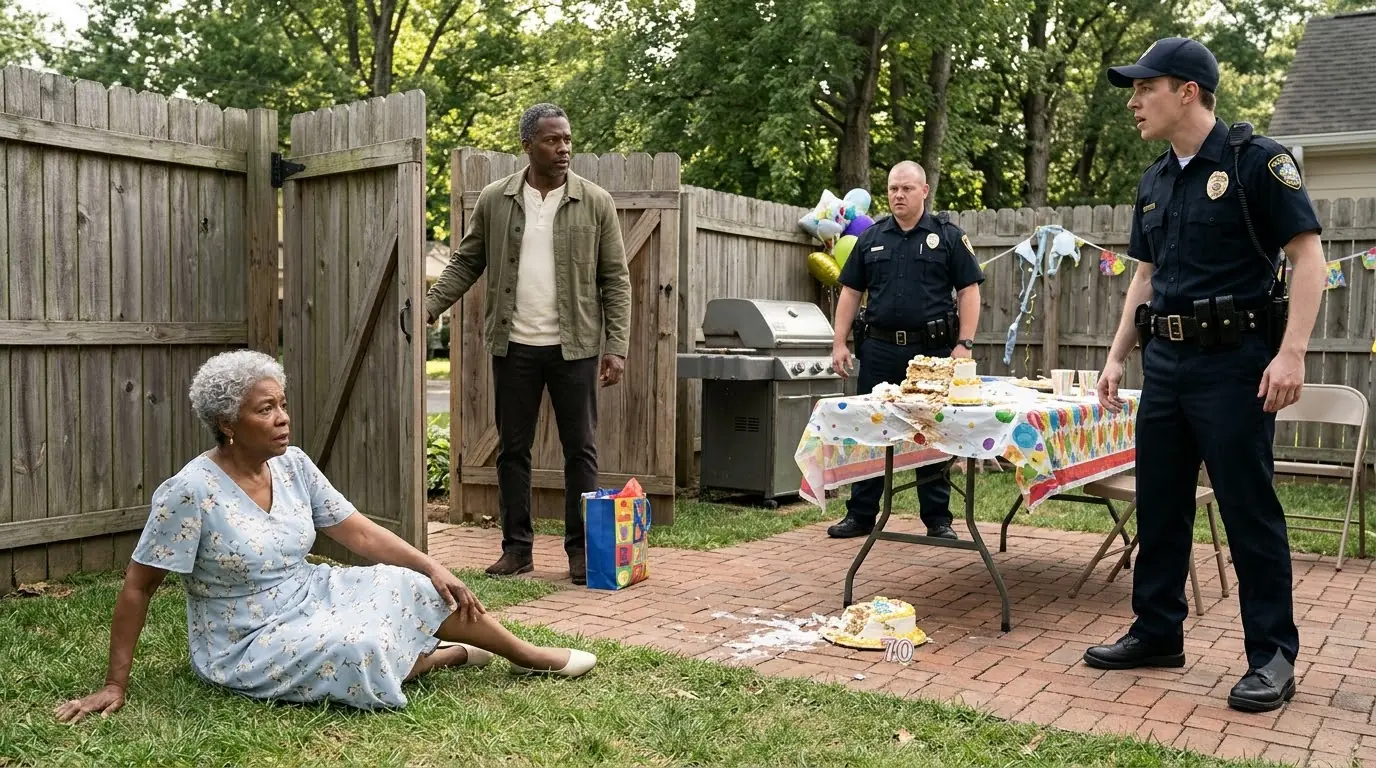
Anthony looked past him at the crushed cake, his sister's frightened face, the frosting on Bole's sleeve. His hands remained at his sides.
"That's my mother," he said. "Look me in the face and tell me why she's on the ground."
Bole started forward, then saw Anthony clearly. His feet seemed to lose their certainty. He caught Grady's forearm just as the younger officer reached toward Anthony.
"Don't," Bole whispered.
"What is your problem?" Grady snapped.
Bole didn't answer. His eyes stayed on the man at the gate. He had seen that face on a screen in a room where officers were required to listen, and again beside a photograph of an investigation that had ended careers. He knew something Grady did not.
Anthony noticed the recognition. But he did not offer either man a way out.
"I'm waiting," he said.
Seven hours earlier, Ernestine's greatest concern had been whether seventy candles would make the cake look ridiculous.
"We are using two numbers," Denise assured her, standing at the kitchen counter with a box of paper decorations. "Nobody is putting a forest fire on your birthday cake."
"Good. Because I plan to turn seventy-one, and I need this house standing."
Denise laughed. At forty-two, she had inherited her mother's tendency to organize a celebration down to the last napkin, then complain that everyone was making too much fuss. She had invited cousins, neighbors, grandchildren, and several women who had known Ernestine since her first years in the neighborhood. An extra folding table stood in the hallway because she expected somebody to bring somebody else.
Ernestine had told her she wanted something small. Denise had agreed with an expression suggesting they had different definitions of the word.
The house had belonged to Ernestine for nearly four decades. She and her late husband had paid for it gradually, sometimes sacrificing holidays or new furniture to stay ahead of the mortgage. A peach tree in the yard had outlived him. Its branches had stopped producing much fruit, but Ernestine refused to remove it.