By the first week of July 2012, three modern wells around Ray Hope’s farm had gone dry.
His neighbor was days away from losing livestock, the bank had stopped returning friendly calls, and the corn across the county had begun curling brown beneath a sky that refused to rain.
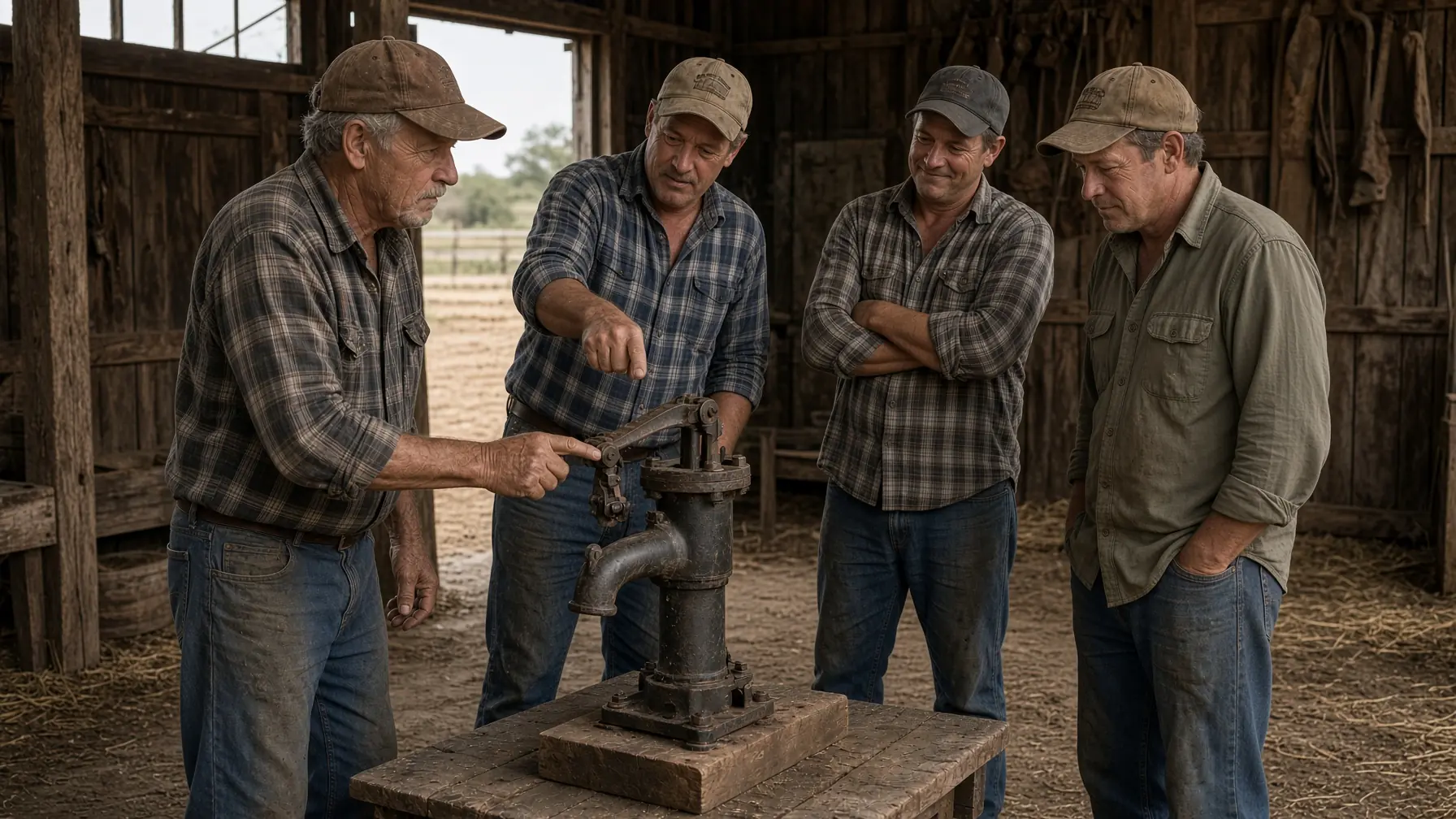
But behind Ray’s barn, inside a patched cinder-block pump house everyone had been telling him to tear down for twenty-five years, a machine installed before most of his neighbors were born was still pulling cold water from the earth.
Everyone thought the miracle was the old pump.
Ray knew better.
The reason it was still running had been written in pencil by his father more than half a century earlier—and buried inside a notebook Ray had ignored for thirty-three years.
The morning Dale Pritchard appeared in Ray Hope’s driveway, the sun had not yet cleared the trees.
It was July 9, 2012.
Not even six o’clock.
The air already felt exhausted.
Ray stood at the kitchen window holding a mug of coffee and watched Dale sit behind the wheel of his faded Silverado with the engine off.
He had been there almost two minutes.
Had not opened the door.
Had not waved.
Just sat with both hands resting on the steering wheel, staring past the house toward the old pump building beside Ray’s barn.
Ray knew that look.
He had seen it on men outside bank offices.
On farmers after veterinarians finished talking.
On his own father once, during the winter of 1963, when a frozen transmission nearly cost them the spring planting.
It was the look of a man doing arithmetic he already knew would not work.
Ray finished half his coffee before stepping outside.
Not because he wanted to make Dale wait.
Because whatever Dale had come to say deserved to be heard by someone steady.
The screen door slapped lightly behind him.
Dale finally climbed from the truck.
Thirty-eight years old.
Sunburned neck.
Work boots powdered gray with drought dust.
He normally carried himself like a man who believed any problem could be solved with enough diesel, wire, or stubbornness.
That morning he looked older.
His eyes went directly toward the pump house.
Low cinder-block walls.
Rust-streaked tin roof.
Painted door faded from white to the color of old bone.
“Ray.”
“Morning.”
Dale did not return the greeting.
He nodded toward the pump house.
“That thing still running?”
Ray took a drink.
“It is.”
Dale looked down at the driveway.
Then back.
“My well’s done.”
Ray said nothing.
He already knew.
Everybody knew.
Hardin County had become a place where bad news traveled faster than weather.
The summer of 2012 was the worst drought most of them could remember.
By July, corn leaves were folding inward before noon.
The creek behind Ray’s lower pasture had dropped enough to expose limestone that had not seen sunlight in decades.
Three farms in the township had already lost usable well pressure.
Dale’s was the fourth.
“I had Consolidated Boring out yesterday,” Dale said. “Static level dropped again.”
“How far?”
“Eleven feet since they drilled.”
Ray frowned.
Dale’s well was modern.
Six-inch casing.
Submersible pump.
Installed less than a decade earlier.
Everything certified.
Everything measured.
Everything expensive.
“How deep are you sitting?”
“Sixty-two.”
“And they want?”
“Eighty minimum. Maybe ninety.”
Ray knew the next sentence before Dale said it.
“Fourteen thousand two hundred.”
Ray looked toward the dry eastern fields.
Fourteen thousand dollars might have been manageable in a good year.
This was not a good year.
Feed prices were climbing.
Corn was failing.
Fuel hurt.
The bank had become careful.
Careful was a polite word farmers used when bankers stopped believing in you.
Dale rubbed the back of his neck.
“I’ve got livestock drinking three, maybe four thousand gallons a day when the heat gets bad.”
Ray said nothing.
“Karen says we need to sell.”
“Livestock?”
“The farm.”
That made Ray look at him.
Dale swallowed.
“She says if we can’t get water, there’s no point borrowing more money just to lose the place six months later.”
The morning stayed still around them.
No breeze.
No birds yet.
Only the slow uneven rhythm coming from the pump house.
Clunk.
Pull.
Clunk.
Pull.
A slight hesitation every fourth stroke.
Ray had heard that rhythm most of his life.
Dale heard it too.
“That’s why I came.”
Ray waited.
“I need water.”
There it was.
Not money.
Not advice.
Water.
The oldest request there was.
Dale looked embarrassed saying it.