At 5:43 on the morning of June 18, 1887, Clara Whitmore buried an axe blade into a pine tree and immediately knew she had swung too hard.
Pain traveled through both wrists.
She closed her eyes.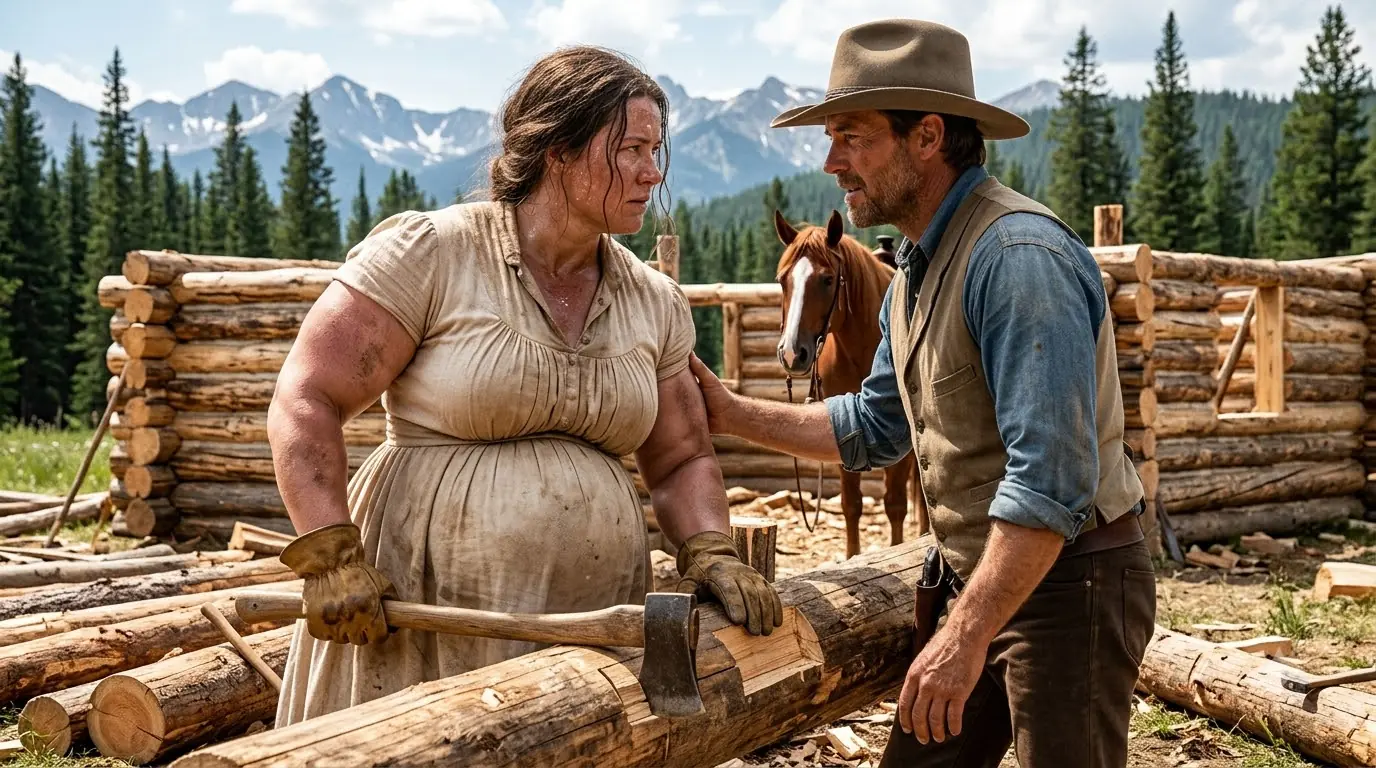
The axe remained embedded in the trunk.
For several seconds, Clara stood absolutely still beneath the tall Montana pines while early sunlight came through the branches and touched the unfinished log walls fifty yards behind her.
Then the baby moved.
A strong rolling pressure crossed the front of her belly.
Clara released the handle with one hand and supported the heavy curve beneath her faded cream work dress.
“Good morning to you too.”
The child kicked again.
Clara breathed slowly.
She was thirty-two years old, seven months pregnant, widowed for eleven months, and approximately twenty miles from the nearest town large enough to have something resembling a proper doctor.
None of those facts improved when considered together.
So she usually did not consider them together.
She concentrated on the tree.
One problem at a time.
That was how Samuel had taught her carpentry.
Measure the problem you have.
Not the ten problems that might come afterward.
Clara wrapped both hands around the axe handle and worked the blade free.
Her palms hurt beneath her brown leather gloves.
Even through the gloves, blisters had become permanent companions.
Her hands had once been softer.
That version of herself felt like somebody she had known years ago.
She looked upward.
The pine stood straight enough.
Approximately eleven inches through where she planned to cut it.
Good timber for another wall course.
Clara positioned her feet.
Her body was substantially heavier than it had been before pregnancy. She had always been a broad, full-figured woman, with thick arms, strong hips, and a softness that no amount of farm work had ever completely erased. Pregnancy had added more weight, much of it centered around the enormous rounded belly pulling against the gathered waist of her work dress.
People in town had stared.
Not because pregnant women were unusual.
Because pregnant widows living alone on forty acres apparently were.
The first time Clara purchased nails in Deer Creek, the shopkeeper looked at her stomach and asked:
“Who’s doing the building?”
“I am.”
He laughed.
Clara bought twice as many nails as she intended.
Spite was expensive.
But occasionally useful.
She lifted the axe.
Another swing.
Thud.
Wood chips scattered.
Again.
Thud.
Again.
After the sixth strike she stopped.
Not because she wanted to.
Because her lungs told her she had no choice.
She leaned one shoulder against the tree.
The morning was already warming.
Montana summers lied.
At sunrise the mountain air could feel almost gentle.
By afternoon the sun would burn the back of her neck.
At night, temperatures could fall enough to remind her winter was never as distant as the calendar suggested.
Clara looked toward the cabin.
Four walls.
Not full height yet.
Stone foundation complete.
Floor joists mostly set.
Door opening framed.
One window opening on the south wall.
No roof.
No proper stove.
No finished chimney.
Thirty-four days remained before the date Clara had privately chosen as her deadline.
Nobody else knew the date.
Samuel would have.
He had loved deadlines.
“Work without a date is wishing,” he used to say.
Clara hated that sentence.
She missed it.
She missed him.
Those two things could exist together.
Samuel Whitmore had been forty when tuberculosis finally took what remained of his strength.
He had been a carpenter longer than Clara had known him.
Not a grand builder.
No city mansions.
No churches.
Mostly barns, cabins, porches, wagon sheds, fences, kitchens, repairs.
Things ordinary people needed.
They had met in Missouri when Clara was twenty-four.
Samuel had been eight years older, quiet, patient, and irritatingly certain that nearly everything could be improved with a level and another hour of work.
Their marriage had not been a great romantic legend.
Clara valued that.
They argued over money.
Samuel left tools in the kitchen.
Clara over-salted beans.
He snored.
She stole blankets.
They occasionally went to sleep angry and woke up embarrassed because neither remembered why.
It had been ordinary.
Which made losing it unbearable.
Samuel dreamed of Montana for years.
Land.
Timber.
A place of their own.
No landlord.
No workshop rent.
No neighbor close enough to complain about sawing after sunset.
When Clara became pregnant, Samuel finally filed the claim.
He had already been ill.
They both knew.
Neither said how ill.
He spent evenings sketching the cabin.
Sixteen by twenty-four feet.
Stone foundation.
South-facing window.
Loft eventually.
Large table near the stove.
He drew it over and over.
Clara learned every measurement because she held the paper while he coughed.
Samuel died in St. Joseph before they could leave.
His final lucid conversation with Clara lasted less than three minutes.
He did not tell her to go to Montana.
That story would have been easier.
He told her:
“Don't build my life after I'm gone.”
She cried.
He continued.
“Build yours.”
Clara hated him for saying it.
Because she understood.
Two months later she boarded a train west.
Not to finish Samuel’s life.
That distinction became important.
The land had been their plan.
The child was hers now.
The decision to continue was hers.
Samuel’s tools came because they belonged to her.
His drawings came because they were useful.
His memory came because memory did not ask permission.
But the cabin?
The cabin would be Clara’s.
Eventually she understood that.
At first, everyone else called it Samuel’s dream.
She stopped correcting them.
Correcting people used energy.
Clara returned to the tree.
Thud.
Thud.
Thud.
The notch widened.
Sweat ran between her shoulder blades.
Her braid stuck against the front of her dress.
She worked in sets of five strikes.
Then four.
Then three.
By the time the tree finally began creaking, her arms felt hollow.
Clara stepped backward.
“Come on.”
The pine leaned.
Needles whispered overhead.
Then gravity took control.
The trunk fell with a tremendous cracking roar.
The ground shook.
Birds erupted from nearby branches.
Clara smiled.
That sound never stopped satisfying her.
Then hoofbeats came from the western trail.
She stopped smiling.
People did not usually visit without reason.
Clara reached for the axe.
Not threateningly.
Practically.
A lone rider appeared between the trees.
Brown horse.
Tall man.
Broad-brim hat.
He slowed when he saw the cabin.
Then stopped completely when he saw Clara.
She almost laughed.
Another one.
The expression was always similar.
First:
Woman.
Then:
Pregnant.
Then:
Axe.
Then:
No man nearby.
The stranger looked at the newly fallen pine.
Then the cabin.
Then Clara.
He removed his hat.
“Morning.”
Clara leaned the axe handle against her hip.
“Morning.”
He remained mounted.
Good.
Men who dismounted without permission irritated her.
“Calloway.”
Clara waited.
“James Calloway.”
He pointed vaguely east.
“Ranch about six miles that direction.”
“I know where it is.”
He looked surprised.
“I've seen your fence.”
“That how you judge neighbors?”
“Usually.”
His mouth twitched.
Clara did not smile.
James looked toward the cabin again.
“You building that?”
“No. Beavers.”
He laughed.
A proper laugh.
Not the mocking sound she heard in town.
Clara found that inconvenient.
“You always this friendly?”
“Only when interrupted.”
James nodded toward the felled pine.
“Looks like I arrived after the hard part.”
“No.”
His eyes went toward the cabin.
“What’s the hard part?”
“Moving it.”
James looked from the tree to Clara’s belly.
She saw the concern before he managed to hide it.
Her expression sharpened.
“Don't.”
He blinked.
“Don't what?”
“Look at me like you're about to explain pregnancy.”
James put his hat back on.
“I wasn't.”
“You were thinking loudly.”
That surprised another laugh from him.
Clara disliked that too.
James dismounted.
She tightened her grip on the axe.
He noticed.
Stopped.
“May I?”
“May you what?”
“Come closer without getting introduced to that blade.”
Clara looked at the axe.
Then him.
“Depends what you want.”
“Water, if you've got enough.”
She considered.
“Barrel by the cabin.”
“Thank you.”
He walked past without touching her tools.
Another good sign.
James Calloway was forty years old and had lived in Montana long enough to know mountains rewarded arrogance with funerals.
He had seen men arrive from eastern cities carrying money, optimism, and boots that had never touched manure.
By November they usually owned less money, less optimism, and better boots.