The girls at the boarding house expected her to come back crying.
That was the whole point.
They had been bored that afternoon, sitting beneath the narrow porch awning while late-summer heat pressed down over the frontier town and flies circled the water trough near the street.
Someone had taken down a work notice from the general store.
Someone else had read it aloud.
Worker wanted. Barn cleaning, stall maintenance, feed room organization. Fair daily pay.
The name at the bottom was enough to make everyone laugh.
The angry rancher.
The man who owned the largest cattle ranch within half a day’s ride of town.
The man people talked about carefully whenever he entered a room.
Nobody agreed on exactly why he had become so feared.
Some said he once threw a ranch hand off his property after catching the man mistreating a horse.
Others claimed he had broken a saloon table with one fist.
One story involved a gambler.
Another involved a cattle thief.
Half were probably exaggerated.
The rancher never corrected any of them.
That silence had helped build the reputation.
The boarding-house girls knew something else.
Workers did not stay long.
The rancher expected work to be done correctly.
He spoke little.
He had no patience for excuses.
His face naturally looked as though somebody had disappointed him.
So when the girls saw the notice, they immediately thought of the one person in the boarding house least likely to survive a day on his ranch.
The plus-size young woman.
She was twenty-six.
Soft-spoken.
Fair-skinned.
Round-faced.
Her chestnut-brown hair was usually pinned back carelessly because she had long ago learned that spending extra time on her appearance only gave cruel people another reason to stare.
She had been staying at the boarding house for six months.
Long enough for everyone to learn which insults made her go quiet fastest.
Her weight was always the easiest target.
It had followed her since childhood.
At school.
At church suppers.
In dress shops.
At weddings.
At any gathering where people believed laughter became harmless if everyone participated.
She had heard every variation.
Too heavy for a horse.
Too heavy for a dance.
Too heavy for delicate chairs.
Too heavy for a man to ever want.
Most people did not say such things directly.
They whispered.
That was sometimes worse.
Whispers let people pretend innocence.
The boarding-house girls had stopped pretending.
One tore the ranch notice from the wall and shoved it toward her.
“You should take this.”
The young woman looked down.
She knew immediately something was wrong.
Three girls were already smiling.
“What is it?”
“A job.”
“I can read.”
“Then read the bottom.”
She did.
Her stomach tightened.
The angriest rancher in the county.
One girl leaned against the porch rail.
“You’re always complaining about needing money.”
“I don’t complain.”
“Then you should be grateful.”
Another girl laughed.
“Imagine his face when she walks in.”
The first girl covered her mouth dramatically.
“He’ll need a bigger barn.”
Laughter.
The young woman lowered her eyes.
She had become skilled at surviving those moments.
Do not answer.
Do not show anger.
Do not cry until you are alone.
Let the moment pass.
Usually it did.
But that afternoon, something changed.
Perhaps because she really did need money.
Perhaps because the boarding house had raised her weekly rate again.
Perhaps because the matron had begun hinting that unpaid balances would soon become a problem.
Or perhaps she had simply grown tired of allowing cruel people to determine where she was willing to stand.
The young woman folded the notice.
Carefully.
The laughter weakened.
One girl frowned.
“What are you doing?”
“Keeping it.”
“You’re not actually going.”
The young woman slipped the paper into her apron pocket.
“Why not?”
The girls looked at one another.
They had expected refusal.
Refusal would have been funny.
Fear would have been funnier.
Acceptance ruined the joke.
The first girl recovered.
“He’ll send you back before breakfast.”
Another added:
“If he doesn’t make you pay for the broom you break.”
More laughter.
The young woman stood.
She did not answer.
But that night, lying in the narrow boarding-house bed, she unfolded the notice again.
Fair daily pay.
That mattered.
A great deal.
She had less than two weeks of lodging money left.
The laundry work she occasionally received was unreliable.
Sewing paid poorly.
The general store had already hired someone.
A widow outside town sometimes paid her to help with preserving food, but harvest season would not begin for another month.
She needed something.
Anything.
The ranch was almost three miles from town.
The next morning, she left before sunrise.
She wore her oldest slate-blue work dress.
A cream undershirt.
A worn beige apron.
Heavy boots.
She carried no lunch because she had nothing suitable to pack.
The walk took more than an hour.
By the time the ranch came into view, her feet already hurt.
The property was larger than she expected.
Long fences.
Several paddocks.
A weathered main barn.
Smaller sheds.
A modest ranch house set farther back from the yard.
Cattle moved in the distance.
Horses stood near a corral.
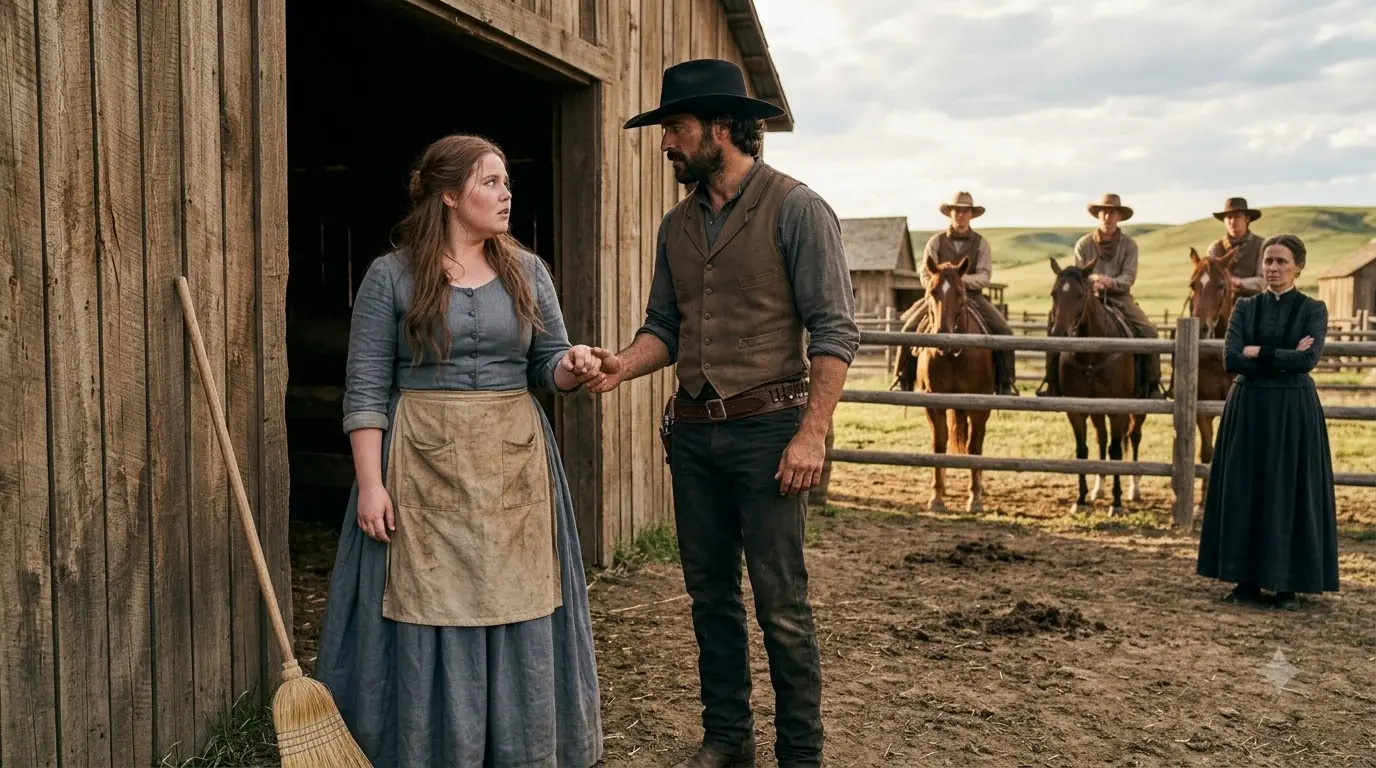
The barn door was open.
A man stood inside.
The young woman stopped.
Even from across the yard, she knew who he was.
The rancher was in his late thirties.
Tall.
Broad-shouldered.
Dark wavy hair beneath a black hat.
Thick trimmed beard.
Brown leather vest over a dark work shirt.
Dusty trousers.
Boots worn almost smooth at the toes.
He looked exactly like the stories had promised.
Not because he was shouting.
He was silent.
That was worse.
His eyes moved from her face to the paper in her hand.
Then back.
The young woman suddenly understood why workers found him intimidating.
He did not glance.
He looked.
Fully.
As though every answer mattered.
“Morning.”
His voice was low.
The young woman swallowed.
“Morning.”
He looked toward the road behind her.
“You lost?”
“No.”
“What do you want?”
She held out the notice.
The rancher took it.
Read his own handwriting.
Then looked at her again.
“You walked from town?”
“Yes.”
“For this?”
“Yes.”
The rancher looked toward the road once more.
“Who sent you?”
Her stomach dropped.
“No one.”
He stared.
The young woman had never been a convincing liar.
He waited.
Eventually she looked down.
“Some girls at the boarding house.”
The rancher said nothing.
“They thought it would be funny.”
His expression changed.
Only slightly.
That was enough.
He understood.
She was not being recommended.
She was being delivered as entertainment.
The young woman braced herself.
This was where the laughter would come.
Or irritation.
Or a polite refusal.
Instead, the rancher folded the notice.
Walked into the barn.
Returned carrying a broom.
He held it toward her.
“If you’re here to work…”
The young woman looked at the broom.
Then at him.
“…then work.”
That was all.
No smile.
No insult.
No pity.
She took the broom.
The rancher pointed toward the first row of stalls.
“Start there.”
“Yes, sir.”
“Don’t call me sir.”
She blinked.
“What should I call you?”
“Nothing unless you need something.”
Then he walked away.
The young woman stared after him.
That may have been the strangest welcome she had ever received.
She began sweeping.
The barn had not been neglected.
But it had been understaffed.
Hay dust covered corners.
Old tack needed sorting.
Several stalls required cleaning.
Feed sacks had been stacked without order.
Water buckets needed scrubbing.
It was real work.