Seventeen-year-old Ellie Harper was ankle-deep in red Arkansas mud when Wade Turner stopped his pickup beside the family pasture. She had long auburn hair braided over one shoulder, sun-warmed skin, a freckled face, and hazel eyes that narrowed whenever someone interrupted her work. Instead of the hat most local farmers wore, Ellie had tied a faded green bandanna around her wrist and dressed in a sage work shirt, brown canvas suspenders, fitted denim pants, and mud-covered ranch boots. Behind her, a rented excavator had already carved a wide basin into three acres of land where the Harper family once planted corn.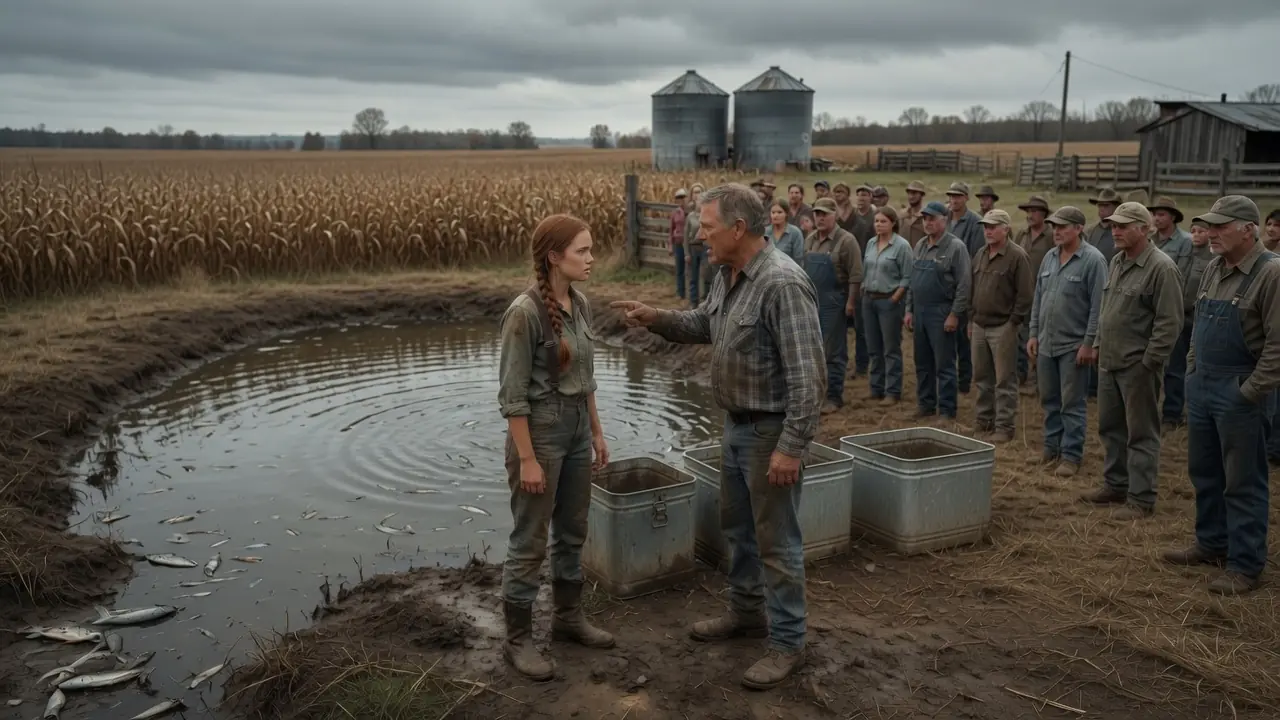
Wade leaned through his open window and stared at the enormous hole. At fifty-eight, he had spent his entire life raising cattle and telling younger farmers which ideas would fail before they tried them. “Your father know you’re turning good farmland into a mud pit?” he asked. Ellie rested both hands on her shovel and told him the basin would become a fish pond.
Wade laughed hard enough to cough. He asked whether she intended to teach catfish how to grow corn or charge neighborhood children admission to swim. Two workers riding in his truck laughed with him, and one called it the most expensive puddle in Caldwell County. Ellie waited until they finished, then returned to shaping the bank.
By Monday, almost everyone in the farming town of Pine Hollow had heard about the Harper girl digging a pond. It was not for livestock, irrigation storage, or recreation, but for raising fish on a family farm known for soybeans and corn. Men at the feed store joked that Ellie had read one library book and mistaken herself for an agricultural scientist. Women at the diner wondered how long her parents would allow the project to continue before making her fill the hole again.
Ellie’s father, Nathan Harper, had not laughed when she first presented the plan. He had listened at the kitchen table while she explained water depth, channel catfish growth rates, feed conversion, aeration, and the possibility of producing protein on land that flooded too often for reliable crops. Still, the Harper farm was behind on two equipment payments, and Nathan could not afford to finance an experiment. He told his daughter she could use the low pasture only if she paid for the project herself and promised it would not interfere with planting season.
Ellie had expected that answer. For three years, she had saved money from babysitting, repairing fences, selling vegetables at the county market, and helping a local veterinarian clean stalls. She purchased a damaged pond liner from a closing landscaping company, rented the excavator for one weekend, and bought used aeration equipment from an abandoned catfish operation two counties south. Every dollar had a place in the handwritten budget she carried inside a black notebook.
That notebook was the real beginning of the pond. Ellie had started it when she was fourteen, after noticing her mother compare prices for chicken, beef, and canned tuna at the grocery store. She began taping receipts onto the pages and recording how much common food cost each month. What began as curiosity gradually became a pattern.
The price of cattle feed had risen for three years. Poultry farmers were spending more on grain, fuel, medication, and transportation, while several regional fish suppliers had quietly reduced production. Refrigerated trucking costs were climbing, and the seafood counter at the Pine Hollow Market received fewer deliveries than it had when Ellie was younger. None of the changes seemed serious alone, but together they suggested that inexpensive protein was becoming less stable.
Ellie mentioned the pattern during dinner one evening. Nathan nodded while reading a report about soybean prices, and her mother, Rachel, agreed groceries were more expensive but said nearly everything cost more. Ellie’s grandfather Owen asked to see the notebook. He examined the dates, prices, news clippings, and handwritten calculations without speaking for nearly twenty minutes.
“You believe food will become difficult to get?” he finally asked.
“Not all food,” Ellie replied. “Protein first. Meat and fish depend on feed, fuel, processing, refrigeration, and long-distance delivery. If several parts fail together, small towns like ours will feel it last—but we’ll also be the last places companies restock.”
Owen closed the notebook carefully. He had farmed the Harper land for forty-two years and survived enough bad seasons to respect quiet warning signs. He did not say Ellie was right, but the next morning he helped her survey the low pasture. It was the first sign that someone else had begun taking her seriously.
The pond required more work than Ellie’s library diagrams suggested. The excavator repeatedly sank into wet clay, forcing her to reinforce the access path with broken concrete and gravel. The liner tore during installation, the first aerator failed after two hours, and a heavy October rain washed part of the bank into the unfinished basin. Wade drove past after the storm and told her the land was trying to reject the idea.
Ellie spent the following week rebuilding the bank. She laid drainage pipe beneath the slope, packed clay around the liner, and constructed a spillway to prevent future overflow. Owen helped her repair the aerator motor, while Nathan used the tractor to move soil after finishing his own work each evening. The project slowly stopped looking like a hole and began resembling a real pond.
By late autumn, it held eight feet of water at its deepest point. Ellie tested oxygen, temperature, acidity, and ammonia levels twice daily, recording each result in her notebook. She drove forty-five miles to a hatchery and returned with several buckets of channel catfish fingerlings, each one barely longer than her index finger. She released them slowly so the temperature difference would not shock them.
Her younger brother, Caleb, watched the tiny fish disappear beneath the water. “That’s it?” he asked. “Those things are supposed to feed people?”
“Not yet.”
“How long?”
“Long enough for everyone to stop watching.”
He was almost right. Interest faded after the first month because nothing impressive happened above the surface. Ellie fed the fish, checked the water, repaired equipment, and continued attending school as though the pond were an ordinary chore. Around town, people began calling it Ellie’s puddle.
Wade used the name most often. He told customers at the feed store that the Harper family had sacrificed crop land so a teenager could play fish farmer. When Ellie purchased floating feed, he examined the bag and announced that she would spend more feeding the catfish than she could ever earn selling them. She paid without arguing.
Winter brought the first warning that Ellie’s notebook might have identified something real. A large regional hatchery announced it would cut production because feed and electricity costs had risen too sharply. The local newspaper buried the story between school-board notes and an advertisement for farm equipment. Ellie clipped the article and added it to her records.
Two months later, the refrigerated trucking company serving Pine Hollow reduced its seafood deliveries from twice a week to once. The grocery manager blamed fuel costs and promised customers the change was temporary. Ellie wrote down the date. When frozen fish prices increased again in March, she circled the amount in red pencil.
The pond survived winter. Ellie installed simple shelters beneath the water, kept part of the surface open during freezing nights, and adjusted the feeding schedule as the catfish slowed in colder temperatures. Not every fish survived, but enough reached spring healthy. When the water warmed, they began eating aggressively and growing faster.
Nathan finally became interested in the numbers. Ellie showed him how catfish converted feed into edible weight more efficiently than cattle and required far less land. The pond could not replace the family’s grain income, but it could diversify the farm and create a local product independent of long refrigerated supply lines. Nathan began helping her calculate operating costs instead of asking when she planned to abandon the project.
By early summer, events beyond Pine Hollow accelerated. A poultry disease outbreak forced farms in neighboring states to destroy thousands of birds. Drought damaged cattle pasture farther west, raising feed prices and pushing ranchers to sell breeding animals earlier than planned. Diesel prices climbed after refinery disruptions, making every refrigerated shipment more expensive.
The first major change appeared in the grocery store’s meat department. Ground beef rose sharply in less than four weeks, and chicken thighs—once the inexpensive choice for large families—followed soon afterward. The seafood case became a narrow display containing a few frozen fillets and small packages of imported shrimp. A printed sign apologized for supply interruptions.
Families began changing what they purchased. Shopping carts held more dried beans, pasta, eggs, and rice, while parents returned packages of meat after reading the price. The owner of the Pine Hollow Diner removed two beef dishes from the menu and increased the cost of chicken meals twice. The local school district announced it might substitute several planned meat lunches with cheese or legumes.
People then remembered Ellie’s pond.
The first customer was Mrs. Alvarez, an elderly widow raising two grandchildren. She had seen Ellie selling a few cleaned catfish at the farmers’ market during spring and asked whether more were available. Ellie harvested four fish, weighed them, and charged a price that covered feed and processing without matching the inflated grocery-store cost.
Mrs. Alvarez returned the following week with her sister.
Soon, six families began visiting the Harper driveway every Saturday morning. Ellie set up a folding table, ice-filled coolers, a scale, and handwritten instructions for cooking whole catfish or fillets. She recorded every sale and refused to harvest more fish than the pond could replace. Her goal was not quick profit but a sustainable supply.
Wade noticed the customers while driving past. He stopped beside the mailbox and watched Nathan help carry coolers toward the table. “People must be desperate if they’re buying from that mud hole,” he said.
Ellie wiped her hands on an apron. “They’re buying fresh food.”
“You cannot feed a county from three acres.”
“I never said I could.”
“Then stop pretending you solved anything.”
“I solved something for the families standing here.”
Wade drove away without buying a fish. The following week, however, his wife arrived alone and purchased two.
By July, grocery shortages worsened. The meat counter sometimes remained half empty for days, and strict purchase limits appeared on chicken and ground beef. A restaurant in the neighboring town closed temporarily because it could not afford reliable deliveries. Rural families with limited incomes felt the pressure first.
The line at the Harper driveway grew from six customers to twenty. Ellie established scheduled pickup times to prevent the crowd from overwhelming the property. Nathan helped clean fish, Rachel managed payments, and Caleb filled ice boxes. Owen sat beneath a shade tent, watching the pond that nearly everyone had called useless.
Ellie still refused to overharvest. She divided the pond into measured sections, tracked average fish size, and ordered a second group of fingerlings before suppliers became too limited. She also began planning a smaller nursery pond where young fish could grow separately. Every decision came from records rather than excitement.
One Saturday morning, Wade arrived before the gate opened. His cornfields had suffered from heat and rising fertilizer costs, while the cattle he raised required feed he could barely afford. He watched nearly forty people waiting along the drive, some carrying empty coolers and others holding envelopes of cash.
“You wasted good farmland on a mud hole,” he told Ellie, loud enough for the line to hear. “Now you think starving people should beg a teenage girl for food?”
Ellie stood beside the chained gate. She wore a faded sage work shirt with sleeves rolled to her elbows, brown suspenders, dusty jeans, and ranch boots darkened by pond water. Her auburn braid rested over one shoulder, and there was no hat hiding the hard look in her hazel eyes.
“You laughed when I built it,” she said. “Don’t bark orders now that your fields are dead.”
Several people fell silent.
Wade stepped closer and pointed toward the feed shed. “Open those bins. You are hoarding food while families suffer.”
“The bins contain fish feed.”
“Then harvest everything in that pond and distribute it.”
“That would feed people briefly and destroy the supply for next month.”
“You’re a child. You don’t decide who deserves food.”
“I decide how many fish leave my pond.”
His face reddened. “Open that gate, or I’ll tear the pond apart and take every fish myself.”
Ellie tightened her grip on the chain. “Touch one post—and you’ll find out why the town came to me before they came to you.”
Nathan emerged from the barn, but Ellie raised one hand to stop him from intervening. She had spent a year listening to Wade dismiss the project. She would not allow him to seize control simply because the value had become visible.
Wade grabbed the gate.
Before he could lift the chain, Sheriff’s Deputy Laura Bennett stepped out of the waiting line. She had come to buy fish for her parents and wore civilian clothes, but her badge remained clipped inside her belt. “Mr. Turner, release the gate,” she said.
Wade looked around at the customers watching him. “I’m asking for fair distribution.”
“You threatened to damage private property.”
“This girl is exploiting a shortage.”
Ellie opened her sales notebook. Every price, harvest weight, customer limit, feed cost, and donated order was recorded clearly. She charged less than half the current grocery-store price and quietly reserved part of each harvest for elderly residents and families referred by the local food pantry.
Deputy Bennett examined the pages and handed them back. “That does not look like exploitation.”
Wade released the gate.
Ellie opened it only after he stepped away. She served every scheduled customer and gave Wade no fish, not because she wanted revenge, but because he had not placed an order and had threatened the operation. His wife returned later, apologized privately, and bought two catfish under her own name.
The confrontation spread through Pine Hollow faster than any earlier joke. Yet the story people repeated was not merely that Ellie had stood up to Wade. They discussed the notebook, purchase limits, sustainable harvest, and the fact that a teenager had prepared for a problem adults ignored.
County agricultural agent Dr. Samuel Pierce visited the farm the following week. He examined the water, aeration system, stocking density, feed records, and bank construction. Ellie expected him to find numerous mistakes, and he did. He identified weak drainage near one corner, recommended additional oxygen monitoring during hot nights, and warned that the pond could collapse if she expanded sales too quickly.
He also told Nathan the operation was unusually disciplined for a first-year project.
With Dr. Pierce’s guidance, the Harpers added a solar backup aerator and improved the spillway. Ellie adjusted feed amounts based on fish weight rather than estimating from surface activity. She began testing water at different depths and documenting growth rates every two weeks. The pond became more productive because she welcomed correction instead of protecting her pride.
The county food pantry contacted her in August. Its usual meat donations had declined, leaving families with few protein options. Ellie agreed to provide a fixed number of fish each week at cost, while the Harper family covered part of the expense using ordinary sales.
Other farmers began asking questions.
Uncle Dale Harper owned a low, swampy corner of land that rarely produced good soybeans. He had been among the first relatives to call Ellie’s pond a childish phase. Now he arrived carrying soil maps and asked whether the area could support aquaculture.
Ellie studied the maps instead of reminding him what he had said. “Maybe,” she answered. “But the drainage is different, and you’ll need a water test before digging.”
“Will you help me?”
“If you follow the data.”
Dale agreed.
Two neighboring farms joined the project, creating a small cooperative rather than competing. Ellie helped design pond depth, feeding schedules, and record systems, while Dr. Pierce arranged training through the state agricultural extension. The farmers shared equipment and planned staggered harvests so no single pond would be emptied too quickly.
Wade refused to participate. He insisted the meat shortages would end before any second pond produced fish and called the cooperative a temporary panic. Then his feed supplier raised prices again, and he sold part of his cattle herd at a loss.
By autumn, he returned to the Harper farm alone.
Ellie found him beside the pond, watching ripples spread across the water. He no longer carried the confidence he had displayed at the gate. Dust covered his jeans, and exhaustion had deepened the lines around his eyes.
“I have eight acres that stay wet every spring,” he said. “Too low for corn.”
Ellie waited.
“I want you to look at them.”
“Why?”
“Because I was wrong.”
She studied him carefully. “About the pond or about me?”
“Both.”
It was not a perfect apology, but it was more than Ellie expected. She agreed to inspect the land if Wade apologized publicly for threatening to destroy her operation. He disliked the condition but accepted it.
At the next county agricultural meeting, Wade stood before nearly one hundred farmers. He admitted that he mocked Ellie because her idea did not resemble anything he understood. He also admitted trying to take control once her work became valuable.
“The girl saw a risk the rest of us ignored,” he said. “Then I treated her preparation like it belonged to me because I was older. It didn’t.”
Ellie sat near the back without smiling.
The grocery shortages eventually eased, but prices did not return to their earlier levels. Supply chains stabilized, poultry farms recovered, and refrigerated deliveries became more regular. By then, however, Pine Hollow no longer depended entirely on distant producers for fish.
The Harper pond supplied local families, restaurants, and the food pantry. Dale’s new pond produced its first harvest the following year, while two additional farms began construction. The cooperative developed rules preventing price gouging during shortages and maintained emergency reserves for vulnerable residents.
Ellie graduated from high school with offers from three agricultural colleges. She chose a state university with a strong aquaculture program but continued managing the pond remotely with Nathan and Caleb. During school breaks, she returned to improve filtration, experiment with feed sources, and train younger students interested in farming.
Her grandfather met her on the dock the evening before she left for college. The original pond reflected the fading sky, and fish disturbed the surface near the feeding station. Owen rested both hands on the rail built from scrap lumber.
“I told you to find a normal job,” he said.
“You did.”
“I had been farming so long that I mistook tradition for knowledge.”
Ellie looked toward him. “You still helped survey the field.”
“I wanted to know whether you were wrong.”
“And?”
“You were wrong about plenty.”
She laughed.
Owen pointed toward the aerator, reinforced bank, and nursery enclosure. “The first design leaked. Your stocking estimate was high. The old motor nearly killed half the fish.”
“But the pond worked.”
“Because you kept changing what didn’t.”
They stood quietly as the aerator moved circles across the water.
Two years later, another disruption affected regional meat deliveries after severe storms damaged highways and warehouses. This time, Pine Hollow did not face empty shelves with no alternative. The cooperative increased harvests carefully, opened temporary sales points, and supplied schools, restaurants, and food banks across three counties.
Vehicles again lined the Harper driveway, but Ellie was no longer alone behind the gate. Dale managed weighing, Rachel organized orders, and Wade carried ice from the storage shed without giving instructions. He had built his own pond under Ellie’s guidance and become one of the cooperative’s most disciplined members.
A reporter asked Ellie whether she had predicted the shortages.
“No,” she replied. “I noticed that the system was becoming less reliable. Building one local food source seemed safer than assuming every truck would always arrive.”
“Did you construct the pond to prove the people who laughed at you wrong?”
Ellie looked across the property. “Proving them wrong would have fed my pride. Keeping the pond alive fed families.”
The reporter asked what she remembered most clearly from the early days. Ellie did not mention the jokes at the feed store or Wade threatening the gate. She remembered standing beside a basin of raw earth while everyone saw only lost farmland.
The pond still existed because she had learned to see more than one use for the ground. She understood that farming was not simply repeating what the previous generation planted. It was observing water, markets, weather, biology, and people closely enough to recognize when familiar answers were no longer sufficient.
By the time Ellie completed her agricultural degree, the Harper operation included three ponds, a small processing room, and an educational program for rural students. She refused offers from investors who wanted to turn it into an industrial fish farm. Growth mattered, but not enough to destroy the local resilience that gave the project meaning.
One afternoon, she walked along the original pond wearing the same brown suspenders and repaired ranch boots she had used during construction. Her auburn hair was again braided over one shoulder, and sunlight revealed the freckles across her face. On the far bank, a group of teenagers measured oxygen levels while Wade explained how excessive feed could damage water quality.
Ellie smiled at the sight.
The man who had once threatened to tear down the pond was now teaching children how to protect it.
People in Pine Hollow no longer called the water behind the Harper barn a mud hole. They called it the pond that kept food on their tables when distant systems failed. Yet Ellie knew the water itself was only part of what saved them.
The real protection began years earlier in a black notebook filled with grocery receipts no one else thought worth keeping. It grew through failed equipment, torn liners, dead fingerlings, rising costs, and long mornings when no evidence existed that her idea would matter. By the time the county became desperate, the work had already been done.
Everyone had laughed because Ellie was building an answer before they recognized the problem.
When the shelves emptied, nobody laughed at the farmer girl beside the pond again.