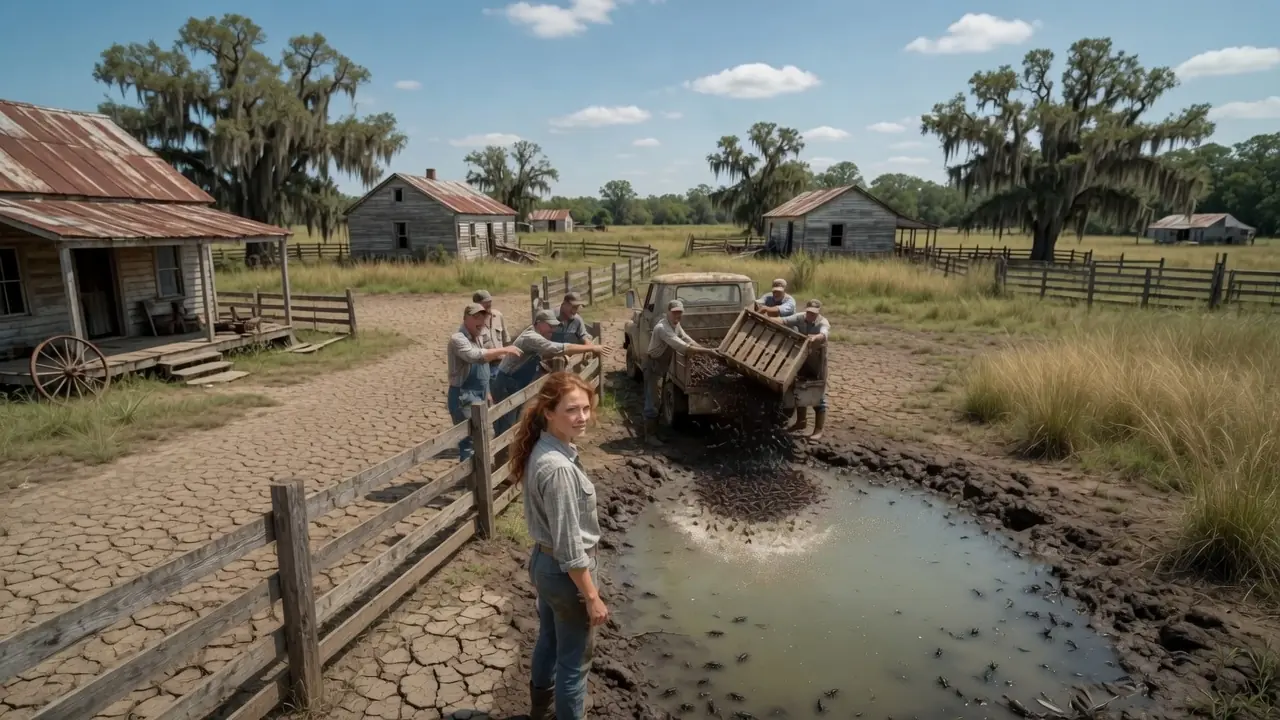
Marie Fontenot inherited fifty acres of tired Louisiana land, one rusted pickup, two weathered sheds, and a pond so dry the mud had cracked open like old pottery.
At twenty-three, she stood on the edge of that pond with red hair blowing across her face and her father’s work gloves folded in her back pocket.
Everyone in St. Martin Parish said the same thing when they drove by the place: sell it before it eats the rest of your life.
Marie heard them, but she never answered from the roadside.
Her father, Raymond Fontenot, had spent the last decade trying to make the land work the way it used to.
He planted soybeans, then corn, then hay, then tried vegetables one desperate season when prices looked good on paper and cruel in practice.
Every crop seemed to take more from him than it gave back, and each bad year left the soil harder, the fences weaker, and the bills stacked higher on the kitchen table.
By the time he was gone, the farm looked less like an inheritance and more like a warning.
The neighbors did not mean to be kind when they told Marie to leave.
They came with folded arms, slow voices, and that careful pity rural people use when they have already decided your dream is foolish.
Beau Landry, who owned the better land north of her property, was the loudest of them all.
He leaned on her fence one morning and said, “Girl, your father couldn’t save this place, and he had forty years more sense than you.”
Marie was cleaning out the old pump house when he said it.
Her hands froze on the wrench, but she did not turn around quickly because she knew anger made men like Beau smile.
She only stood, wiped grease on her jeans, and looked at the fields behind him.
“My father left me land,” she said. “Not permission to quit when fools started talking.”
Beau laughed like the answer amused him.
He was in his fifties, broad in the belly, with a sunburned neck and a habit of talking as if his acreage made him mayor of every dirt road.
“Land?” he said, pointing toward the dry pond. “That ain’t land, Marie. That’s a grave with weeds around it.”
Then he climbed into his truck and drove away, leaving dust and insult behind him.
That night, Marie sat at her father’s kitchen table with a stack of bills, his old notebooks, and a cup of coffee gone cold.
Raymond had written everything down in blue ink: rainfall totals, soil notes, seed prices, fuel costs, failed harvests, and little thoughts he probably never expected anyone to read.
On the last page, beside a sketch of the abandoned pond, he had written one line that made Marie stop breathing for a moment.
Water remembers where it belongs.
Her father had talked about crawfish when she was little, back when the pond still held water through spring and frogs sang loud enough to keep her awake.
He used to say the land was too wet for what men kept forcing it to be and too valuable for people who only understood dry rows.
Marie had been too young then to understand the weight of that regret.
Over the next week, she studied until her eyes burned.
She read extension guides, crawfish farming reports, old notes from LSU AgCenter, and every scrap of her father’s pond records she could find.
She learned about flooding schedules, forage, rice stubble, water depth, traps, oxygen, burrows, and how crawfish could turn a muddy lowland into a living system if managed properly.
The more she learned, the more her father’s sentence began to sound less like memory and more like instruction.
The first thing she did was repair the old levee.
The second was clear the ditch that fed the pond after heavy rain.
The third was call a hatchery two parishes over and ask questions until the man on the phone stopped speaking to her like a confused girl and started speaking to her like a customer.
By the end of the month, Marie had spent almost everything she had left on pipe, fuel, seed crawfish, and rented equipment.
People noticed quickly.
In a town that small, a woman could not buy a truckload of pipe without half the parish hearing about it before supper.
When she began pumping water into the abandoned pond, trucks slowed along the road, and men leaned out windows to stare.
By the time the first crates of crawfish arrived, Beau Landry was back at the fence with three other farmers, laughing loud enough for her to hear across the yard.
“You threw your future into dirty water, Marie,” Beau called, pointing at the muddy pond.
“And now you’re calling it farming.”
Marie stood knee-deep near the bank, releasing the crawfish into the shallow water while mud sucked at her boots.
She looked up and said, “No, Beau. I buried your laughter in this pond and let it grow claws.”
The men laughed, but one of them stopped sooner than the others.
Old August Boudreaux, who had farmed rice before his knees gave out, narrowed his eyes at the pond and said nothing.
Marie noticed that silence.
It was the first silence she had received that did not feel like dismissal.
The first season tested every part of her.
The pump failed twice, the levee leaked after a hard rain, raccoons tore through a line of traps she had borrowed before she even used them, and the water turned cloudy in ways she did not yet know how to read.
She worked before sunrise and after dark, learning by mistake, correction, and exhaustion.
At night, she fell asleep at the kitchen table with mud still under her fingernails and crawfish notes open beside her father’s notebooks.
Her friends from high school did not understand why she stayed.
One had moved to Lafayette and worked at a salon, another was studying nursing, and a third sent her messages saying she could find a real job if she wanted one.
Marie knew they meant well, but every suggestion sounded like another person standing at the edge of her father’s land with a shovel.
They all wanted to help her bury something she was still trying to revive.
Money became so tight that she began selling old equipment for parts.
She sold the hay rake first, then a broken planter, then a trailer her father had sworn he would fix one day.
Each sale hurt because it felt like removing pieces of Raymond’s old life from the yard.
But every dollar went back into water control, feed, repairs, traps, or fuel, and Marie told herself grief could not be allowed to sit where work needed to stand.
The pond began changing in small ways before anyone else could see it.
Birds came first, then frogs, then the muddy banks softened into something alive instead of abandoned.
The water held better than she expected, and the grass around the edges grew thick and green.
When Marie lifted the first test trap months later and saw crawfish moving inside it, she had to sit down on an overturned bucket because her legs suddenly felt weak.
It was not a harvest yet.
It was only proof.
Still, she carried that first small catch to the kitchen, laid it in a metal pan, and cried over it like it was a letter from her father.
That night, she cooked a tiny pot for herself with cayenne, garlic, lemon, and salt, then placed one crawfish beside Raymond’s photo before she ate.
The second season was stronger.
Marie planted forage around the pond, improved the levee, fixed drainage problems, and took advice from August Boudreaux, who finally appeared one afternoon with a folding chair and a thermos of coffee.
He sat near the bank, watched her check traps, and said, “Your water’s falling too fast on the south side.”
Marie turned, surprised, and he added, “Don’t stare at me like that. I knew your daddy before he got stubborn.”
After that, August came twice a week.
He never asked to be paid, though Marie fed him lunch whenever he stayed past noon.
He taught her how to read the pond by smell, by color, by where birds stood, and by how mud clung to her boots.
“Books tell you the rules,” he said once. “Water tells you when the rules are lying.”
Beau Landry kept laughing, but less often.
He called the pond “Marie’s mud soup” at the feed store, and men chuckled because habit was easier than admitting curiosity.
But they also began asking August what he was doing out there so much, and whether the girl had really pulled a decent test catch.
August always shrugged and said, “Go laugh at her yourself if you’re brave enough.”
Harvest season arrived under a bright sky and heavy air.
Marie woke at three-thirty in the morning, tied her hair back, drank coffee so strong it made her eyes water, and walked to the pond with a headlamp and a prayer she did not speak aloud.
The first trap came up heavy.
The second came up heavier.
By sunrise, the tailgate of her old truck was covered in sacks of crawfish.
They moved and scratched and clicked against the mesh, alive and red-brown and worth more than anything her land had produced in years.
Marie stood there with mud to her knees, sweat on her face, and laughter rising in her chest so hard she almost could not breathe.
The dead pond had not died after all.
By noon, the county was talking.
A seafood buyer from Lafayette came after August made one phone call, inspected the sacks, and offered Marie a price that made her grip the side of the truck to stay steady.
She sold the first load before Beau Landry even knew the harvest had started.
By evening, half the road had slowed to stare at the pond they had mocked.
Beau arrived the next morning in a clean truck, his jaw tight and his eyes fixed on the sacks near the shed.
Marie was rinsing traps when he stepped out and looked over the pond like he had discovered something that should have belonged to him.
“Well,” he said, trying to sound amused, “looks like you got lucky.”
Marie set the trap down and faced him.
“Luck did not wake up at three in the morning,” she said.
“Luck did not rebuild the levee, fix the pump, study water charts, or work this mud when everyone was laughing.”
Beau’s face tightened, but she kept going because the words had waited too long inside her.
“Next time you see a woman working, Beau, don’t mistake your ignorance for her failure.”
He looked toward the pond, then back at her.
“You always did have a mouth.”
Marie stepped closer, mud on her boots and sunlight catching her red hair.
“And you always had opinions you couldn’t back with results.”
The men at the fence heard that and said nothing.
They had come expecting Beau to put her in her place, but the place had changed.
Marie was standing in the middle of proof, and proof made mockery sound small.
When the buyer’s truck pulled in for the second load, Beau climbed back into his truck without another word.
The money from the first harvest did not make Marie rich, but it saved the farm from immediate danger.
She paid overdue taxes, repaired the roof on the smaller shed, and replaced the pump with one that did not sound like it was begging for death every time she started it.
She also paid August, though he grumbled and tried to refuse.
When she handed him the envelope, she said, “My daddy would haunt me if I let you work for free.”
August took the money and wiped his eyes with the back of one hand.
“Your daddy would be unbearable right now,” he said.
“He’d be leaning on that fence, pretending he knew this would work all along.”
Marie smiled, but the smile trembled.
“Maybe he did.”
The third season brought visitors.
Farmers from neighboring parishes wanted to see the setup.
A local reporter came with a camera and asked Marie to stand by the pond, then asked if she could smile more.
Marie looked at the woman and said, “I smile when the traps are full,” which August enjoyed so much he repeated it at the diner for a week.
The article made her uncomfortable.
It called her “the Crawfish Girl of St. Martin Parish,” which she hated, but it also brought buyers, invitations, and attention from people who suddenly found her interesting.
Some of the same neighbors who told her to sell now asked how deep she kept the water and where she bought her seed crawfish.
Marie answered most questions because she did not believe knowledge grew weaker by being shared.
Beau did not ask for help until the fourth year.
His land had struggled through two bad seasons, and the low field near his back fence was holding water too long for soybeans.
He arrived at Marie’s farm one afternoon with his cap in his hands, trying to look casual and failing badly.
She saw him from the shed and waited for him to speak first.
“I’ve got a wet patch,” he said.
Marie crossed her arms.
“Congratulations.”
He looked away, embarrassed.
“I was wondering what it takes to start crawfish.”
The old Marie, the one who had swallowed insults and answered with silence, might have given him help too quickly just to prove she was kind.
The woman standing there now had learned that kindness without boundaries could become another kind of surrender.
“You mocked my father,” she said.
Beau’s face tightened.
“I said things I shouldn’t have.”
“You mocked me.”
He nodded once, stiffly. “I did.”
Marie waited.
The wind moved through the grass, and somewhere behind them a pump kicked on with a low steady hum.
Beau swallowed and looked at her fully.
“I was wrong.”
The words were rough and uncomfortable, but they were there.
Marie studied him for a long moment, then nodded toward the pond.
“I charge consultation by the hour.”
Beau blinked, and August, sitting in his folding chair nearby, started laughing so hard he nearly spilled his coffee.
Marie did help him, eventually.
Not for free, not as a favor, and not because he deserved her labor after years of cruelty.
She helped him because land did not need to suffer for a man’s pride, and because charging him fairly felt better than hating him cheaply.
Beau paid every invoice without complaint.
Within five years, Marie’s fifty acres became a working model for lowland crawfish production.
She added a second pond, improved her drainage system, planted forage rotations, and built a small processing shed with clean tables and a walk-in cooler.
Local restaurants began buying directly from her, and one chef in New Orleans put “Fontenot Farm Crawfish” on a menu written in handwriting too fancy for mud.
Marie kept a copy of that menu pinned beside her father’s notebooks.
She never forgot the first cracked pond.
Even after she could afford better equipment and hired seasonal workers, she still checked the original traps herself on the first morning of every harvest.
She liked the weight of the line in her hands, the muddy pull, the moment of not knowing before the trap broke the surface.
Every full trap felt like the land speaking back.
One spring morning, a school group came to visit.
Marie stood by the pond while children in rubber boots asked if crawfish slept, whether mud was dirty or useful, and why anyone would laugh at farming.
That last question made the adults smile awkwardly.
Marie looked at the children and answered carefully.
“People laugh when they cannot imagine what you see,” she said.
“That does not always make them evil, but it does make them dangerous if you start believing them.”
She picked up a handful of wet soil and let it crumble between her fingers.
“The land was not dead. It was waiting for the right question.”
Years later, people in the county told the story as if Marie had surprised everyone overnight.
They forgot the months of mud, the broken pump, the empty bank account, the laughter at the fence, and the lonely mornings when only faith and stubbornness got her out of bed.
They remembered the harvest because harvests are easier to admire than preparation.
Marie remembered all of it.
She remembered Beau pointing and laughing.
She remembered August sitting by the pond with a thermos and a quiet lesson.
She remembered her father’s handwriting: Water remembers where it belongs.
Most of all, she remembered the day she understood that the land had not been asking to become something else.
It had been asking for someone to listen.
On the tenth harvest after her father’s passing, Marie stood at the edge of the original pond before sunrise.
The water was still, the air heavy, and the first birds were beginning to move in the trees.
August was gone by then, buried near his wife under a stone that said simply: He listened to land and people.
Beau had become an unlikely ally, old enough now to admit that pride had cost him more than money.
Marie knelt by the bank and touched the water with two fingers.
Behind her, workers prepared traps, trucks waited, and the farm that everyone called finished breathed with life.
She thought of her father standing beside the dry cracked pond, too tired to try one more thing but wise enough to leave her the clue.
Then she whispered, “We did it, Daddy.”
The first trap came up heavy.
Marie smiled then, not for the reporter who was not there, not for the neighbors, not even for the county that had finally gone quiet.
She smiled for the mud, the water, the crawfish, the worn-out land that had kept its secret beneath cracks and dust.
They had laughed when she filled a dead pond with crawfish.
But the pond had never been dead.
It had only been waiting for Marie Fontenot to stop listening to fools and start listening to the farm.