The first scream in Pine Valley’s training yard did not come from Elena Reese.
It came from the electric clippers.
The machine snapped awake inches from her right ear, buzzing harshly beneath the bright afternoon sky while nearly two hundred trainees stood in rigid rows across the gravel. Conversations had already stopped, but when Senior Instructor Victor Kaine wrapped his fist around a section of Elena’s long platinum-blonde hair, even the restless shifting of boots disappeared.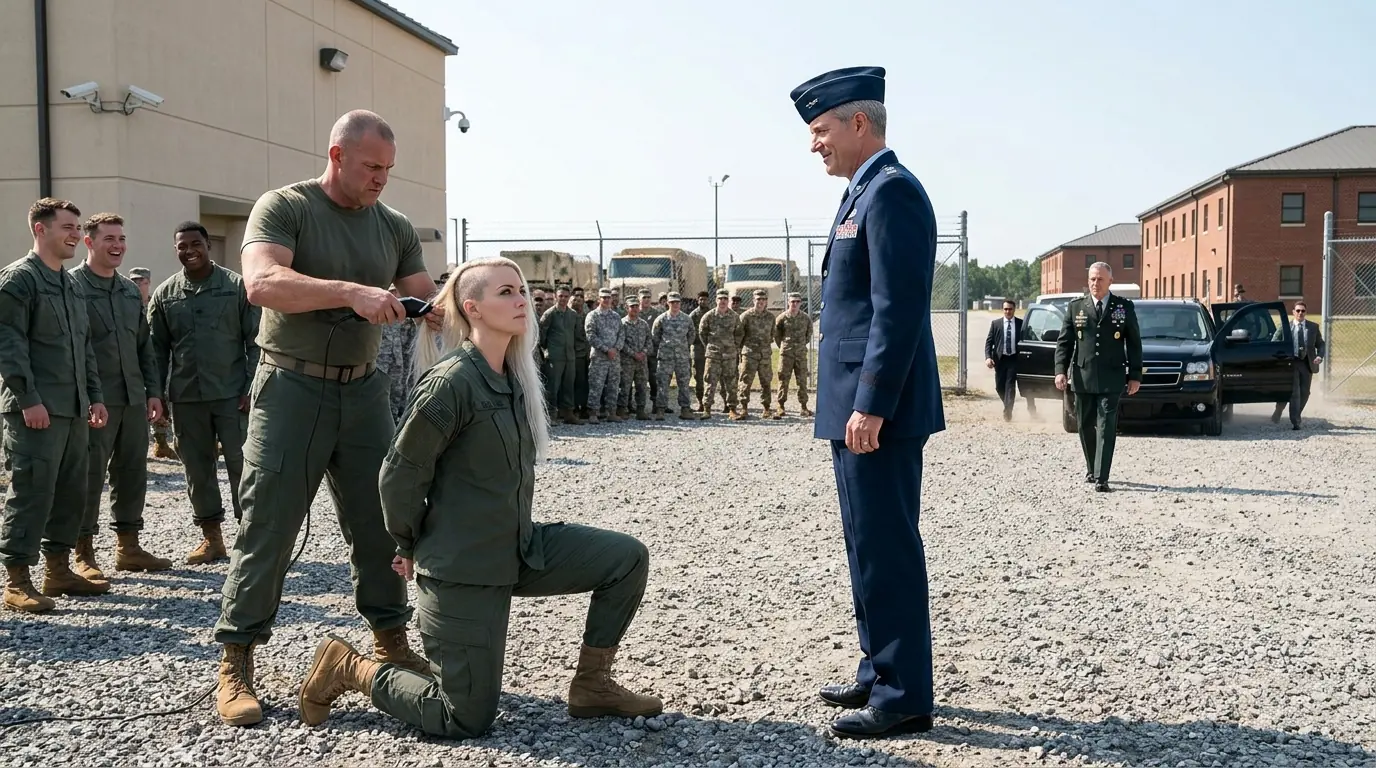
Elena remained on one knee.
Her hands were held behind her by two assistant instructors who looked increasingly uncomfortable with what they had been ordered to do. Dust covered the knees of her dark-gray training uniform, and a loose strand of blonde hair moved against her cheek in the afternoon wind.
Kaine leaned closer.
“Still think somebody is coming to save you?”
Elena raised her eyes toward him.
“No.”
Kaine smiled.
Then Elena looked toward the administration building.
“I think they’ve already seen enough.”
Kaine followed her gaze.
Several small black security cameras were mounted beneath the roofline.
His smile weakened for less than a second.
Then Academy Director Owen Briggs stepped forward.
Briggs was fifty-two, tall, carefully groomed, and almost always dressed more formally than everyone around him. He had spent eleven years running Pine Valley and understood the power of presentation better than almost anyone Elena had investigated.
He stopped several feet in front of her.
“You still think those cameras matter?”
Elena looked at him.
“They usually do when they’re recording.”
Several trainees shifted.
Briggs noticed.
He turned toward the formation.
“Look carefully.”
His voice carried across the yard.
“This is what happens when somebody decides standards apply to everyone except themselves.”
Nobody responded.
Briggs looked back toward Elena.
“You came here believing you were special.”
“No.”
“You questioned instructors.”
“Yes.”
“You challenged evaluations.”
“I asked why they changed after being signed.”
“You collected names.”
“Yes.”
That answer irritated him.
Briggs crouched slightly.
“You think a notebook makes you powerful?”
He reached into the chest pocket of Elena’s uniform and removed a small black notebook.
Elena watched.
Briggs opened it.
Pages contained dates.
Names.
Times.
Room numbers.
Evaluation codes.
Payment references.
Initials.
One sentence was underlined twice:
MISSING COMPLAINT FILES DO NOT MATCH DIGITAL INTAKE COUNT.
Briggs’s expression changed.
He closed the notebook.
Then dropped it into the gravel.
“Your little record means nothing.”
He placed his shoe over it.
Pressed down.
Elena looked toward the notebook.
Then back at him.
“That wasn’t the record.”
Something moved across Briggs’s face.
Not fear yet.
Recognition.
Kaine noticed.
“What does that mean?”
Elena looked toward the cameras again.
Briggs straightened.
“Enough.”
He nodded toward Kaine.
“Finish it.”
The clippers moved toward Elena’s head.
Nine days earlier, nobody at Pine Valley knew her name.
That was exactly how Elena wanted it.
She arrived on a Monday morning aboard a white shuttle van carrying eight transfers from different federal training programs. Her official file listed her as Elena Reese, age thirty-four, temporary reassignment, advanced compliance track.
Nothing more.
No executive history.
No special credentials.
No senior office.
No indication that several people in Washington were watching her progress through encrypted daily reports.
Her file had been intentionally stripped.
Not illegally.
Deliberately.
Pine Valley had been under quiet investigation for eighteen months.
Complaints kept arriving.
Then disappearing.
Trainees reported evaluations being changed after disagreements with instructors.
Contractors alleged unusual pressure to route purchases through specific vendors.
Two former employees claimed they were dismissed after reporting harassment.
One instructor said electronic records had been rewritten.
Every complaint created the same problem.
By the time outside investigators requested documentation, Pine Valley’s files looked perfect.
Too perfect.
Elena had spent fifteen years investigating institutions where authority gradually stopped believing it needed explanation.
She knew what perfect files often meant.
Not innocence.
Preparation.
The first investigative team conducted interviews remotely.
Nothing.
The second requested documents.
Nothing.
A scheduled inspection produced spotless facilities, organized records, compliant personnel, and an Academy Director who answered every question with polished confidence.
Then a trainee named Maya Torres contacted Elena’s office anonymously.
Her message contained twelve words.
They behave differently when they think nobody important is watching.
Elena read the sentence five times.
Then volunteered to become nobody important.
Her deputy, Samuel Price, opposed the idea.
“You run the office.”
“That helps.”
“That makes this worse.”
“How?”
“If they discover you—”
“Then we learn they check backgrounds properly.”
Samuel stared.
“You enjoy this too much.”
“No.”
Elena closed the file.
“I hate investigations where frightened people keep telling us something is wrong and paperwork keeps telling us nothing happened.”
Samuel leaned back.
“So you want to walk into the place?”
“Yes.”
“As a trainee?”
“Yes.”
“You’re thirty-four.”
“Thank you for noticing.”
“That was not the concern.”
Elena smiled faintly.
Samuel sighed.
“Commissioner Reddick approved this?”
“Not yet.”
“He’s going to say no.”
He did.
For eleven minutes.
Then Elena showed him the complaint history.
Forty-three formal grievances in three years.
Only six reached external review.
Thirty-one could no longer be located in the primary archive.
Four employees resigned during internal investigations.
Two trainees withdrew immediately after receiving excellent preliminary evaluations.
Commissioner Marcus Reddick stared at the chart.
“How long?”
“Ten days.”
“Maximum?”
“Fourteen.”
“Daily contact?”
“Encrypted.”
“Live monitoring?”
“Passive unless triggered.”
“Extraction condition?”
Elena listed them.
Physical danger.
Unlawful detention.
Evidence destruction.
Exposure of identity.
Reddick thought.
Then asked:
“What are you trying to prove?”
Elena shook her head.
“Nothing.”
He looked at her.
“I’m trying to observe.”
That answer secured approval.
She arrived at Pine Valley with no visible protection.
Victor Kaine noticed her within the first two hours.
He ran physical assessment.
Former competitive athlete.
Powerful build.
Shaved head.
Cold gray eyes.
Forty-one years old.
Kaine had worked at Pine Valley for thirteen years and possessed a remarkable instinct for discovering which trainees could be pressured.
He studied Elena after she finished the obstacle course.
“You transferred?”
“Yes.”
“From where?”
“Central assessment.”
“What did you do there?”
“Assessment.”
Kaine stared.
“You funny?”
“No.”
That was their first conversation.
Their second happened during a timed equipment-assembly test.
Elena finished first.
Kaine looked at the stopwatch.
Then the workstation.
Then her.
“Again.”
She repeated it.
Faster.
He frowned.
“Who trained you?”
“Several people.”
“Names.”
Elena gave three legitimate names from earlier professional certification programs.
Kaine recognized none.
Good.
The following morning, Elena’s score appeared on the board.
Third place.
She looked at it.
Then at Ethan Walsh standing beside her.
Ethan was twenty-six, quiet, observant, and had been at Pine Valley for six weeks.
He whispered:
“You were first.”
Elena looked toward him.
“You noticed?”
“Everybody noticed.”
“Then why does the board say third?”
Ethan looked immediately toward Kaine.
Then away.
“Don’t ask.”
Elena did.
After breakfast she approached the instructor’s desk.
“My time is wrong.”
Kaine did not look up.
“No.”
“I finished in four minutes twelve.”
“Four twenty-nine.”
“No.”
Kaine slowly raised his eyes.
“You arguing?”
“I’m clarifying.”
“Same thing here.”
Elena smiled faintly.
“That’s interesting.”
His expression hardened.
She walked away.
That evening she wrote:
DAY 2. KAINE ALTERED PERFORMANCE TIME AFTER COMPLETION. WALSH WITNESS. POSSIBLE CONTROL TEST RATHER THAN SIGNIFICANT RECORD ISSUE.
She sent the entry through an encrypted device hidden inside a standard charging adapter.
Washington received everything.
Day three became more interesting.
A trainee named Jordan Bell failed an evaluation he had passed the previous week.
Jordan challenged it.
Kaine told him:
“You must have misunderstood the original result.”
Jordan insisted he had a signed sheet.
The sheet disappeared.
Elena asked Jordan privately whether he had photographed it.
He had.
She recorded the image.
Day four, she discovered intake numbers did not match complaint archives.
Day five, a purchasing coordinator mentioned an approved vendor named North Meridian Solutions.
Elena recognized it.
North Meridian had appeared in an unrelated audit two years earlier.
Not criminally.
Just unusually.
She checked public records through Washington.
The vendor’s regional consultant was Patrick Briggs.
Owen Briggs’s younger brother.
No conflict disclosure appeared in Pine Valley’s procurement summary.
Interesting.
Not proof.
Elena documented it.
Day six, Kaine began targeting her directly.
Her room inspection failed because a mattress was wet.
Elena had left it dry.
Her meal authorization disappeared at lunch.
Administrative error.
Her evening testing appointment moved without notice.
Another error.
One mistake was nothing.
Three became pattern.
She never complained emotionally.
That bothered Kaine.