Marcus Ellis was halfway through lunch when three deputies decided he needed to stand up. They offered no explanation before pulling his chair backward, spilling his drink, and closing the space around him. Marcus kept his hands visible while the food court watched, but the deputy holding his arm mistook that restraint for weakness. Then Marcus asked him to check one pocket—and the youngest deputy suddenly stopped smiling.
The chair moved before Marcus saw the hand.
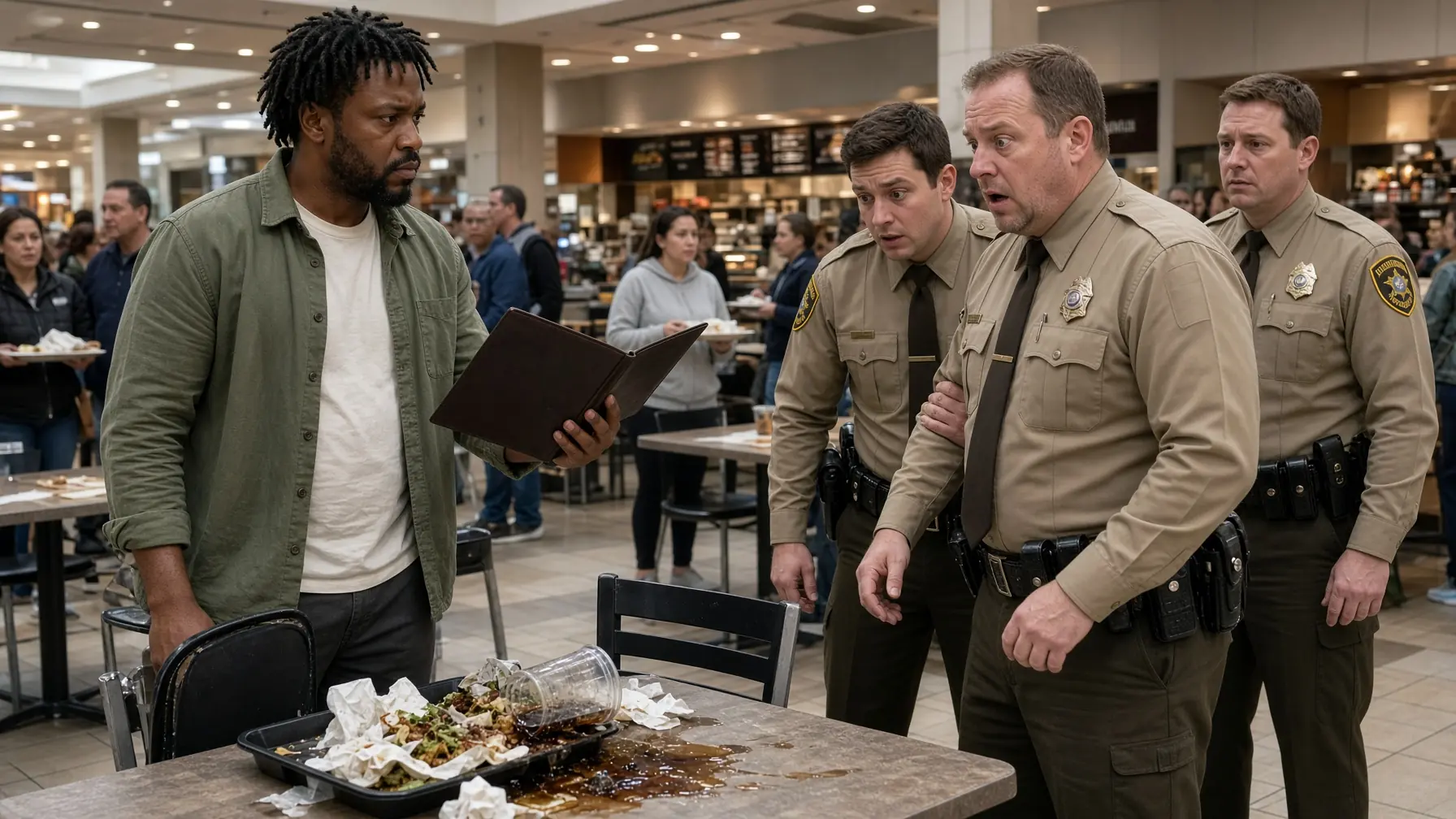
Its legs scraped across the food court floor, jerking him away from the table. His knee struck the underside of the tray, and the paper cup beside his sandwich tipped forward.
Tea spread across the plastic surface.
Marcus caught the edge of the table with one hand, preventing himself from falling backward. When he looked up, a broad deputy in a tan sheriff’s uniform was standing beside him.
Two more had already moved into place.
One stopped near the aisle. The other positioned himself between Marcus’s table and the neighboring seats, leaving no easy direction to turn.
“Up,” the lead deputy said. “Don’t make me drag you.”
He closed his hand around Marcus’s upper arm.
Marcus looked at the grip, then at the man’s face.
Around them, the lunch crowd continued moving for another second or two. Orders were called from restaurant counters. A child asked for ketchup. Someone laughed at a table behind the deputies.
Then the people closest to Marcus began noticing.
He stood slowly.
His palms remained open, one above the wet tray, the other lifted beside his chest.
“What exactly did I do?”
The deputy’s expression suggested that the question itself was part of the problem.
“You heard me.”
“I’m standing.”
“Then keep cooperating.”
Marcus felt the fingers tighten through his muted green overshirt. He drew a breath and looked toward the deputy blocking the aisle.
That man avoided his eyes.
The youngest deputy watched Marcus’s hands.
Marcus was forty-two, with short twists, a neatly trimmed beard, and a face his daughter said always looked serious in photographs even when he thought he was smiling. That morning, she had tried to make him practice looking cheerful before she left the house.
“Less like you’re checking the weather,” she had told him.
He had raised his eyebrows.
“Like that?”
“No. Now you look like the weather disappointed you.”
She had laughed, and he had caught her lightly around the shoulders as she passed.
His wife had been searching for a missing shoe near the doorway.
“Leave him alone,” she said. “That’s the face I married.”
“You knew what you were getting.”
“Most days.”
The house had been full of ordinary morning movement: a bag lifted from a chair, a phone briefly misplaced, someone remembering that something needed signing after everyone was already supposed to be leaving.
Marcus had signed it at the kitchen counter.
Then his daughter had asked whether he could stop at the mall.
She needed a plain cream-colored top for a school performance. She had described the shade carefully, showing him a photograph on her phone and explaining that white was wrong, yellow was worse, and something with a large design across the front would not be allowed.
Marcus had studied the picture.
“Cream,” he said.
“Actual cream.”
“I understand.”
“No, you understand a color. I need you to understand this color.”
His wife laughed from the doorway.
Marcus took a screenshot.
That satisfied his daughter enough to let her leave, though she called back that he should keep the receipt.
He had intended to.
Now, standing beside a soaked lunch tray in a North Carolina shopping mall, he thought suddenly of that conversation.
Actual cream.
The memory arrived so clearly that for a moment he could see the phone screen in his daughter’s hand.
It was not useful.
It was merely something normal his mind reached for while the deputy’s fingers held his arm.
“Tell me why you’re touching me,” Marcus said.
The youngest deputy shifted his weight.
The lead deputy glanced at him, then back at Marcus.
“We’re going to ask you some questions.”
“You could have asked while I was sitting.”
“You don’t decide how this goes.”
A woman at the next table gathered her child’s napkins.
She did not leave yet.
Marcus noticed that.
He noticed the man farther away who had lowered his fork, and the employee behind the nearest counter watching over a stack of paper cups.
The whole scene was still small enough that someone might mistake it for a conversation.
That frightened Marcus more than a shout would have.
Small scenes could be described later as something else.
He had arrived at the mall earlier than planned.
The morning had opened with rain that never quite committed to falling, leaving the roads damp and the sky pale. By the time he parked, clear daylight was coming through the clouds.
He chose the entrance nearest the clothing stores.
Inside, the mall smelled of coffee, cleaning solution, and fresh bread from a kiosk preparing for lunch. Store employees were adjusting displays, and a man on a small floor-cleaning machine moved along the corridor with his eyes fixed ahead.
Marcus stepped aside to let him pass.
The man nodded.
Marcus returned the nod and checked the screenshot.
He had promised himself this would be a quick visit.
Quick visits became less quick when the person shopping had to distinguish between ivory, cream, oatmeal, and a shade the sales clerk insisted was called natural.
He held two tops beneath the store lights and sent a photograph to his daughter.