“Stand up. Quit hiding behind that damn chair.”
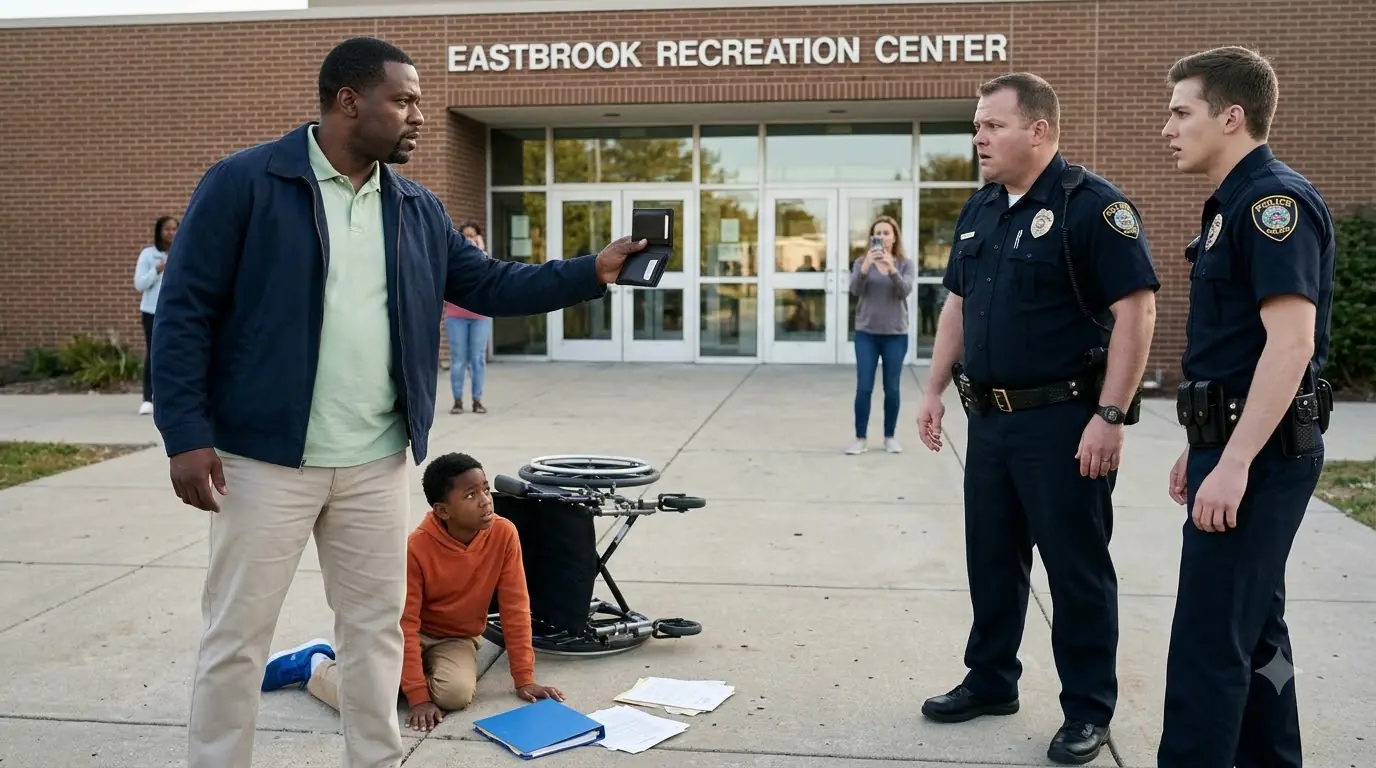
The words reached Malik Carter through the ordinary noises of a Wednesday afternoon: the rhythmic bounce of basketballs behind the recreation center's glass doors, a truck reversing somewhere across the parking lot, leaves scraping along a low concrete wall. The officer standing behind him had both hands on his wheelchair. That detail frightened Malik more than the man's voice. The chair was not a shopping cart, a bicycle, or a piece of furniture anyone could move without asking. It was how Malik traveled through the world, and a stranger had just taken control of it.
“I can't stand,” Malik said. “Please. My dad's coming.”
Officer Brent Cole, thirty-eight years old and thick through the shoulders, shook his head as though he had heard a childish excuse. His navy uniform was neat, his boots polished. From a distance he might have looked like the reassuring figure people expected a police officer to be. Up close, Malik saw something else: a man whose decision had already been made, and who seemed to regard every answer as further defiance. Officer Tyler Shaw, younger and slimmer, stood by the front wheel. He kept a little smile on his face, the kind some boys at school wore when they were waiting for somebody else to make a joke cruel enough to repeat.
Cole pulled sharply backward. Malik's shoulders hit the back of his chair. “Don't,” Malik cried. The officer thrust the chair forward, and Malik, unable to brace with his legs, slipped sideways. For an instant his hand caught an armrest. Then the fabric of his orange hoodie slid against the edge, his fingers failed, and the ground rushed up. His shoulder hit first. His hip followed. The wheelchair toppled beside him, metal striking concrete with a sound like a dropped ladder.
Malik lay still because he could not immediately make sense of the pain. He was aware of his blue sneakers, still pointed in the direction of the fallen footrests. He could see a pale piece of gravel near his cheek and a line of ants winding beneath the edge of the sidewalk. His left arm responded when he tried to move it, although every motion seemed to pull at something sore. Above him Shaw said, “Look at that. You got out after all.”
Somebody screamed. Somebody else said they had recorded it. Neither officer offered a hand. And then, through the confusion, Malik heard the one voice he had been hoping to hear all afternoon.
“Malik!”
His father was running from the parking lot. David Carter, forty-five, broad-shouldered, wearing beige trousers and a navy casual jacket over a pale green polo, dropped to his knees beside the boy. He did not grab or lift him. “I'm here,” he said, with an extraordinary steadiness that made Malik feel safe enough to cry. “Tell me where it hurts.”
“They pushed me,” Malik whispered. “I said I couldn't stand.”