“CHECK THE ADDRESS! YOU'VE GOT THE WRONG HOUSE!”
Wanda Carter's voice cracked against the carpet as Officer Derek Mercer forced her wrists together behind her back. The handcuffs closed with a metallic click that seemed much louder than the boots pounding through her hallway. Beyond her shoulder, officers in dark tactical equipment swept past the wooden staircase, their radios chattering over one another, their flashlights cutting through the pale morning light.
Her front door hung open. A splintered piece of its frame lay beside an overturned table. Somewhere upstairs, a man shouted that a room was clear. Someone else demanded to know where the basement stairs were. The beautiful house Wanda had spent twenty years turning into a home had become a maze of shouted instructions and strangers with weapons.
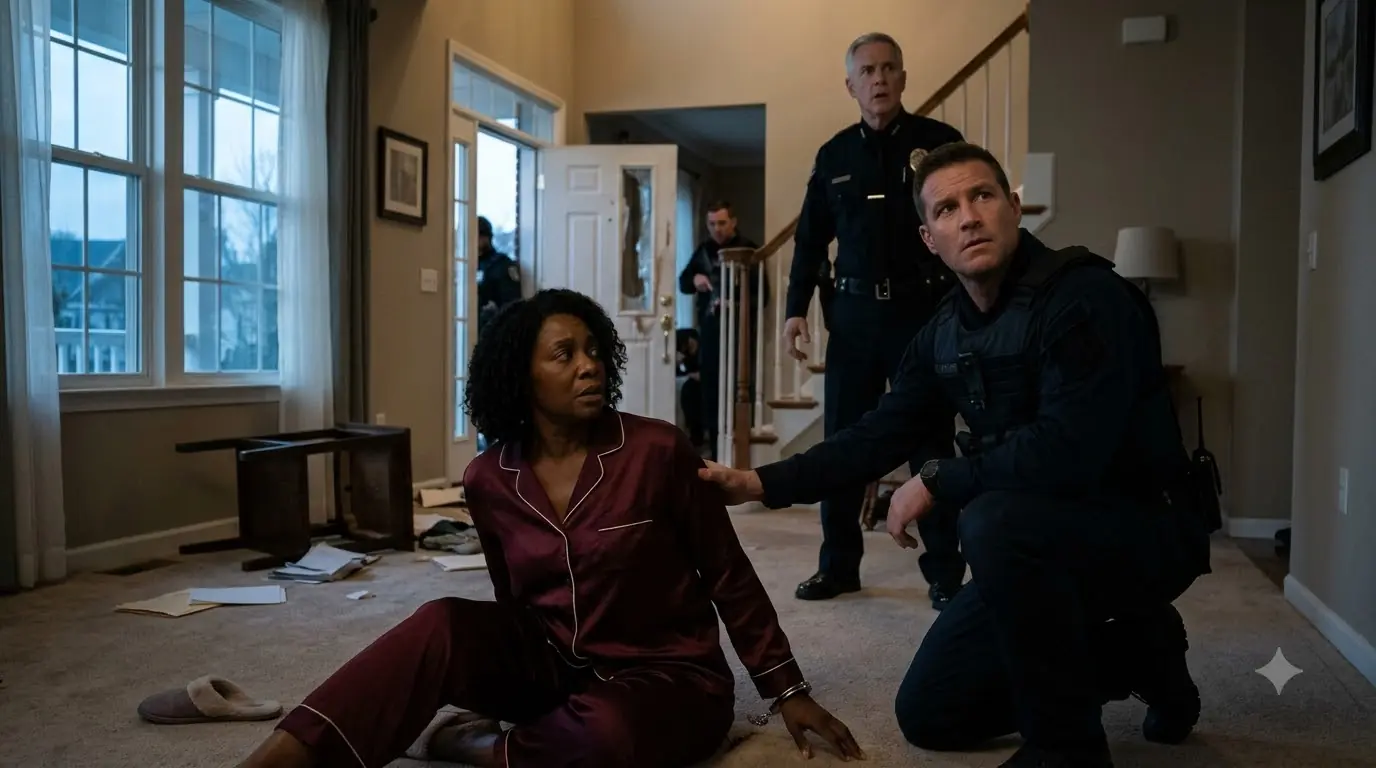
“Shut up,” Mercer told her. “We have a warrant.”
Wanda pressed her cheek against the rug. “Then read it. Read the number.”
He shifted his weight beside her, impatient rather than uncertain. “You're not giving me instructions.”
At the front entrance, another figure appeared. Police Chief Richard Hayes stepped over the broken threshold, his silver hair immaculate above a black command uniform. His eyes moved quickly around the room, taking in the officers, the scattered furniture, and the woman handcuffed on the floor. Then his gaze caught on something fixed to the decorated wall across from the staircase.
He stopped.
For a moment, the radios and the boots continued, but the chief no longer seemed to hear them. His expression lost the confident hardness he had carried through the doorway. He took one slow step toward the wall, then another. Wanda could not see what held him. She could see only the sudden change in his face.
That was the moment, though Wanda could not know it, when the morning's careful assumptions began to collapse.
Twenty minutes earlier, she had been upstairs making her bed.
Wanda usually woke before sunrise. At fifty-two, she had learned to love the brief silence before her neighborhood came alive: the humming refrigerator, the soft rush of water through the bathroom pipes, the first birds under the eaves. Her husband was away visiting relatives for the weekend, and the house felt larger without him, but not lonely. She had lived in it long enough to know the sound of each stair and the way autumn light moved across its windows.
She wore burgundy silk pajamas and worn slippers, a small luxury she allowed herself after years of dressing for work before daylight. On the bedside table rested a book with a folded receipt marking her place. A cup of tea steamed near the window. She had planned an ordinary morning: sweep leaves from the porch, call her sister, water the last plants before the first frost, and perhaps take the boxes of winter blankets down from the upstairs closet.
The previous evening she had polished the framed photographs along the stairway and dusted the decorated wall in the living room. She was particular about that wall. Visitors sometimes lingered there, reading and asking questions, and Wanda always answered only what she wanted to. It was her home, not a public museum. That morning she gave it no special thought. She had no reason to expect that strangers would stand in front of it before the sun rose.