The sound appeared only on hills.
That was what drove Daniel Mercer crazy.
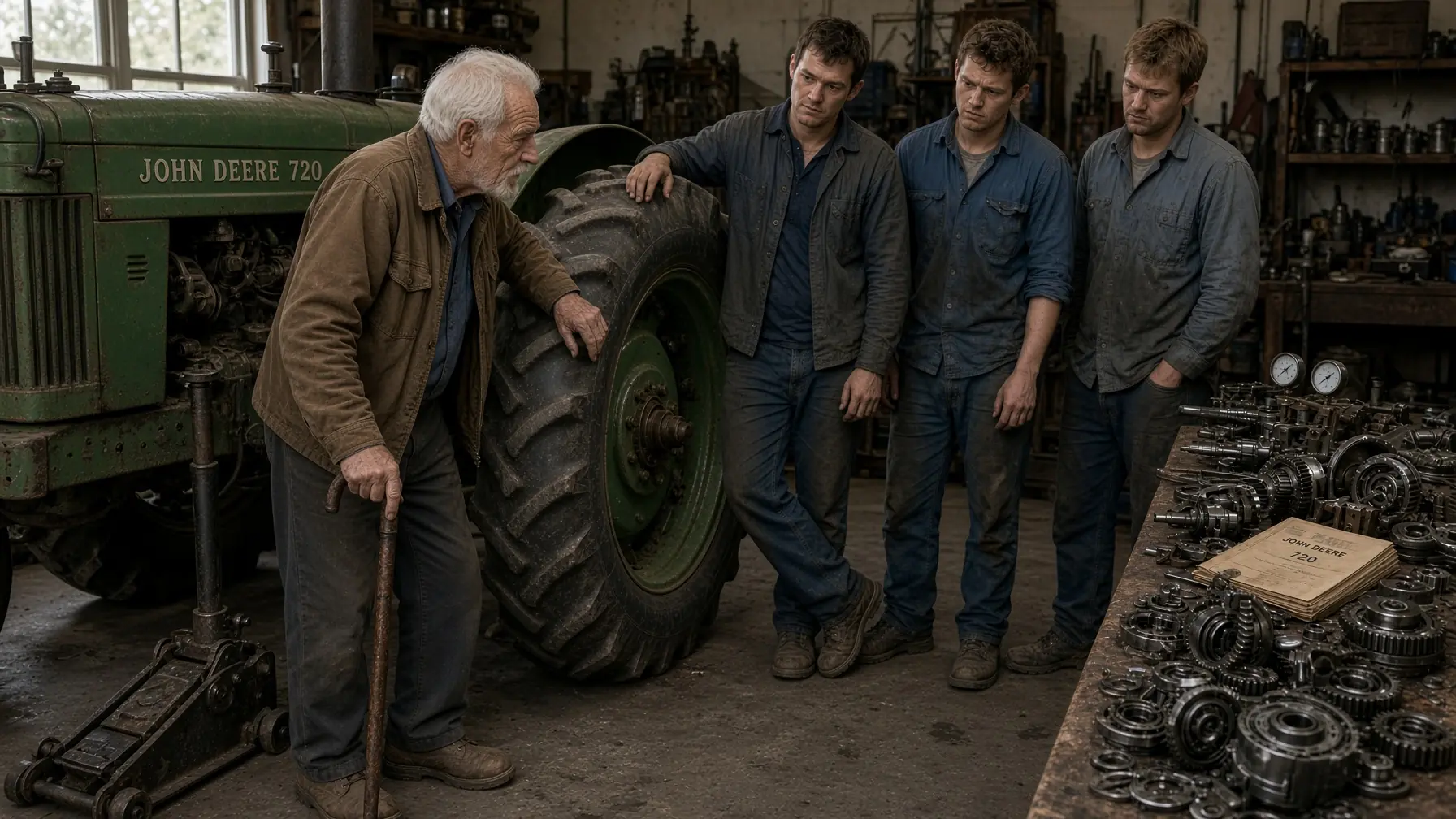
On flat ground, his old John Deere ran as smoothly as a tractor approaching forty years old had any right to run. The diesel pulled cleanly. The transmission shifted without grinding. The hydraulic system could lift a loaded hay wagon without hesitation.
Nothing overheated.
Nothing leaked.
Nothing shook.
But the moment Daniel pointed the tractor uphill with real weight behind it, something beneath him changed.
The engine would settle into its working rhythm.
The rear tires would dig into the ground.
Then—
Clank.
One hard metallic strike.
Then silence.
It did not repeat with wheel speed.
It did not follow engine revolutions.
It never happened while descending.
Only climbing.
Only under a load.
One clank.
Then nothing.
By late August of 1989, that single sound had cost Daniel Mercer more sleep than some broken machines cost farmers money.
And it had already fooled some of the best mechanics in Red Willow County.
Daniel was thirty-two and operated one hundred and eighty acres outside Red Willow, Wisconsin, with his wife Rebecca and their two sons.
The land had belonged to his father before him.
And to his grandfather before that.
The tractor had too.
It was a John Deere 720 diesel from the 1950s, still wearing much of the faded green paint Daniel remembered from childhood. Its seat had been replaced twice. The left fender carried a shallow crease from a wagon accident that had happened before Daniel was born.
But the engine remained strong.
That tractor had spread manure, pulled plows, cut hay, hauled grain, and fed cattle through winters harsh enough to freeze water in metal buckets before breakfast.
Daniel trusted it.
That was exactly why the new sound bothered him.
His father had taught him something when he was barely old enough to see over a tractor hood.
Machines talked.
A squeal meant friction.
A knock meant clearance.
A rattle meant movement where movement did not belong.
A hiss meant pressure escaping.
A machine did not suddenly invent a new sound for entertainment.
Every sound had a source.
And every source, ignored long enough, eventually became a failure.
The first clank came in June.
Daniel was pulling a loaded forage wagon up the lane from the lower field.
Near an old stone wall, the lane climbed sharply.
The 720 settled into the hill, diesel working harder as Daniel kept the throttle steady.
Then—
Clank.
Daniel felt the impact through the seat almost as much as he heard it.
He immediately eased off.
At the top of the hill he stopped, climbed down, and walked around the machine.
Nothing.
No oil underneath.
No loose hitch.
The drawbar pin remained secure.
The wagon tongue was fine.
No cracked housing.
No visible movement.
He drove to the barn.
The sound did not return.
Two days later, Daniel took the same hill.
Clank.
His older son Michael was riding on the wagon.
“What was that?”
Daniel looked over his shoulder.
“I don’t know.”
“Transmission?”
“Maybe.”
Daniel hated the answer the moment he said it.
That evening he changed the transmission oil.
He examined the magnetic drain plug.
There was a small amount of fine metal collected on it, but nothing unusual for an old machine.
He removed the inspection cover and looked at every gear he could see.
Worn?
Of course.
Broken?
No.
The following morning he tried something.
He drove the tractor up the same lane alone.
No wagon.
No heavy implement.
Nothing.
The John Deere climbed without complaint.
Daniel turned around.
He attached a loaded manure spreader.
Then tried again.
Halfway up—
Clank.
Daniel stopped.
Now he knew he wasn't imagining it.
He called Larson Agricultural Repair.
The shop stood twelve miles away beside the county highway in a long concrete building smelling permanently of diesel fuel, gear oil, welding smoke, and coffee.
Carl Larson had owned it for nearly thirty years.
Farmers trusted Carl because he was confident without pretending to know things he did not.
When Daniel described the problem, Carl listened carefully.
“Only uphill?”
“Only uphill under a heavy load.”
“Same gear?”
“Usually fourth. Happened once in third.”
“Clutch slipping?”
“No.”