By noon, three professional recovery trucks had failed to move the tanker even an inch.
Forty thousand pounds of steel sat buried deep in the soft clay shoulder of County Road 7.
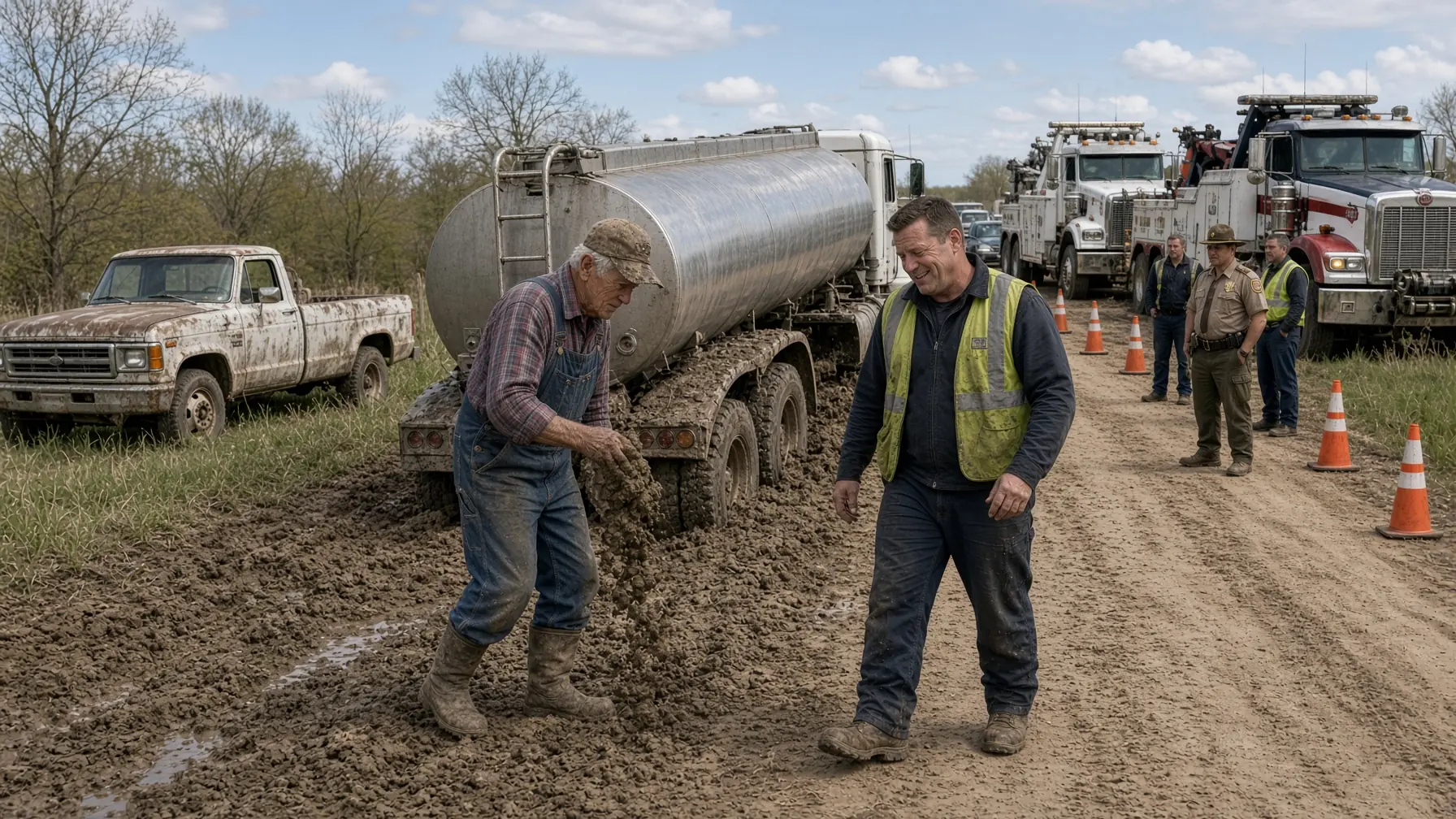
Its rear tires had disappeared almost halfway into the earth.
Mud packed tightly around the axles.
One fifty-ton recovery truck stood directly behind it.
Another sat angled near the drainage ditch.
A third waited farther down the road with hazard lights flashing.
Heavy chains lay in the mud.
Two snatch blocks hung from cable.
A ground anchor had already been driven and pulled loose once.
Fourteen vehicles were backed up along the road.
And Deputy Carl Moss had run out of new ways to explain why a job that should have taken an hour had now blocked the county road for six.
The tanker driver, Mike Reeves, stood beside his cab rubbing both hands across his face.
His company had called four times.
The last conversation had not been pleasant.
“Any progress?”
Mike had looked at the tanker.
Then at the three recovery trucks.
Then at the trench his rear wheels had dug into the shoulder.
“No.”
That answer was becoming expensive.
Ten yards away, Derek Stone stood with his arms crossed.
Forty-three years old.
Broad shoulders.
Clean-shaven.
Dark recovery jacket under a reflective vest.
Owner of Stone Recovery, the best-equipped heavy recovery company in three counties.
At seven-thirty that morning, Derek had been confident.
By nine, determined.
By ten-thirty, irritated.
By noon, angry.
Not because his equipment was inadequate.
That was precisely the problem.
His equipment was excellent.
His operators were experienced.
His rigging was rated well beyond the tanker’s weight.
Every calculation told him the truck should have moved.
Yet every pull had only buried it deeper.
Then an old pickup appeared at the roadblock.
Derek barely noticed.
The driver pulled onto the shoulder.
The door opened.
And a seventy-eight-year-old farmer climbed out.
He was lean in the way old farmers became lean after decades of work that never cared whether they had eaten lunch.
Sun-lined face.
Sharp gray eyes.
Denim overalls over a faded plaid shirt.
Battered cap.
Mud-caked boots.
Hands permanently shaped by rope, wire, steel, and weather.
His name was Harold Gaines.
He closed the pickup door.
Then stood silently at the edge of the road.
He did not ask what happened.
Did not introduce himself.
Did not look impressed by the recovery trucks.
He just studied the tanker.
Derek noticed him.
“You lost, sir?”
Harold glanced at him.
“No.”
Then looked back at the tanker.
Derek waited.
Nothing else came.
Harold stepped off the pavement.
Walked into the mud.
One of Derek’s younger crewmen muttered:
“Who’s Grandpa?”
Derek shrugged.
“Probably somebody from one of these farms.”
Harold did not walk directly toward the tanker.
Instead, he entered the ditch.
He dragged one boot through the clay.
Crouched.
Pressed his thumb into the exposed wall where the shoulder had broken.
Scooped up a handful.
Squeezed.
Watched how the clay held shape in his palm.
Then let it fall.
Derek watched.
“What’s he doing?”
The young operator beside him smiled.
“Playing in the mud.”
Derek said it louder.
“Looks like it.”
Harold heard them.
He did not turn around.
Instead, he walked slowly along the entire length of the tanker.
Stopped beside the left rear tires.
Studied the angle.
Walked around the back.
Looked at the axle.
Then the ditch.
Then an open patch of shoulder nearly twenty feet away.
He stood there for almost two minutes.
Doing absolutely nothing.
Derek finally lost patience.
“Sir.”
Harold looked over.
“We've been working on this since sunrise.”
Harold nodded.
“I expect you have.”
Derek gestured toward the tanker.
“We know where it's stuck.”
“I expect you do.”
“Then what exactly are you looking for?”
Harold brushed the clay from his hands.
“Where it wants to move.”
One of the recovery men laughed.
Derek almost did too.
“Where it wants to move?”
“Yes.”
“It’s a tanker.”
“I noticed.”
“Tankers don't want anything.”
“No.”
Harold looked at the clay.
“But ground does.”
That stopped the laughter for a second.
Derek pointed toward his trucks.
“We tried a straight pull.”
Harold listened.
“Angle pull.”
A nod.
“Underlift.”
Another nod.
“Snatch block multiplication.”
Harold waited.
“Ground anchor.”