By twelve forty-seven on Tuesday afternoon, County Road 7 looked less like a Kansas farm road and more like the staging ground for a disaster. A forty-thousand-pound chemical tanker leaned dangerously into the muddy shoulder, its rear wheels buried nearly eighteen inches into saturated clay while three professional recovery trucks surrounded it like defeated giants. Heavy chains, snatch blocks, ground anchors, cables, and mud-covered equipment lay scattered everywhere after almost six hours of failed attempts. Then seventy-two-year-old Harold Gaines arrived at four miles per hour on a faded red 1962 Farmall tractor.
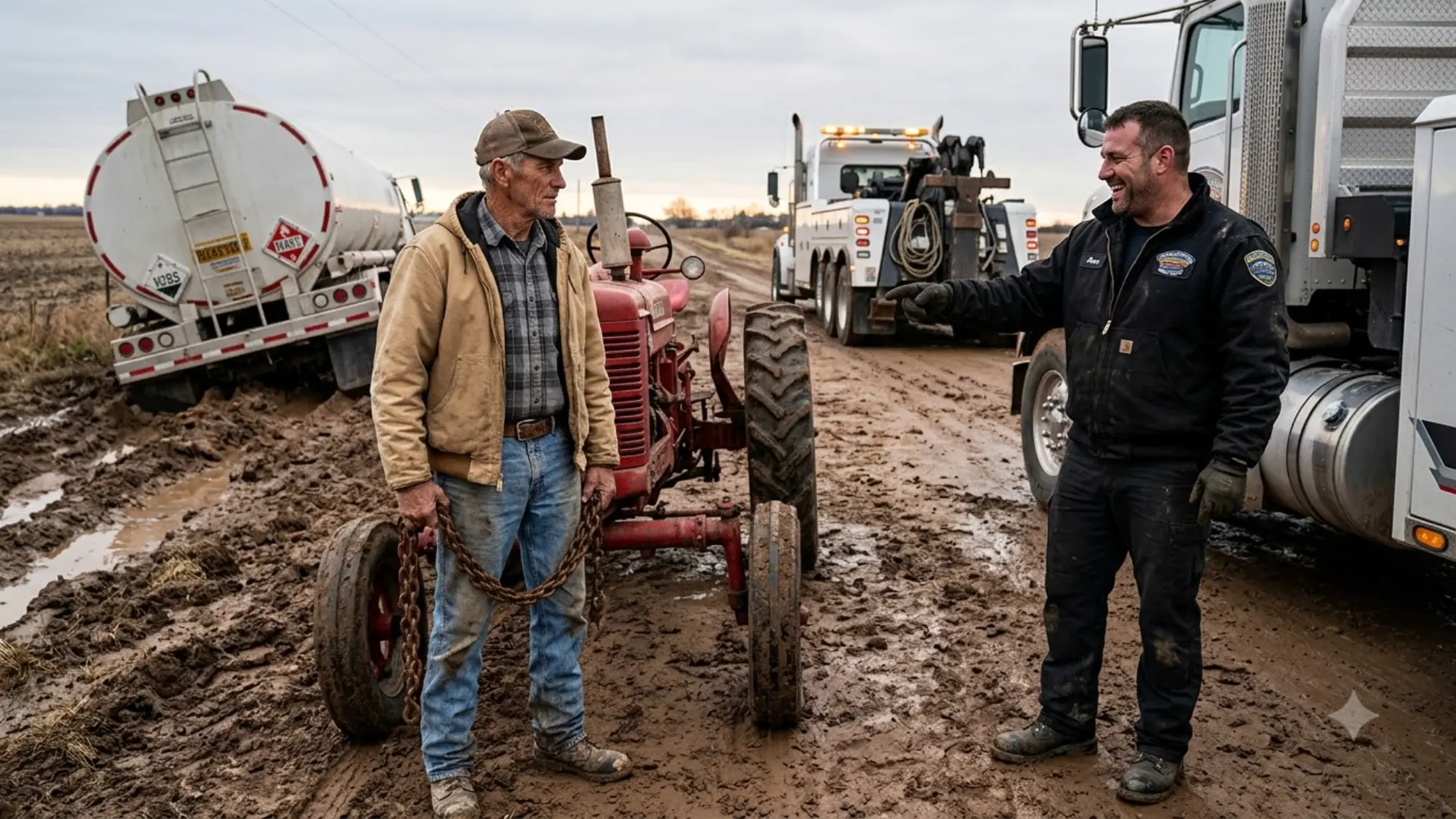
Recovery boss Derek Stone looked up from beside his fifty-ton underlift and immediately started laughing. Harold climbed down wearing a faded tan farm jacket, gray plaid shirt, dirty jeans, worn work boots, and the calm expression of a man who had no interest in impressing anyone. He carried a thick steel recovery chain in one hand and walked past nearly forty thousand dollars of equipment without even slowing down. Derek pointed toward the ancient Farmall and said, “Sir, my equipment costs more than your whole farm—and none of it moved that tanker.”
Harold stopped and looked at the buried tanker instead of Derek. “Good,” he answered. “Hook my chain and watch what your money forgot to learn.” Derek’s laughter disappeared for half a second before returning harder, and several exhausted recovery workers exchanged looks as if wondering whether the old farmer had lost his mind. Harold ignored every one of them.
The trouble had begun shortly after sunrise. Mike Reeves, a commercial tanker driver who had traveled County Road 7 dozens of times, was hauling chemical transport through the region when his right-side tires drifted just a little too far onto the softened shoulder. The road had taken heavy rain during the previous days, and what looked like firm ground turned almost instantly into deep, saturated clay beneath the weight of the tanker. At 6:14 a.m., Mike felt the trailer sink.
He stopped before making the problem worse, but by then the damage had already been done. The rear section of the tanker sat deep enough that the surrounding clay seemed molded around the tires and lower frame. Mike contacted his company, which immediately called Derek Stone Recovery, one of the best-equipped heavy-recovery operators in the region. Derek arrived around seven thirty convinced he would have the road open before breakfast traffic became a serious issue.
His first attempt involved the fifty-ton underlift. The recovery truck had enough rated pulling capacity to move loads far heavier than the tanker, and Derek had used it successfully on overturned semitrailers, loaded grain haulers, and heavy construction equipment. He positioned the truck behind the tanker, attached the recovery points, and applied steady power. The recovery truck’s wheels spun against the soft ground while the tanker barely moved.
Derek changed the setup. A snatch-block system would multiply the available pulling force, reducing the load on individual cables while increasing the mechanical advantage. His crew spent nearly an hour repositioning equipment, installing rigging, checking cables, and preparing another pull. When the lines tightened, the tanker rocked slightly and sank deeper on one side.
The third attempt used a ground-anchor system. Derek drove the anchor deep enough that everyone expected it to hold, then connected the recovery line and gradually increased tension. The saturated soil betrayed him again. Instead of pulling the tanker free, the anchor itself began moving through the earth.
By ten o’clock, Derek had called for a second recovery truck. By noon, a third had arrived, each carrying specialized equipment designed specifically for situations exactly like this one. The tanker still had not moved meaningfully, County Road 7 was closed in both directions, and a line of frustrated motorists had begun building beyond the deputy’s barricades. Even Derek was running out of ideas he could explain confidently.
Deputy Carl Moss had spent the morning telling drivers the road would reopen soon. By noon, he had stopped giving estimates entirely. Fourteen vehicles sat backed up along the route, including farm pickups, delivery trucks, and a school maintenance van. Mike remained near the tanker, increasingly worried about the angle of the load and whether another aggressive pull might damage something more serious than a tire or axle.
Around the same time, Harold’s grandson Seth Gaines passed the scene while returning from town. Seth slowed long enough to count three recovery trucks, several frustrated operators, and one tanker that looked almost exactly as stuck as it had probably looked hours earlier. He pulled his pickup onto the shoulder beyond the traffic queue and called his grandfather. “Grandpa, there’s a tanker buried on County Road 7.”
Harold was repairing a gate hinge when the phone rang. “How buried?” he asked. Seth looked toward the tanker. “Three recovery trucks have been here all morning and they haven’t moved it.”
“What’s the ground like?”
“Soft.”
Harold waited.
“Really soft,” Seth added.
Harold set down the hinge. “Go to the machine shed and get my long chain.” Seth laughed because he thought his grandfather was joking. Harold did not.
Twenty minutes later, the old Farmall appeared on County Road 7. It moved painfully slowly compared with the recovery trucks lined along the road, its faded red paint covered in decades of scratches and repairs. Derek saw it coming and asked one of his men whether the county had called somebody to mow the ditch. Then he realized the tractor was heading directly toward them.
Harold parked and did not immediately touch anything. Instead, he walked around the tanker. He stepped carefully into the ditch, pushed the toe of his boot into the clay, picked up a handful of mud, squeezed it, then let it fall through his fingers.
Derek watched from a distance. “What is he doing?” he asked. No one answered because Harold’s movements did not resemble the preparation procedures they had been using all morning. He was not inspecting the cables or calculating rated pull capacity. He was studying the ground.
Harold walked behind the tanker and crouched near the deepest wheel tracks. He looked at how the clay had risen around the tires, how the trailer leaned, and where the soil had compressed beneath the axle. Then he walked several yards to one side and stared back toward the road. Eleven minutes passed before he said anything.
Seth followed him with the chain over one shoulder. “You can move it?” he asked. Harold pointed toward the buried wheels.
“They’re pulling against the ground.”
Seth frowned. “Isn’t that what you’re supposed to do?”
“No.”
Harold pointed toward Derek’s trucks. “They’ve got enough power to tear that tanker in half. Power isn’t the problem.” He kicked the clay with his boot. “This is.”
Saturated clay behaved differently from ordinary mud. Under extreme weight, water and fine soil particles could create a strong adhesion around a buried object, almost like a suction seal. Pulling directly against that seal could demand enormous force because the recovery equipment was effectively fighting the tanker’s weight and the ground’s grip simultaneously. Harold did not use scientific terminology when he explained it to Seth.
He simply said, “They’re trying to lift it out of the hole.” Seth looked toward the tanker. “What are you going to do?”
“Roll it out of the grip.”
Harold positioned the Farmall at a shallow offset rather than directly in front of or behind the tanker. The angle looked wrong to Derek immediately. Harold also chose a position several feet lower relative to the tanker frame, placing the tractor so the chain would pull downward and sideways at the same time instead of straight.
Derek walked over. “That’s not going to work.”
Harold kept adjusting the tractor.
“You’re pulling crooked.”
“I know.”
“You’ll waste half your force.”
Harold looked at him. “That’s the part you still don’t understand.”
Derek stepped closer, irritation replacing amusement. “We’ve been doing heavy recovery for twenty years.”
Harold nodded. “Then you’ve had twenty years to learn when not to pull straight.”
A few recovery workers looked away so Derek would not see their reactions. Harold drove the tractor another two feet, checked the position, reversed slightly, and stopped. He finally seemed satisfied.
Seth handed him the chain. Harold did not attach it to the standard towing point Derek’s crew had been using. Instead, he crawled into the mud near the rear axle housing and selected a lower connection that changed the direction of the pull. Derek immediately objected.
“That is not the standard attachment point.”
Harold secured the chain.
“No.”
Derek waited.
Harold stood.
“It’s the right one.”
The old farmer had spent fifty-three years working machinery in Kansas soil. He had pulled stuck combines from spring fields, loaded grain wagons from washed-out lanes, tractors from creek bottoms, pickups from clay, and cattle trailers from pastures where professional wreckers could not safely reach. Every failure had taught him something, and he remembered terrain the way some people remembered faces.
Years earlier, Harold had discovered that certain heavy machines buried in saturated clay behaved strangely. Pull straight and the machine resisted almost indefinitely. Pull slightly sideways and down, however, and the edge of the clay seal broke before the full load began moving.
The first time he learned it, he had nearly destroyed a tractor clutch.
The second time, he changed the angle.
The third time, he understood why.
Nobody had written equations for Harold Gaines. Nobody had given him an advanced recovery certificate. He simply spent decades watching what happened when steel, weight, water, and Kansas dirt interacted.
Derek stood with his hands on his hips. “That antique won’t move forty thousand pounds an inch.”
Harold climbed onto the Farmall.
“Then stand right there.”
He looked back at Derek.
“You’re four minutes away from learning why you wasted six hours.”
Seth pulled out his phone.
“Recording?”
Harold nodded.
“Record the wheels and tanker, not me.”
Mike Reeves climbed into the tanker cab so he could control braking if the vehicle suddenly moved. Deputy Moss pushed the closest spectators farther back. Derek’s crew moved clear of the chain and recovery zone, though several were already watching with the interested expressions of mechanics who secretly hoped the impossible would happen.
Harold increased the throttle gradually.
The Farmall engine settled into a hard, steady rhythm.
The chain lifted from the mud.
Every loose link disappeared.
Then it went taut.
The tractor did not jump.
Harold did not slam the throttle wide open.
He let the load build slowly.
The Farmall’s rear tires pressed into the shoulder at the exact position Harold had chosen. The soil deformed beneath them, but instead of spinning wildly, the tires maintained enough contact to keep transferring force.
Thirty seconds passed.
Nothing.
Derek folded his arms.
One minute.
Still nothing visible.
At ninety seconds, one recovery operator muttered, “He’s just going to bury that tractor too.”
Harold made a tiny steering correction.
The chain angle changed.
Seth moved closer to the safe edge of the road, phone still recording.
At two minutes, the Farmall had barely moved.
Derek began smiling again.
Then, at approximately two minutes and forty seconds, everyone heard it.
A deep releasing sound came from beneath the tanker.
It was not metal breaking.
It was not a chain snapping.
It sounded like thick earth suddenly exhaling.
Mike felt the tanker shift sideways by perhaps half an inch.
“Movement!” he shouted from the cab.
Derek’s smile disappeared.
Harold did not react.
He kept the throttle steady.
The tanker moved another fraction.
Then another.
Mud separated from the buried wheel along the left rear quarter, creating a visible crack between rubber and clay. Once the seal began breaking, the resistance changed rapidly.
The massive tanker shifted sideways.
The chain remained tight.
Harold adjusted the tractor again.
Now the buried wheels began climbing instead of digging.
Derek took one step toward the road before remembering the line was still under tension.
“Keep clear!” one of his own operators shouted.
Three minutes passed.
The tanker had moved more in twenty seconds than it had during the previous six hours.
Mike feathered the controls from the cab while Harold maintained the shallow pull. The Farmall rear wheels churned steadily but never exploded into uncontrolled spinning.
At three minutes forty seconds, one rear tire reached firmer ground.
Twenty seconds later, the second began climbing.
At four minutes and twelve seconds, the tanker rolled completely free of the clay and settled onto stable road shoulder.
Nobody spoke.
The Farmall idled quietly with the chain still hanging between tractor and tanker.
Harold reduced the throttle and looked back.
Mike climbed from the tanker cab and stood beside the vehicle staring at the old farmer. His face carried the strange expression of someone who had just watched six hours of frustration disappear in four minutes.
He walked toward Harold.
No speech.
No congratulations.
He simply extended his hand.
Harold shook it.
Then another sound came from beside the recovery trucks.
Clapping.
Derek Stone stood beside his fifty-ton underlift applauding.
Slowly at first.
Then harder.
One of his operators joined him.
Another followed.
Soon nearly the entire recovery crew was clapping for the seventy-two-year-old farmer standing beside an antique Farmall.
Derek walked through the mud toward Harold.
His expression was completely different from the one he had worn minutes earlier.
“What did you do?”
Harold looked toward the tracks.
“Changed the direction.”
“That can’t be all.”
“It’s most of it.”
Derek shook his head.
“We had more power than you.”
“Way more.”
“Better tires.”
“Yep.”
“More equipment.”
Harold smiled.
“Definitely.”
Derek pointed toward the clay.
“So why did you move it?”
Harold stepped beside him and drew a rough line in the mud with his boot. “You pulled straight. Every time the tanker tried to come up, the clay held the bottom tighter.”
He drew another line sideways.
“I pulled down and across.”
Derek studied it.
“You broke the seal first.”
Harold nodded.
“Once the mud let go, you weren’t moving forty thousand pounds out of a hole anymore. You were rolling it toward the road.”
Derek looked toward his equipment.
For the first time all day, he appeared embarrassed rather than angry.
“We should’ve seen that.”
“Maybe.”
Harold picked up the loose chain.
“Or maybe you needed to get stuck long enough to learn it.”
Seth laughed.
Derek did too.
County Road 7 reopened shortly after one in the afternoon. Deputy Moss removed the barricades, traffic began moving, and Mike Reeves slowly drove the tanker away after inspecting the vehicle for damage. Harold wrapped his chain around the Farmall and prepared for the slow ride home.
Derek stopped him before he left.
“Mr. Gaines.”
Harold turned.
“Harold.”
“Harold, how long have you been recovering equipment?”
“I haven’t.”
Derek frowned.
“You just recovered a tanker my crew couldn’t move.”
“I’m a farmer.”
“That’s what I mean.”
Harold thought about it.
“Fifty-three years, I suppose.”
Derek nodded.
“I’ve been doing this professionally twenty.”
“Then you’ve got thirty-three years before you catch me.”
Derek laughed.
This time Harold laughed with him.
Seth’s video reached the internet that evening.
He expected perhaps a few hundred views from farmers around the county.
Instead, the clip spread.
People watched the three recovery trucks lined behind a tanker that had not moved for hours. They watched Harold arrive on a machine built decades before most of Derek’s crew had been born.
They watched the old farmer reposition his tractor while professionals seemed skeptical.
Then they watched the chain tighten.
The clay release.
The tanker move.
Four minutes and twelve seconds.
Within days, millions of people had seen it.
Some viewers claimed the Farmall possessed unbelievable pulling power.
Harold hated that explanation.
“It didn’t overpower anything,” he told Seth.
“Then what should I tell people?”
“Tell them power wasn’t the problem.”
That became the detail people gradually understood.
Harold’s old Farmall did not magically become stronger than three professional recovery trucks. The professionals had more horsepower, better hardware, stronger winches, more sophisticated rigging, and far greater rated recovery capacity.
Harold had something else.
Specific experience.
He recognized what saturated clay was doing because he had dealt with that exact problem repeatedly across half a century.
Equipment solved many problems.
Experience told you which problem you were actually trying to solve.
Three weeks later, Derek called Harold.
“Got coffee?”
Harold was confused.
“What?”
“You said you were a farmer, not a recovery man.”
“I am.”
“Well, I’ve got a loaded feed truck sitting axle-deep in clay twenty miles north of you.”
Harold laughed.
“You asking for help?”
“I’m asking for consulting.”
“How much does consulting pay?”
Derek hesitated.
Harold answered for him.
“Coffee.”
Derek laughed.
“Done.”
They worked the recovery together.
This time Derek did not laugh when Harold walked the ground first.
He followed him.
Asked questions.
Checked the angle.
When Harold suggested shifting the primary pull point twelve degrees sideways, Derek’s crew repositioned without argument.
The truck came free in less than twenty minutes.
Months later, another call came.
Then another.
Harold never joined Derek’s company.
He never bought a professional recovery truck.
Sometimes he arrived in the Farmall.
Other times he simply stood beside Derek and studied the ground.
Their strangest partnership became something of a local legend: the professional recovery boss with hundreds of thousands of dollars in equipment and the elderly farmer whose entire consulting fee remained coffee.
The relationship mattered to Derek more than he admitted.
Before meeting Harold, Derek believed expertise meant accumulating the right machinery and knowing how to use every tool.
After County Road 7, he changed how he trained younger operators.
Before a cable was attached, he made them walk the scene.
“What are we fighting?” he would ask.
New operators usually answered weight.
Derek shook his head.
“What else?”
Slope.
Ground condition.
Friction.
Suction.
Load angle.
Tire position.
Vehicle geometry.
Only after they understood those things were they allowed to talk about pulling power.
One young operator eventually asked where Derek learned the method.
Derek smiled.
“Seventy-two-year-old farmer made me look stupid beside three recovery trucks.”
The trainee laughed because he thought Derek was joking.
Derek showed him Seth’s video.
The laughter stopped.
Harold never considered himself brilliant.
Whenever people asked why he succeeded, his explanation remained frustratingly simple.
“I’d seen mud do that before.”
But that simplicity concealed a lifetime of observation.
More than fifty years of mistakes.
Machines stuck during planting.
Harvest equipment trapped after storms.
Trailers buried near cattle lots.
Tractors pulled incorrectly.
Chains broken.
Clutches burned.
Lessons remembered.
Every failure had become information.
That was the knowledge Harold brought to County Road 7.
Not a miracle.
Not luck.
A pattern recognized because he had lived long enough to recognize it.
Years later, Seth asked his grandfather whether he remembered what Derek said when the Farmall first arrived.
“Something about his equipment costing more than the farm.”
“Did that make you angry?”
Harold considered it.
“No.”
“Really?”
“He was mostly right.”
Seth laughed.
Harold looked toward the old red tractor parked inside the machine shed.
“People get confused about what things are worth.”
He pointed toward the Farmall.
“That tractor isn’t worth much compared with his recovery trucks.”
Then Harold tapped his temple.
“But that’s not where the useful part was.”
Seth understood.
County Road 7 became ordinary again.
Rain washed away the deep tire marks eventually.
Grass grew across the damaged shoulder.
Drivers passed the location without knowing a forty-thousand-pound tanker had once sat buried there while three professional recovery trucks fought it for six hours.
But Seth remembered.
Derek remembered.
Mike Reeves certainly remembered.
And whenever somebody brought up the viral video, Harold always corrected the same misunderstanding.
“The Farmall didn’t beat those recovery trucks.”
People usually looked disappointed.
They preferred a simpler story.
Old tractor defeats expensive machines.
Farmer defeats professionals.
Harold rejected both.
“Those boys knew their equipment,” he said. “They just hadn’t dealt with that dirt the way I had.”
That mattered.
Because the real lesson was not that modern equipment was useless.
It was that experience and technology worked best when neither became arrogant enough to ignore the other.
Derek brought capability.
Harold brought context.
Together, they became better than either had been alone.
One late autumn afternoon, Harold and Seth drove past the location again.
Seth slowed.
“That’s where it happened.”
“I know where it happened.”
“Four minutes twelve seconds.”
Harold rolled his eyes.
“You going to tell me that number forever?”
“Probably.”
Seth grinned.
“Six hours versus four minutes twelve.”
Harold looked toward him.
“Wrong comparison.”
“What?”
“The six hours weren’t wasted.”
Seth frowned.
Harold looked out across the fields.
“If Derek had pulled it free the first time, nobody would’ve learned anything.”
Seth considered that.
“So failure mattered?”
“Usually does.”
Harold leaned back.
“Just costs more than people like.”
The old Farmall still ran.
Its paint became more faded.
Its seat cracked.
One rear fender developed another dent.
Harold refused to restore it.
“Why make it look new when it earned looking old?”
Sometimes Derek Stone still called.
Sometimes Harold went.
Sometimes he told Derek he did not need him.
That became part of the partnership too.
But Derek never again laughed when an old farmer walked slowly around a recovery scene before anyone attached a chain.
He waited.
Because on County Road 7, he had learned something no expensive piece of equipment could teach by itself.
Before you apply more force, make sure force is actually the answer.
And Harold Gaines had learned that lesson decades earlier, one muddy field at a time.