Tom Brant slammed the tractor door hard enough to shake the glass, climbed down, and kicked the rear tire.
Pain shot through his toes.
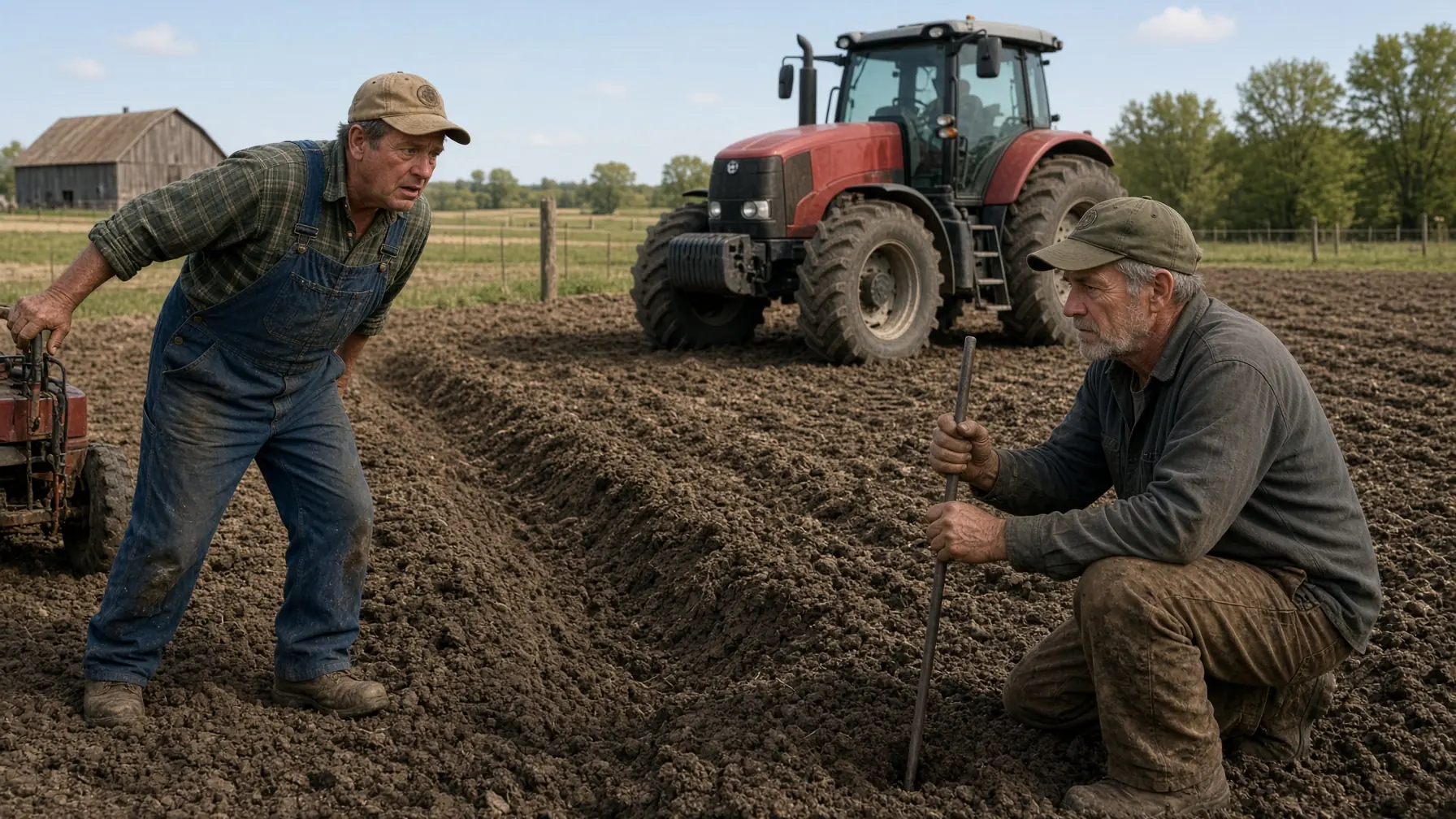
The tire did not move. Neither did the tractor, which sat at an angle in the freshly worked soil with its engine dead and one rear wheel lower than the other.
Tom stepped back, breathing hard. Across the field, an old pickup rolled slowly toward him, stopping well short of the deep tracks behind the machine.
Ray Kowalski got out carrying a long steel probing rod.
Tom watched him close the truck door. He wanted Ray to hurry. He wanted an answer before the mechanic had even reached him, something simple enough to understand and cheap enough to survive.
Ray looked at the tractor, then at the ground.
“Three tractors, Ray!” Tom shouted. “Three different tractors have broken down in this exact field! You expect me to believe that’s just bad luck?”
The words traveled across the open farmland.
Ray kept walking.
Behind him, the distant wooden barn stood beneath a clear spring sky. Birds moved along the fence, and a breeze passed through the trees beyond the creek.
Everything around the dead tractor looked ordinary.
That was what Tom could no longer bear.
Eight days earlier, he had stood in the doorway of the same barn and watched sunlight begin reaching the field.
The soil had finally dried enough to work. After weeks of weather that kept him checking forecasts at breakfast and again before bed, the farm seemed ready to move.
He had four hundred acres of corn to plant.
The Creek Forty would go first.
It always did.
The field had belonged to his family long enough that Tom could remember it through the height of different people: waist-high beside his grandfather, shoulder-high beside his father, and finally spread around him from the seat of a tractor he drove himself.
At forty-eight, he had farmed it for thirty years.
He knew where the turns tightened, where the fence leaned, and how the surface looked after a light rain compared with a heavy one. He knew the feeling of the soil beneath his boots and the way it worked behind a planter when conditions were right.
Or he believed he did.
That morning, confidence had seemed reasonable.
Jenny came out of the house carrying two mugs of coffee. She handed him one and stood beside him at the barn door.
“Starting down there?”
Tom nodded toward the lower field.
“Get that done, then move north.”
“The forecast still good?”
“Better than it’s been.”
She glanced at the machinery behind them.
“And everything’s ready?”
“Everything I can make ready.”
It was the kind of answer farmers gave when they had checked a machine thoroughly but knew machines did not sign agreements to behave.
Jenny accepted it.
She had lived with the uncertainty long enough to know that asking the same question twice would not remove it.
The seed was paid for. Fuel had been delivered. Parts he expected to need were already on the shelf, and the used planter he had bought over the winter was prepared for its first season on the farm.
The planter had been a careful purchase.
Not a bargain he stumbled into.
Not a machine he bought because another man had one.
Tom had spent evenings measuring the work his old setup required and comparing it with what the larger equipment could accomplish. He had looked at the cost, the time, and the strain of trying to cover the same acres inside increasingly uncertain weather windows.
The decision had made sense.
Now the planter stood in the barn, ready to justify it.
Tom finished his coffee and handed the mug back.
“Lunch in the field?” Jenny asked.
“If I’m still moving.”
“You’ll be moving.”
He smiled.
At that point, neither of them had a reason to say otherwise.
His own tractor was twenty years old, but it had not reached that age by accident. Tom maintained it, Ray repaired what required more than Tom’s tools or experience, and both men knew its familiar sounds.
There was a rattle that mattered.
There was another that did not.
Tom had learned the difference through years of listening.
Before leaving the yard, he walked around the machine one more time. He checked connections, looked at the tires, and inspected the planter as though another glance might reveal something the previous checks had missed.
Then he climbed into the cab.
From the doorway, Jenny raised a hand.
Tom raised his own and drove toward the Creek Forty.
The first passes went smoothly.
Dark soil opened beneath the equipment. The tractor worked steadily, and the field began acquiring the orderly lines that made a difficult season feel manageable.
Tom watched the planter behind him, then the ground ahead.
The new equipment demanded attention, but nothing about it seemed beyond him. He adjusted to its width, took his turns carefully, and began finding a rhythm.
Halfway across the field, the front end dipped.
The movement was brief.
A wheel crossing a shallow depression might have felt similar, and Tom corrected almost without thinking.
Then came a crack.
It was sharp enough to separate itself from the ordinary machinery noise.
He stopped immediately.
For a second, he sat with one hand still on the control, listening.
The engine continued running.
Something else had changed.
When he climbed down, he saw the damage at the front of the tractor.
The axle support had split.
Tom crouched beside it, then stood again because seeing it from a different height did not make the break less real.
There was no object lying in front of the wheel.
No stump.
No piece of iron.
No obvious mistake he could point to and correct before continuing.
He looked back along the track.
The soil was darker where the tire had pressed into it, but the field looked much as it had a hundred times before.
Old machine, he thought.
Old metal.